
JRF Newsletter
How to Conduct a Mock Jury Trial? Secrets Revealed!
Last edited: 2026-08-29
Dear friends:
With the presidential and legislative elections approaching, every candidate is shouting slogans about "letting the people participate in trials," but to what extent does this participation actually go?
This special publication on mock trials, based on the "jury system," is not intended to "showcase achievements." On the contrary, it is our calm self-reflection after conducting four mock trials.
Through these four activities, we have gained a deeper understanding of the operation of the jury system, and at the same time, we have better understood that promoting a "true" system of public participation in trials cannot be achieved overnight. This is an institutional reform involving numerous facets. It requires adequate communication, detailed comparison, honest simulation, and sincere proposals for complementary measures; only then can it be considered responsible policy promotion.
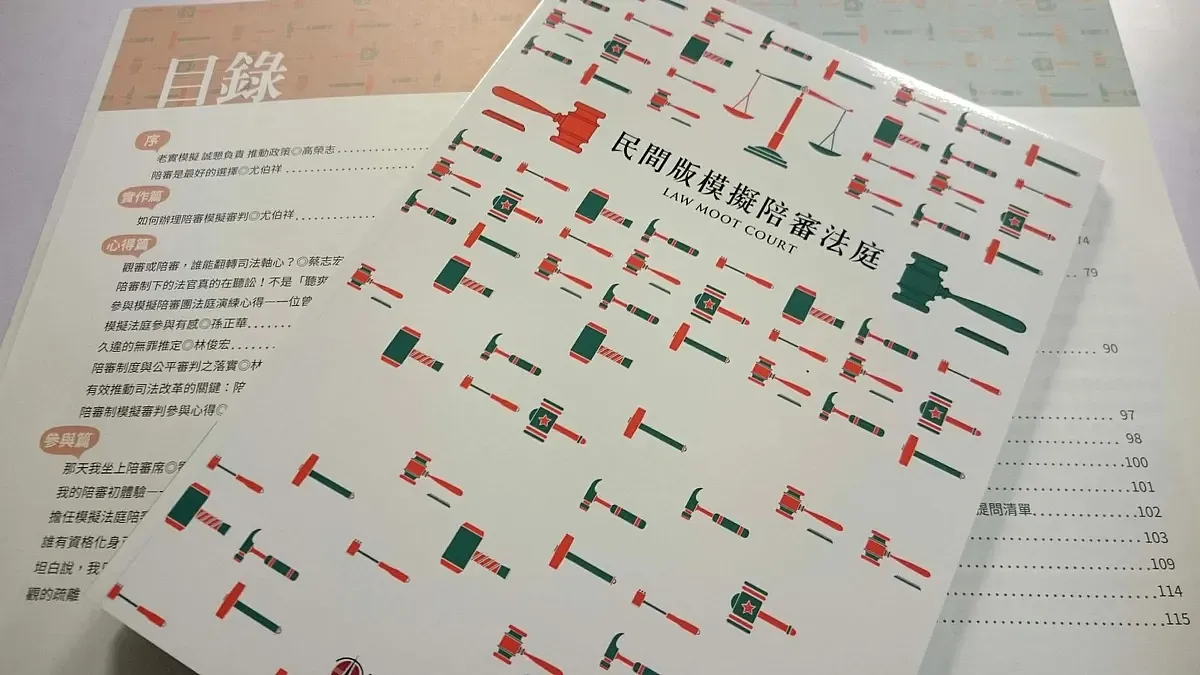
Despite our inadequacies, we have compiled the accumulated experiences, invited actors, jurors, and commentators who participated in the mock trials to write reflection articles, and gathered them into this annual special publication for distribution and promotion, hoping to achieve the effect of experience exchange and learning with all sectors. You are welcome to request/download copies, and we also invite all sectors to co-host mock trial activities in order to accumulate richer and more refined operational experiences, refine the system, and promote dialogue.
This issue of the newsletter excerpts highlights. For more detailed content, you are welcome to read the GitBook online or download the PDF file. If government agencies at all levels, schools, or organizations wish to request physical copies, please contact Ms. Huang at JRF directly at 02-25231178#19.
To test the feasibility of the jury system in Taiwan (especially the grassroot version of the "Draft Act on Criminal Trials Involving Citizen Participation" drafted with JRF's participation), observe the ability of the Taiwanese people to understand cases, evidence, and deliberations, identify deficiencies in the draft provisions, and let the public know that the people of Taiwan can have a better choice than the lay participation system, JRF took on this task—which should have been fulfilled by the government—despite extreme hardships in terms of manpower and resources. Starting from July 2014, based on the grassroot version of the "Draft Act on Criminal Trials Involving Citizen Participation" and in coordination with the proposed amendments to the single-charge-sheet principle in the Code of Criminal Procedure currently being developed by JRF, with the strong support of many JRF volunteers and enthusiastic citizens, and the generous lending of venues by Soochow University, JRF has held four jury mock trials at the downtown campus of Soochow University. In the future, we plan to venture outside of Taipei City to central and southern Taiwan to observe the performance of the jury system in those regions.
Although JRF is not a government agency, as a public interest foundation, all activities conducted with donations from various sectors are, and can only be, aimed at pursuing the public interest. In this regard, the experience and knowledge accumulated by JRF during the course of these activities are essentially public goods and should be shared with all citizens. The knowledge gained by JRF through these four jury mock trials naturally must be made public, thus giving birth to this special publication. We thank all the partners who participated in the performances of these four mock trials, and especially thank all the friends who registered to serve as jurors. We believe our joint efforts will make Taiwan a better place.
 Photo / Convener of the Citizen Jury Mock Trial, YU PO-HSIANG
Producer's Words
The Jury Is the Best Choice ◎ Attorney YU PO-HSIANG
Through these four jury mock trials, we observed that the Taiwanese public is indeed capable—just as we judged when drafting the bill—of understanding the cases and evidence presented by both parties as well as the instructions given by the judge, and conducting in-depth and thorough deliberations based thereon. The dimensions and depth of issues considered by juries during deliberations often represent meaningful doubts that prosecutors and lawyers failed to anticipate, which fully reflects the advantage of the jury system—collective wisdom surpasses independent study, and studying alone without peers often leads to isolation and narrow-mindedness. Furthermore, the discussions and interactions among jurors during each deliberation are truly touching. Although viewpoints differ, jurors always manage to listen to each other, allow dissenting views to be fully expressed, and thereby attempt to persuade one another.
 Photo / Attorney YEH CHIEN-TING participating in the mock trial, serving as a judge
Judge's Reflections
Judges Under the Jury System Are Truly Listening to Trials! Not Just "Enjoying the Listening" ◎ Attorney YEH CHIEN-TING
You might not have come to observe this mock trial, and that's okay. I have simply written down the process of this mock trial from the perspective of a judge. What did you discover? The objective and neutral role of the judge has been consistently maintained. Isn't this actually the most modest demand that the public has held for the reform of the criminal litigation system for a long time? Under the system combining the jury system and the single-charge-sheet principle, the judge acts akin to a tennis referee, rather than a soccer referee running all over the field following the players. Truly, just "listening to trials" is enough!
 Photo / Attorney SHEN YUAN-KAI delivering arguments while serving as prosecutor
Prosecutor & Defense Reflections
Reflections on Participating in Jury Mock Trials ◎ Attorney SHEN YUAN-KAI
Having experienced multiple jury mock trials, especially after having experienced playing the role of the defendant, when I re-examine the origins of the jury system, I increasingly understand why, over eight hundred years ago, those five English men from Westminster accused by Alice were willing to accept a trial by "twelve of their neighboring landowners." "For better or worse," it is probably because rather than being judged by an omniscient "adult," one would rather accept trial by "ordinary people" like oneself. At least under living experiences relatively close to mine, their perspective on evidence will not be too disconnected from mine. On the basis that most people are participating in a joint trial and jointly deciding guilt or innocence for the first time, it is theoretically better able to check and balance judicial errors caused by bias, arbitrariness, or negligence.
Dinosaurs are not necessarily just judges, and the blind and emotional are not solely the people. Only through good institutional design can legal professionals and laypersons jointly participate, communicate, and discuss within the trial procedure, thereby truly preventing the aforementioned dinosaur, blind, and emotional phenomena, and truly rebuilding public trust in the judiciary.
 Photo / Jurors raising hands to answer questions during the voir dire process
Juror Reflections
My First Jury Experience—It's All About Procedure ◎ YANG HSIAO-HSIEN
Many people only care about the judgment results of judicial cases while ignoring that without due process, even if substantive justice is achieved in individual cases, it is merely by coincidence. Reform of the judicial system, such as whether to adopt the jury system, is actually a discussion of what kind of trial procedure is fair and reasonable. Procedure is not the answer to all problems, but without a respected due process, one might not even have the coordinates to search for the answer.
 Photo / Professor CH'EN YUN-TS'AI providing commentary after the mock trial
Commentator's Words
A Broad Highway Leading to the Castle Protecting Human Rights? ◎ Professor CHEN YUN-TSAI
Observing that Taiwan's pursuit of democracy and the rule of law is still in progress, and frankly speaking, under the long-standing condition where the public generally lacks trust in bureaucrat-led criminal trials, introducing citizen participation in criminal trials, conceptually speaking, not only echoes the demand for judicial democratization and helps implement the principle of popular sovereignty revealed in the Constitution, but can also enhance the public's understanding and trust in the criminal justice system. This is a path leading to the castle protecting human rights. However, this simulated jury trial reminds us that transplanting the jury system entails much more than just introducing a jury into the court; complementary reforms or amendments to litigation procedures and rules of evidence are also indispensable. Therefore, it is certainly not a smooth broad highway. This mock trial can be described as a milestone worthy of record for promoting the system of citizen participation in trials.
This article is an AI-generated translation of the original Chinese text. In the event of any discrepancy, the Chinese version shall prevail.
