
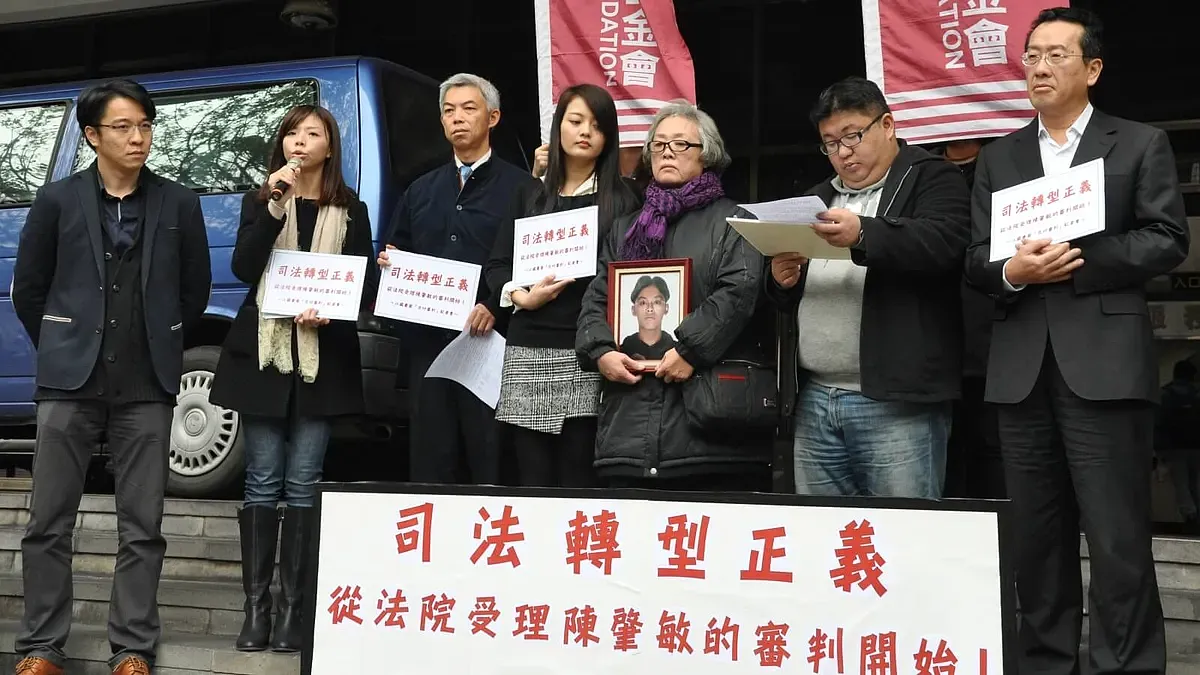
Judicial Transitional Justice Begins with the Court Accepting the Trial of Chen Chao-Min!~Press Conference on the "Application for Committal to Trial" in the Chiang Kuo-ch'ing Case
Last edited: 2026-08-29
Taking advantage of the intense presidential and legislative elections, while public opinion was distracted elsewhere, the Taipei District Prosecutors Office decided not to prosecute Chen Chao-Min for the third time. Chiang's mother subsequently filed a motion for reconsideration, but the Taiwan High Prosecutors Office quietly dismissed the motion in the Chiang Kuo-Ching case, finalizing the non-prosecution decision for Chen Chao-Min and others. In response, Chiang's mother stated that the current practice of the Taipei and High Prosecutors Offices in shielding Chen Chao-Min and others is identical to the military trials of the past, and she cannot trust a judiciary that operates this way. What Chiang's mother finds unacceptable is this: regardless of whether those responsible for Chiang Kuo-Ching's wrongful death face legal punishment, why is even requesting a judicial trial to uncover the truth so profoundly difficult?
The judiciary's shielding of misconduct in military trials has a long history. Shortly after the lifting of martial law, Judicial Yuan Grand Justices Interpretation No. 80 affirmed the constitutionality of individuals being subjected to military trials during the martial law period, providing a legal veneer for "civilians subjected to military trials." After the lifting of martial law, the Grand Justices further used Interpretation No. 272 to restrict final cases adjudicated by military trials during the martial law period, prohibiting appeals or interlocutory appeals to ordinary courts after martial law was lifted, thereby making it extremely difficult to exonerate miscarriages of justice in military courts. From the martial law era through the period before and after its lifting, Grand Justices of such high standing acted as accomplices—let alone ordinary judges and prosecutors? The public's profound distrust of the judiciary stems from these historical experiences. Today, the finalized non-prosecution of Chen Chao-Min and others proves that the prosecuting authorities remain half-hearted about pursuing state responsibility. If even such a modest wish—requesting judicial review for a case that is undeniably a miscarriage of justice with clear perpetrator conduct—cannot be fulfilled, the public cannot help but suspect that ideologies colluding with authoritarianism and condoning state violence remain deeply rooted in the minds of judicial personnel and still need to be eradicated.
Last Saturday's election results were announced, bringing a party turnover alongside a generational shift, and Taiwan has entered a period of political transition. President-elect Tsai Ing-wen promised before the election that she would convene a national judicial reform conference after taking office. The numerous difficulties encountered in pursuing accountability in the Chiang Kuo-Ching case serve as a warning: one of the core axes of national judicial reform should be how to advance judicial transitional justice. The judiciary must acknowledge past systematic persecution and even pursue individual unlawful liability in order to sever ties with past injustices and rebuild public trust. Today, we have invited legislators to show their support, expressing their determination to promote judicial transitional justice reforms in the new parliament and pledging to fulfill the ideal of a judicial paradigm shift.
At the same time, Chiang's mother will not easily give up. Pursuant to Article 258-1 of the Code of Criminal Procedure, she will file an application for committal to trial with the Taipei District Court, petitioning the court to accept the case. This will test whether, following the democratization of the state, the judicial system possesses the self-awareness and willingness to undertake transitional justice engineering, and whether it has the determination to sever the past and pursue justice when confronting state violence. (Attachment 1) The new generation of judges and prosecutors did not commit these wrongs; they simply inherited the collective historical karma of the older generation. The Judicial Reform Foundation calls on the new generation of judges and prosecutors: rather than being passively reformed, they should actively respond to the public's expectations for judicial transitional justice. Accepting the application for committal to trial in the Chiang Kuo-Ching case is precisely what the victim's family desires most—a trial that restores the truth, cuts ties with the past, and answers the call of justice. Let us begin judicial transitional justice by trying Chen Chao-Min and others.
Chronology of Criminal Accountability in the Chiang Kuo-ch'ing Case
| Date | Agency | Event |
| August 3, 1997 | Ministry of National Defense | Chiang Kuo-ch'ing was executed by firing squad. |
| May 12, 2010 | Control Yuan | Released the first investigation report on the Chiang Kuo-ch'ing case, pointing out that the investigation and trial procedures violated human rights, and directed the Ministry of Justice to instruct the Prosecutor-General to pursue criminal liability. |
| May 24, 2011 | Taipei District Prosecutors Office | Indicted Hsu Jung-chou for murder and other crimes; decided not to prosecute Ch'en Chao-min and 7 others. (For the non-prosecution disposition, see Attachment 2) |
| June 14, 2011 | Taiwan High Prosecutors Office | Remanded the non-prosecution case of Ch'en Chao-min and 7 others for further investigation. |
| September 3, 2011 | Military Court | Chiang Kuo-ch'ing was acquitted in a retrial judgment. |
| August 24, 2012 | Taipei District Prosecutors Office | The Taipei District Prosecutors Office issued a second non-prosecution disposition for Ch'en Chao-min and 7 others. (For the non-prosecution disposition, see Attachment 3) |
| December 9, 2012 | Taiwan High Prosecutors Office | Remanded the non-prosecution case of Ch'en Chao-min and 7 others for further investigation. |
| July 4, 2013 | Army Sixth Corps | Hung Chung-chiu died due to abuse during confinement. |
| August 6, 2013 | Legislative Yuan | Amended the Military Trial Act, transferring all criminal cases involving military personnel during peacetime to judicial authorities. |
| July 10, 2014 | Control Yuan | Released the second investigation report on the Chiang Kuo-ch'ing case, pointing out that Air Force Deputy Commander-in-Chief Ch'en Chao-min interfered with the military trial through a handwritten note of instructions. |
| November 6, 2015 | Taipei District Prosecutors Office | The Taipei District Prosecutors Office issued a third non-prosecution disposition for Ch'en Chao-min and 7 others. (For the non-prosecution disposition, see Attachment 4) |
| December 29, 2015 | Taiwan High Prosecutors Office | Dismissed the motion for reconsideration, finalizing the non-prosecution of Ch'en Chao-min and 7 others. (For the disposition dismissing the motion for reconsideration, see Attachment 5) |
Attachments
- Criminal Application for Committal to Trial
- Non-Prosecution Disposition by the Prosecutor at the Taipei District Prosecutors Office (100年度偵字第10617號)
- Non-Prosecution Disposition by the Prosecutor at the Taipei District Prosecutors Office (100年度偵續字第591號)
- Non-Prosecution Disposition by the Prosecutor at the Taipei District Prosecutors Office (101年度偵續一字第190號, 102年度軍偵續一字第1號)
- Disposition by the Taiwan High Prosecutors Office (104年度上聲議字第9761號)
Attendees
Chiang Kuo-ch'ing's Mother / Ms. Wang Tsai-Lien
Chiang Kuo-ch'ing Case Pro Bono Legal Team / Attorney Yu Po-hsiang, Attorney Lo Wan-Ting
Newly Elected Legislator / Ms. Hung Tzu-Yung
Newly Elected Legislator / Attorney Ku Li-Hsiung
Soochow University Department of Law / Professor Hu Po-Yen
JRF CEO / Attorney Kao Jung-Chih
Press Contacts
JRF CEO / Attorney Kao Jung-Chih
JRF Executive Secretary / Hsiao I-Min
This article is an AI-generated translation of the original Chinese text. In the event of any discrepancy, the Chinese version shall prevail.