
China Human Rights Lawyers Group: Selection of the Top Ten Human Rights and Rule of Law Cases in China for 2014
Last edited: 2026-08-29
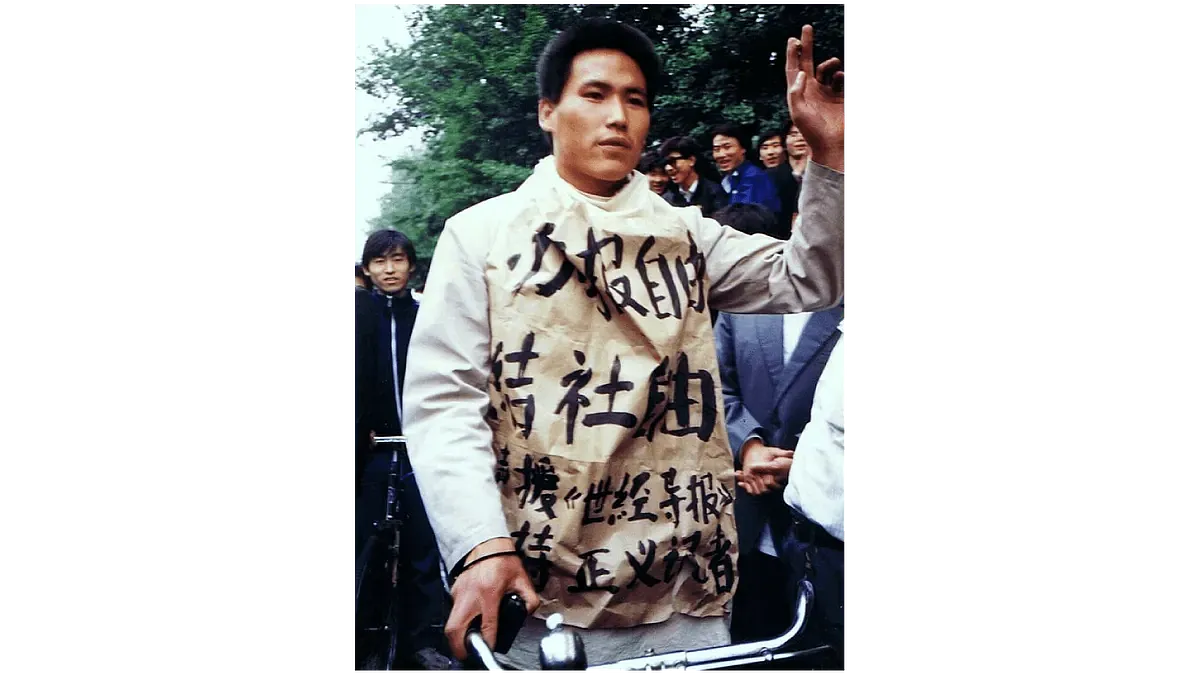
Photo / Wikipedia P'u Chih-ch'iang
Jiansanjiang Series of Cases
- Selected Case: The case of four lawyers—Tang Chi-Tien, Chiang Tien-Yung, Wang Cheng, and Chang Chun-Chieh—along with citizens, being illegally detained and having their ribs broken
- Draftsman: Hu Kuei-Yun
- Reviewer: Liang Hsiao-Chun
On March 20, 2014, four defense lawyers—Tang Chi-Tien, Chiang Tien-Yung, Chang Chun-Chieh, and Wang Cheng—along with several family members of clients, went to the "Heilongjiang Agricultural Reclamation Management Bureau Ch'inglungshan Legal Education Base" located in Jiansanjiang, Heilongjiang, to demand the release of Falun Gong practitioners illegally detained there. In the early morning of March 21, the four lawyers were illegally arrested by local police at their hotel and subsequently subjected to torture at the Hsinghsing Branch of the Jiansanjiang Public Security Bureau. The four lawyers were subjected to criminal and administrative detention respectively. Following the expiration of their detention, medical X-rays showed that a total of 24 of their ribs had been broken. Starting from March 23, over a hundred lawyers and citizens from across the country traveled to Jiansanjiang to request visits and provide assistance to the four illegally detained lawyers, carrying out consecutive days of 24-hour protest activities centered around on-site observation and lawful visitation. On March 29, local police cleared the scene, using black hoods to illegally arrest lawyers and citizens. Several lawyers were released after being illegally detained for 24 hours, but over a dozen citizens were illegally subjected to 15 days of administrative detention, during which many were repeatedly subjected to torture. After the clearance, more lawyers went to Jiansanjiang to welcome the four lawyers, to defend the rights of the lawyers who had been beaten earlier, and to provide legal aid to the illegally detained citizens. Tang Chi-tien and others resorted to lawsuits, accusations, and other means to hold the Jiansanjiang authorities accountable, but received no response; lawyers such as Tsai Ying requested rights protection from the All China Lawyers Association, but to this day have received no clear reply; the petition launched by lawyer Feng Yen-chiang regarding the abolition of the Heilongjiang agricultural reclamation system is still ongoing. In retaliation, the Jiansanjiang authorities prosecuted five people, including Shih Meng-wen and Meng Fan-li, in court. Despite extremely difficult conditions, eight defense lawyers traveled far to Jiansanjiang multiple times to fully defend the lawful rights and interests of their clients, only to be crowded out of the courtroom due to the authorities' blatant violations of law. Afterward, the lawyers and the clients' families continued to file complaints and accusations regarding the illegal and criminal acts in both Jiansanjiang and Harbin...
The Jiansanjiang incident collectively reflects the drawbacks of China's backward agricultural reclamation system and stability-maintenance system. Long-term closed management has led managers within this system to completely disregard China's existing laws and regulations, forming an independent kingdom that not only severely violates the basic rights of lawyers to practice, but also directly infringes upon the personal rights of lawyers and citizens. However, the intervention of lawyers shook the foundations of this closed agricultural reclamation system, exposed its drawbacks, and drew widespread attention through reports by domestic and foreign media.
At the same time, we should also see that the existence of this backward agricultural reclamation system is a concrete manifestation and microcosm of China's entire existing system; it is by no means isolated, nor does it happen by accident. Barbarism, backwardness, bureaucratic will, rejection of modern civilization, immensely powerful public power, and extremely compressed civil rights... These symbolic characteristics under the authoritarian system were all vividly reflected in the Jiansanjiang incident.
The Jiansanjiang incident demonstrates to us the current status of China's rule of law, portends the illusory nature of the "Chinese Dream" as "the moon reflected in the water and a flower in a mirror," and warns compatriots to maintain a prudent attitude toward the authorities' promises of rule of law. China is, in fact, still very far from the rule of law.
Freedom of Speech Series of Cases
- Selected Case: Pu Chih-chiang's case of inciting splittism, inciting ethnic hatred, picking quarrels and provoking trouble, and illegally obtaining citizens' personal information
- Draftsman: Tsou Li-hui
- Reviewer: Wang Cheng
Case Brief
Pu Chih-chiang is a famous Chinese human rights lawyer who actively advocated for the abolition of the Re-education through Labor system and has represented rights-protection cases for many years. On December 20, 2013, Pu Chih-chiang was named "2013 Rule of Law Figure Influencing China" by China Newsweek. He has been called a "die-hard" lawyer within the legal profession, yet he holds the greatest goodwill toward legal reform. Amid sharply poignant events that defy moral and conscientious endurance, he chose a series of re-education-through-labor cases as entry points, attempting to melt the seemingly impregnable glacial barrier of bad laws with minor acts of goodness. He was safeguarding his clients' dream of the rule of law while also performing a "conscientious duty" as a legal professional.
Because of representing rights-protection cases, Pu Chih-chiang was also subjected to multiple rounds of pressure from the authorities. For example: On October 10, 2010, when Pu Chih-chiang was meeting with a reporter from the French newspaper Le Monde in Beijing regarding Liu Hsiao-po receiving the Nobel Peace Prize, state security personnel stepped in to block them, after which Pu lost contact with the outside world. On February 6, 2013, Pu Chih-chiang publicly and under his real name filed a report against former Politburo Standing Committee member Chou Yung-kang, demanding that the top leadership of the Chinese Communist Party hold Chou Yung-kang and his decade-long stability-maintenance problems within the Political and Legal Affairs Commission system accountable, and build a rule-of-law society and constitutional system. On June 13, 2014, Pu Chih-chiang was arrested by the Beijing Municipal Public Security Bureau on suspicion of picking quarrels and provoking trouble and illegally obtaining citizens' personal information.
Case Commentary
Pu Chih-chiang's case is a typical case of conviction for speech. Similar cases include writer Tieh Liu's case of picking quarrels and provoking trouble, Chao Feng-sheng's case of inciting subversion of state power, journalist Liu Hu's defamation case, and the case of a Gansu teenager administratively detained for reposting a net post 500 times, etc.
The Constitution explicitly states that every citizen has the freedom of speech and the right to criticize public power. However, in real social life, public power frequently commits malicious acts of despising human rights, ignoring the rule of law, and restricting or even depriving citizens of freedom of speech. Justice serves politics, and incidents where citizens are convicted for criticizing state organs or certain public officials or for commenting on current affairs occur repeatedly. If people accidentally participate in sensitive events that make certain bureaucrats "unhappy," they risk being classified under catch-all offenses such as picking quarrels, spreading rumors and defamation, and inciting subversion. This is a great disgrace to China's rule of law.
Pu Chih-chiang's case is another high-profile case involving a lawyer investigated and handled by Beijing judicial authorities after the 18th National Congress. If even lawyers can be convicted for speech, other citizens can be even less exempt. If this continues, how many unwarranted "crimes" will be arbitrarily spawned in China?! Pu's case will undergo a difficult game of judicial procedure between government public power and popular sovereignty. Whether the outcome can withstand the test of history is something everyone is waiting to see with bated breath, and it is bound to become the focal point of attention for the entire nation and the international community.
Civil Rights and Political Rights Series of Cases
- Draftsman: Chang Lei
- Reviewer: Li Ju-yu
- Selected Case: The criminal prosecution cases against Kuo Fei-hsiung, Liu Yuan-tung, Sun Te-sheng, Yuan Ping, Yuan Hsiao-hua, Huang Wen-hsun, and others.
Case Brief
Among the aforementioned individuals, Kuo Fei-hsiung is an important figure in China's rights-protection movement, Liu Yuan-tung is an active participant in southern street politics, and the others are all important participants in the rights-protection movement or street political activities. To varying degrees, they all participated in street political rallies at the entrance of the Southern Weekend newspaper office during the symbolic historical event of early 2013, the "Southern Weekend Incident." They also engaged in political expression activities in southern China multiple times, such as holding signs on the streets and unfurling banners, demanding that the National People's Congress ratify the *International Covenant on Civil and Political Rights* and demanding that officials disclose their assets. Because of engaging in these political activities, they faced retaliatory crackdowns and persecution by the authorities, being prosecuted under various charges such as "gathering a crowd to disrupt public order" and "inciting subversion of state power." Their cases have all entered the court trial stage; some have already held hearings without a judgment yet rendered, while others have yet to be tried.
Commentary
The criminal prosecution of the aforementioned individuals is a manifestation of the authorities' comprehensive suppression of political activists active in southern China. These citizens actually did not violate any laws. Based on the explicit provisions of China's current constitution and laws regarding the freedom rights enjoyed by citizens such as speech, assembly, procession, and demonstration, they practiced civil and political rights, took to the streets to exercise freedom of speech and expression, and conducted assemblies, processions, and demonstrations to demand that the state ratify the *International Covenant on Civil and Political Rights* and demand the public disclosure of officials' assets. What they reflected were the most direct and intense calls of contemporary Chinese civil society, issuing the voice of the people and the demands of the times. Yet, they were treated as "enemies of the state" and were consequently subjected to retaliatory crackdowns and persecution by the authorities utilizing judicial tools. These pioneers, whose rights consciousness has awakened and who have taken action, are suffering persecution, but through their courage and sense of responsibility, they are greatly encouraging those who come after them.
Similar Cases
Other candidates included in this category of "Civil Rights and Political Rights" cases are the "Mock Trial Case of the Guizhou Yang Ming Twenty-Year Miscarriage of Justice Citizens' Decision Jury" and the "Ilham Tohti Case." The successful holding of the citizens' decision jury (also translated as jury) mock trial experiment is an exploration by Chinese grassroots legal professionals into the paths of judicial reform and institutional construction, embodying the fervent yearning for and passionate efforts toward the rule of law by grassroots legal professionals. The Ilham Tohti Case is a very important case involving ethnic groups and border issues in Xinjiang. From the handling of this case (Ilham Tohti was sentenced to life imprisonment, and several of his students were also sentenced), one can discern to a certain extent the policy mindset and handling methods of the Chinese authorities regarding the Xinjiang issue at present.
NGO Series of Cases
- Selected Case: The illegal business operation case of Peking Chuan Zhi Xing Social and Economic Research Institute's Kuo Yu-shan, Huang Kai-ping, and Ho Cheng-chun
- Draftsman: Chang Lei
- Reviewer: Ko Wen-hsiu
Case Brief
On October 9, 2014, Kuo Yu-shan, founder of the Peking Chuan Zhi Xing Social and Economic Research Institute, was criminally detained by Beijing police. On October 10, incumbent director Huang Kai-ping was taken away from his office by police officers and has since been subjected to enforced disappearance. On November 26, administrative head Ho Cheng-chun was criminally detained. During this period, Liu Chien-shu and others associated with Chuan Zhi Xing were also detained for dozens of days before being released. In the relevant legal documents issued by the Beijing police, they alleged that the suspects were involved in illegal business operations.
Chuan Zhi Xing is a non-governmental think-tank research institution whose mission is dedicated to investigating and researching issues and phenomena related to freedom and justice during the process of social transition, covering tax system reform, industry regulation reform, citizen participation, and research on transitional experiences. Kuo Yu-shan, founder of the Chuan Zhi Xing Research Institute, and multiple staff members of the institution deeply participated in the Chen Kuang-cheng incident that occurred in 2012, providing multifaceted assistance for the rescue of Chen Kuang-cheng, which may have directly offended the authorities as a result. In 2013, Beijing's municipal cultural management department issued a decision to ban the Chuan Zhi Xing Research Institute. However, Chuan Zhi Xing changed its operational format and tenaciously persisted.
Commentary
This crackdown by the Beijing police on Chuan Zhi Xing may, from a micro perspective, be retaliation for their participation in the rescue of Chen Kuang-cheng. From a macro perspective, it should be a "new normal" by the Chinese authorities to strengthen social control, weaken grassroots forces, crack down on civil associations, and eliminate all potentially organized forms in their infancy. Furthermore, Chuan Zhi Xing's research directly confronted and exposed the phenomena and roots of social injustice and unfreedom in contemporary China. In this round of crackdowns, the blows against civil society groups were not limited to Chuan Zhi Xing alone; Liren Rural Library and Liren School were also closed down. Hsueh Yeh, chairman of the board responsible for the operation of the Liren Library, and Liu Chien-shu, deputy general director, were also detained and held for dozens of days in this round of crackdown operations. Other influential NGOs also suffered varying degrees of suppression.
The Chuan Zhi Xing case holds extremely significant symbolic meaning for contemporary China. Its subsequent development and trajectory will have a major and far-reaching impact on whether China's grassroots civil society can develop and grow, whether NGOs have survival space, and whether social freedom in political, economic, and cultural aspects exists to a certain extent.
Abuse of Public Power Causing Death Series of Cases
- Selected Case: Taiyuan wage-seeking woman dies at police station
- Draftsman: Li Ho-ping
- Reviewer: Liu Szu-hsin
Case Brief
On December 13, 2014, Ms. Chou Hsiu-yun, a migrant worker from T'ancheng County, Henan Province, and her family were demanding over 20,000 yuan in overdue wages at the "Longruiyuan" construction site near Longcheng Street in Taiyuan, Shanxi. They were first groundlessly obstructed by police officers and security guards, and were subsequently insulted and beaten by police officers from the Longcheng Police Station. Her husband, Wang Yu-chih, was beaten to the ground, had four ribs broken by police officers, and was forcibly handcuffed. Chou Hsiu-yun was grabbed by the hair and pinned to the ground by police officers, with a heavy-set police officer, Wang Wen-chun, stepping on her hair so she could not move. The violence lasted for over an hour. She was subsequently dragged into a police car by police and jammed into the seat gap. During this period, police continued to hurl insults, kick, and beat her, shouting that she was "faking death." After being hauled to the police station, the police continued to subject Chou Hsiu-yun to violence, and Chou Hsiu-yun ultimately died miserably inside the police station. Afterward, the Taiyuan police illegally pressured and monitored Chou Hsiu-yun's family and co-workers, illegally destroyed on-site audio and visual evidence at the earliest opportunity, and even refused to pursue criminal and other legal responsibilities against Wang Wen-chün and other rogue police officers, attempting to continue using the old routine of pacifying ordinary folks to cover up the truth and shield the rogue police.
Ten days later, an on-site photo of a heavy-set man in police uniform stepping on Chou Hsiu-yun's hair went viral on the internet, and only then did this vicious case of police homicide enter the public eye. Under tremendous social pressure, the Taiyuan procuratorate was passively forced to arrest Wang Wen-chün and other rogue police officers and bring them to justice. The reason why the case of the wage-seeking woman Chou Hsiu-yun dying at the police station attracted intense nationwide attention is truly because such vicious cases—where police officers who ought to protect and serve the people instead arbitrarily harm the people—have occurred repeatedly in recent years and cannot be eradicated; truly because the harm caused by such vicious cases of police abusing state violence to harm the people is far more severe than ordinary homicide and assault cases; truly because vicious cases of police violent harm against people have been everywhere in recent years, proliferating almost like a locust plague; truly because the anger of the people over such police violence cases has been suppressed for too long, and public grievances have long been boiling over!
Commentary
Murder cases involving police abusing state violence to harm the people are countless, ranging historically from suspicious cases such as Nieh Shu-bin, Hukejiletu, Kao Ying-ying, Chien Yun-hui, Chu Sheng-wen, Wu Fan, Sang Li-wei, Li Wang-yang, and Yen Hsiao-ling, to recent cases such as Hsueh Fu-shun, who mysteriously fell to his death inside the courtyard of the Shandong Qufu Procuratorate; the cases of Shandong Longkou's Li Shu-lien and Luan Kuei-lien who died due to illegal detention by local police while petitioning; the case of Chang Hsien-yueh, a centenarian in Mayang, Hunan, whose home was forcibly demolished by the government, resulting in the illegal arrest of six adult family members and her own mysterious death; and the case of human rights defender and legal professional Tsao Shun-li, who died of abnormal causes following illegal detention, among innumerable others! As for cases where public power acted arbitrarily, willfully, and abusively to infringe upon citizens' personal freedom and property, they are even more innumerable: the case of Shan Hsi's Sung Kuei-ching, who was illegally and harshly sentenced to 4-term imprisonment for petitioning; the case of Kung Chin-chun, who rose up in justified self-defense and killed an illegal interceptor of petitioners; the case of Chang Hsiao-yü and his wife, who bravely killed an illegal interceptor of petitioners in justified self-defense; the case of Ting Han-chung, who bravely resisted forced demolition, acted in justified self-defense, and fought to the death against a forced demolisher only to be sentenced to death; the case of Fan Mu-ken, who resisted forced demolition for ten years, acted in justified self-defense, and angrily killed a forced demolisher... All these fully prove that the new enclosure movement of forced expropriations and demolitions that has caused widespread public resentment over the past two decades is closely related to the abuse and usurpation of public power by police and others!
Against this historical backdrop of widespread abuse of public power, the picture of the rogue police officer Wang Wen-chun stepping on Chou Hsiu-yun's hair naturally possesses strong symbolic, contemporary, and historical significance! This picture vividly, artistically, and truly exposes the profound harm inflicted on Chinese society by unchecked, tyrannical, violent, and arbitrary police authority in these vicious cases; it exposes the antagonistic water-and-fire relationship between the police and the public, and between officials and the public; and it exposes the infinite sins of the anti-people, evil, and brutal stability-maintenance system dominated by Chou Yung-kang for more than a decade! In the modern era of the rule of law where class antagonism has long been eliminated, life, liberty, and property are in any country the most fundamental rights of individual citizens—namely, basic human rights. However, in China, over the past decade or more, these basic human rights have been wantonly trampled upon under the guise of stability maintenance by the anti-people evil forces headed by Chou Yung-kang. The people have suffered humiliation and numbness, the masses have dared to be angry but not speak out, while public power itself has turned a blind eye to evil, pretending that all is peaceful under heaven! Chou Hsiu-yun's unjust death under the iron hooves of the police constitutes a tearful indictment of police violence and public power violence over the past decade or more, condensing all the evil elements of public power in the era of Chou Yung-kang's usurpation of power! Grassroots citizens firmly believe that the unjust death case of Chou Hsiu-yun is not only a vicious legal and rule-of-law event at the end of 2014, not only a humiliating event for China's grassroots citizens, not only an indelible disgrace for the Chinese police and Chinese judiciary, but will also be a benchmark event for China's transition from an era of rule by man, rule by power, and untamed tyrannical power to an era of rule of law, rights, and popular sovereignty! Chou Hsiu-yun, an ordinary, kind, and helpless grassroots female citizen, will leave a positive image in the process of China's rule of law, whereas the heavy-set police officer Wang Wen-chun, the police force to which he belongs, and even the entire judicial sector are bound to leave behind a shameful page!
This article is an AI-generated translation of the original Chinese text. In the event of any discrepancy, the Chinese version shall prevail.