
Wounds on the Body, Blood on the Chest: A Day in the Life of a Chinese Criminal Defense Lawyer
Last edited: 2026-08-30
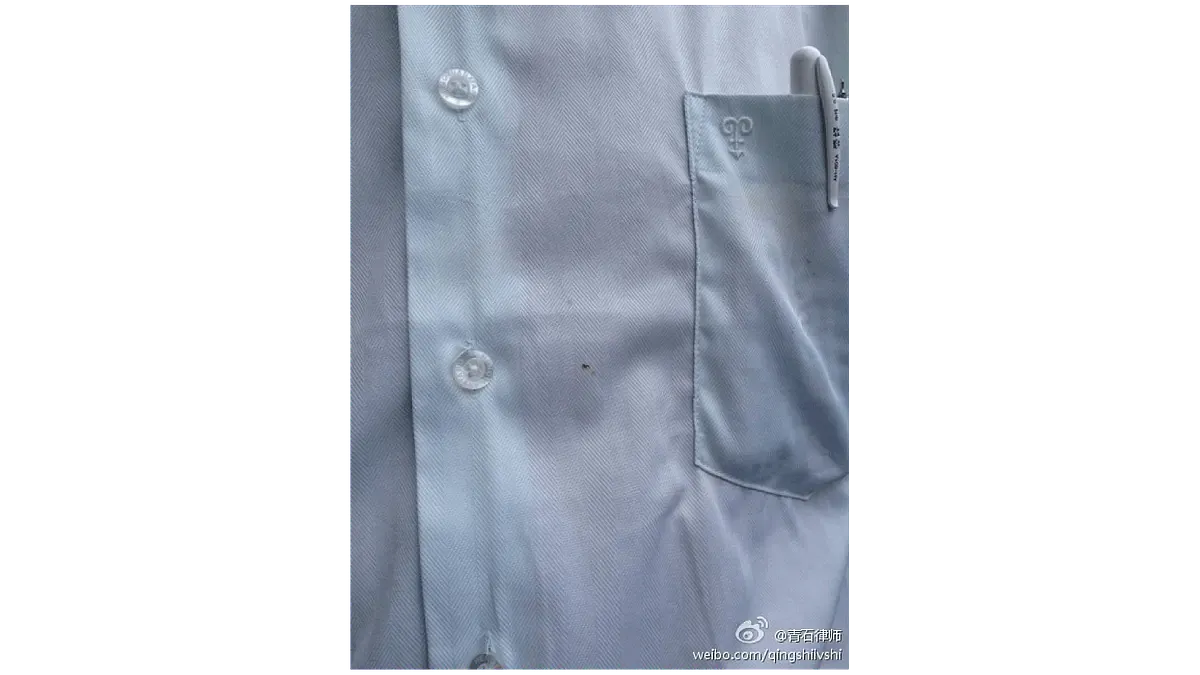
Photo/During the court session, attorney Chen Hai was beaten by court bailiffs and plainclothes officers at the entrance of the courtroom, with blood faintly visible on the chest of his clothes; all defense counsel withdrew from the court in protest.
The case we defended was tried by the Chungshan District Court of Dalian City, with court proceedings held at the Hsi-kang District Court courtroom. A total of 13 defendants were accused of "using an evil cult to undermine the implementation of the law." The facts charged in the indictment were that these defendants installed satellite receivers for others to receive overseas New Tang Dynasty Television broadcasts, the content of which "promoted the 'Falun Gong evil cult' and slandered the Party and the government." These defendants also shared something in common: they were all practitioners of "Falun Gong."
Failure to Notify Court Sessions in Accordance with Legal Procedures
Previously, the Chungshan Court sent a text message on the afternoon of July 1 notifying us of a court session on July 4. Defense lawyers considered this notification illegal, as it failed to comply with the provisions of law and judicial interpretations requiring notification to defense counsel three days prior to the session. Consequently, apart from three local lawyers who entered guilty pleas for two of the defendants, eight lawyers and five family defense counsel collectively refused to cooperate with the illegal session. In view of this, the Chungshan Court subsequently did not hold the session that day, "in order to safeguard the defendants' right to defense."
Following that, the Chungshan Court gave ten days' advance notice to defense counsel and resumed the trial on August 2.
Midnight Room Inspections
Last night, all out-of-town defense lawyers arrived in Dalian and checked into the Jinjiang Inn on Chieh-fang Road. At past 11:00 PM, uniformed police officers began conducting room inspections. They first checked attorney Chao Yung-lin's room; attorney Chao did not open the door. Next, they checked attorney Liang Hsiao-chun's room, and attorney Liang also did not open the door. The police lingered outside the door. Attorney Wang Hsing and I received a call from attorney Chen Hai, whose room was next to attorney Liang's, and went downstairs to check on the situation and support attorney Liang. At the door of attorney Liang's room, we saw seven or eight uniformed police officers. The police asked what we were doing, and we asked what the police were doing. At this point, attorney Chen Hai came out and demanded that the police show their identification. A police auxiliary worker loudly told attorney Chen, "What right do you have to see our identification?" Attorney Ch'en immediately gave him a lesson on the rule of law. Another police officer stepped forward and showed his police badge to attorney Chen. At this moment, attorney Liang Hsiao-chun and attorney Kuo Hai-yueh came out of their rooms, and attorney Chao Yung-lin and attorney Chen Chien-kang also arrived. Attorney Liang questioned the police as to why they were conducting room inspections in the middle of the night. The police claimed it was a random check. Attorney Wang Hsing looked at the random check list in the police officer's hand; our rooms were not on the list, yet attorney Chao Yung-lin's, attorney Liang Hsiao-chun's, and attorney Chen Hai's rooms had all had their doors knocked on and inspections demanded.
Attorney Chen Hai told the police that they had no legal basis to conduct room inspections at night, and that police room inspections nationwide were illegal. Attorney Liang questioned the police: why were we subjected to police room inspections before the court session when we stayed at another hotel last time, and why are we being subjected to them again this time, both times in the dead of night? During this process, attorney Chen Chien-kang and attorney Chao Yung-lin used video cameras and mobile phones to record the entire dialogue between both sides.
Plainclothes Interceptions
Early this morning, outside the Hsi-kang District Court in Dalian City, just like the previous few court sessions, there were multiple police cars, fire engines, and countless plainclothes officers. By visual estimation, there were probably over 200 peripheral plainclothes personnel, with a "cordon" range of 200 meters around the court. As we walked toward the courtroom, we were intercepted by multiple plainclothes men who demanded to check our identification. We asked them to present their identification; initially, they were reluctant to do so. We told them that without showing their identification, they had no right to inspect ours. At this point, seven or eight plainclothes men surrounded us and began pushing and shoving us. Later, a middle-aged man showed his police badge, and we told him we were lawyers appearing in court. Afterward, those seven or eight men dispersed.
There was no security screening upon entering the court, which was secured through collective protest last time.
Severe Violations of Trial Procedures: Defense Counsel Protest in Court
The session started at 9:00 AM. Only 10 defendants remained in the courtroom; the other three defendants were handled in separate cases due to health reasons. After the session began, the public prosecutor continued to present evidence, and the defendants and defense counsel cross-examined it. Once the public prosecutor finished presenting evidence, the defendants and defense counsel presented theirs. Defense counsel submitted multiple pieces of evidence. Among them, four family defense counsel requested to demonstrate a computer presentation in court to prove that any computer with internet access could receive overseas television broadcasts, meaning that installing satellite receivers did not constitute a crime. The presiding judge did not permit these four defense counsel to present this type of evidence on the spot, stating that an arrangement would be made after the court session for both the prosecution and the defense to present such evidence together. This arrangement by the presiding judge was met with objections from defense counsel. Defense counsel argued that presenting evidence is a statutory right of defense counsel and should be conducted during the court session; post-session evidence presentation has no legal basis. They insisted on presenting evidence in court. The court ignored this, forcefully advanced the trial proceedings, directly declared the court investigation closed, and entered court debate. At this point, the public prosecutor immediately began reading the prosecution's opinion.
At this moment, attorney Chen Hai raised that he had submitted multiple applications to the court prior to the session, including an application for re-appraisal (Note 1), which the court had not yet responded to, and that the court investigation could not be concluded just like that. The presiding judge ignored this and asked the public prosecutor to continue presenting debate arguments. At this point, attorney Chen Hai stated that the court must at least provide a response to his application—whether it agreed or disagreed with the re-appraisal and other applications, it at least needed to provide a response. The presiding judge ordered attorney Chen Hai to maintain courtroom order and obey the presiding judge's commands. Attorney Chen Hai stated, "Mr. Presiding Judge, your commands must be legal." The presiding judge stated that he had already warned him, and if he continued to disrupt courtroom order, bailiffs would be instructed to remove him from the courtroom. Attorney Chen Hai stated, "Your trial procedures are severely illegal, and I am going to file a complaint and accusation against you right now." Having spoken, he stood up and prepared to leave the courtroom. At this point, the presiding judge ordered bailiffs to remove attorney Chen Hai from the courtroom.
Shouts and Dull Thuds
We saw attorney Chen Hai walk out of the courtroom. As soon as he exited the doorway, we heard a shout and several dull thuds, followed by the sound of an impact. Because attorney Tang Tien-hao had been held by multiple bailiffs and beaten by plainclothes officers right here in this courtroom and at this very courtroom doorway last time, we feared for the personal safety of attorney Chen Hai.
Attorney Liang Hsiao-chun stated that he needed to go out to verify attorney Chen Hai's personal safety. The presiding judge ignored him and demanded that the public prosecutor continue presenting debate arguments. The lawyers and family defense counsel protested collectively. Attorney Liang stood up to go check on attorney Chen Hai. At this moment, multiple bailiffs stepped forward and ordered the defense counsel to sit down and remain still. Attorney Liang told the presiding judge that he needed to go immediately to verify attorney Chen Hai's personal safety, and stood up to head outside the courtroom to check on his condition. At this point, two bailiffs blocked attorney Liang's path, and one bailiff grabbed attorney Liang's arm, forcefully pushing him back toward the defense counsel seating area. This action was once again protested by multiple defense lawyers and family defense counsel, who demanded to check and confirm attorney Chen Hai's personal safety. At this point, the presiding judge declared a recess.
Wounds on the Body, Blood on the Chest: Total Withdrawal from the Court
We walked out of the courtroom and did not see attorney Chen Hai. We shouted attorney Chen Hai's name aloud and later found him in a room with three police officers standing closely beside him. Upon seeing us, attorney Chen Hai told us that as soon as he stepped out of the courtroom, two uniformed police officers grabbed his arms and twisted his neck, while another plainclothes personnel beat him. We discovered injuries on attorney Chen Hai's hands and neck, and blood stains on the chest of his clothes.
My grief and indignation were unbearable.
We asked attorney Chen Hai who had beaten him. Attorney Chen Hai immediately identified the two uniformed police officers standing closely beside him, stating that the other plainclothes assailant had fled. The two identified police officers maintained their composure, even sneering, and asked attorney Chen Hai, "Who beat you? Who beat you? What evidence do you have?"
What evidence? The wounds on the body, the blood on the chest—that is the evidence.
In view of this grave situation, in view of the fact that this is the second time attorney Chen Hai has been beaten, in view of the fact that attorney Tang Tien-hao has already been beaten once in this courtroom, and in view of the fact that defense lawyers have now been beaten for the third time in connection with this case—moreover, beaten by uniformed police officers—all defense counsel believe that the Dalian courts no longer possess the basic conditions for lawyers to perform their defense duties. We have decided that all defense counsel will withdraw from the court.
Breaking Through the Blockade
As we walked out of the main entrance, a uniformed judge attempted to block us from leaving the court. He first bolted the revolving door and then wedged himself inside it to prevent us from exiting the courthouse. We shouted, "On what grounds do you prevent us from leaving the court?" We subsequently rushed through his blockade together.
Outside the courthouse gates, it was virtually a battlefield. I discovered that we were surrounded by hundreds of plainclothes personnel (some wearing earpieces) near and far, with many holding video cameras filming us. We filmed them right back.
We walked away, and the encirclement moved along with us. During this time, someone asked us to stay and communicate. We believed that under that environment, there was truly no possibility of on-site communication whatsoever. If we stayed even one more minute, unexpected incidents might occur.
After leaving, attorney Chen Hai and the rest of us went directly to the Dalian City Procuratorate to file complaints and accusations against the illegal conduct of the collegiate bench of the Chungshan District Court in this case and the police assault on the lawyer. By the time we arrived, the procuratorate had already finished work. Attorney Ch'en Hai handwrote a complaint letter on the spot and dropped it into the procuratorate's complaint mailbox.
Slightly later at noon, someone called us to say that the situation in Dalian was currently very grim, and to ensure the personal safety of the lawyers, they urged the lawyers, especially attorney Chen Hai, to leave Dalian as soon as possible; otherwise, personal safety could not be guaranteed.
What era are we living in? What kind of place is Dalian? Has it really come to this?
In the afternoon, we went to the detention center to meet with the defendants. The presiding judge, surnamed Liang, later also arrived at the detention center, after which all uncompleted meetings were directly and forcefully terminated.
This is China on August 2, 2013, in Dalian—a day in the life of Chinese criminal defense lawyers.
August 2, 2013, Dalian
Note
- This is a key fact of this case. Attorney Chen's application for re-appraisal targets the appraisal stating that the satellite receiver could only receive one overseas television station; the original appraisal institution lacked appraisal qualifications and the appraisal procedure was illegal.
This article is an AI-generated translation of the original Chinese text. In the event of any discrepancy, the Chinese version shall prevail.