
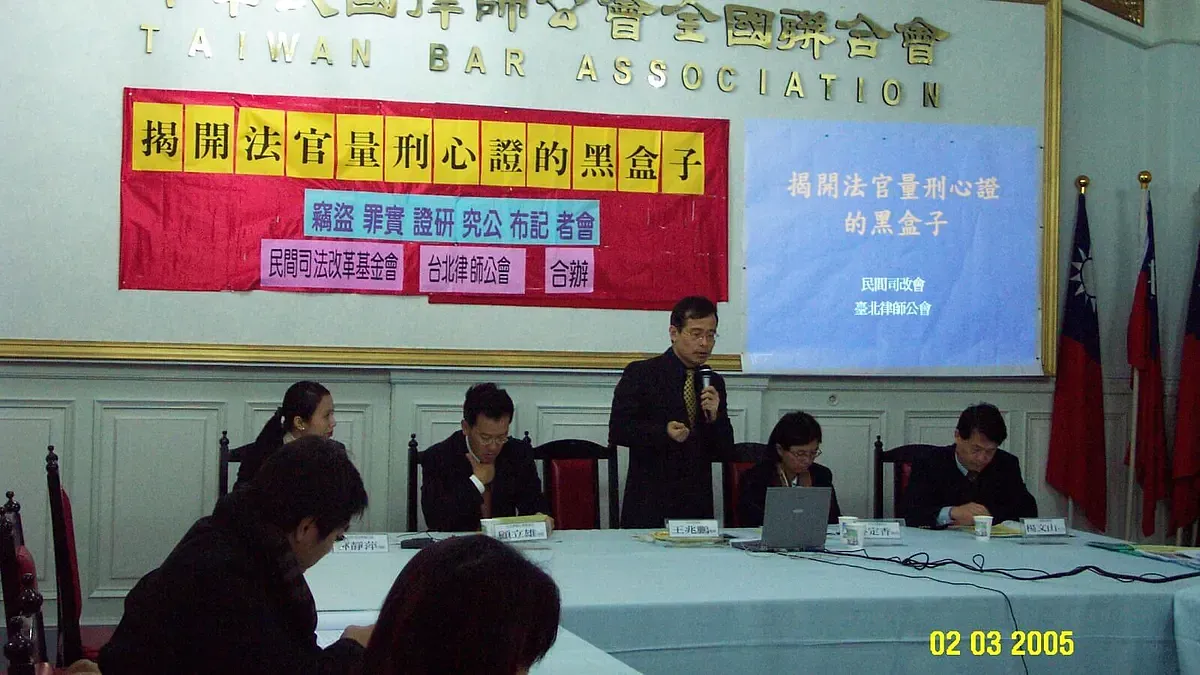
Unveiling the Black Box of Judges' Sentencing Discretion: Results of Empirical Statistical Research on "Theft" Publicly Released!
Last edited: 2026-08-30
The Judicial Reform Foundation (JRF) and the Taipei Bar Association jointly held a press conference today (the 2nd) titled "Unveiling the Black Box of Judges' Sentencing Discretion," releasing the results of a year-long empirical statistical study on "theft" commissioned to Professor Wang Chao-peng of the Department of Law at National Taiwan University, Professor Lin Ting-hsiang of the Department of Statistics at National Taipei University, and Director Yang Wen-shan of the Institute of Sociology at Academia Sinica. Because Taiwan's laws have historically granted judges extremely broad sentencing discretion, whether judges properly exercise this discretion has often been like a "top secret" unknown to outsiders. Coupled with the fact that Taiwan has never had any statistical data or related research concerning judges' sentencing mentalities, the public release of this research has garnered extraordinary attention.
The JRF stated that this research sampled district courts nationwide, excluding courts at the High Court level or above. Among district courts, offshore island courts (Penghu and Kinmen) were excluded from this analysis due to an excessively low total number of cases, bringing the total to 18 district courts in Taiwan proper. The research period covered judgments rendered over a three-year span from 2000 to 2002 (the 89th to 91st years of the Republic). To ensure representativeness and keep the sampling error within 3%, the study calculated a required sample size of 1,068 cases. Utilizing stratified proportional sampling and the database of Lawbank Info-Tech Co., Ltd., samples were drawn proportionally from each district court annually based on their share of the total sample size, resulting in a total of 1,164 theft judgments drawn as samples for this project.
The JRF further explained that the research results of this "Theft Sentencing Analysis" highlight several key points worthy of the attention of the public and judicial authorities:
General Patterns
- Judgments fail to clearly account for sentencing reference factors, raising doubts as to whether judges followed the provisions of Article 57 of the Criminal Code in sentencing or simply sentenced based on impressions [See pages 9-11, 13 of the report; Preliminary Statistics 5-1, 6-1, 7, 13-1].
- Judges tend toward "lenient sentencing" [See pages 20, 21 of the report; Preliminary Statistics 25-4, 25-5].
Region or Judge Characteristics
- Theft committed in non-metropolitan areas is more likely to result in probation [See page 23 of the report; Appendix Table 1, Figure 1].
- Judges aged middle-aged (46 and older) and above are more lenient and more likely to grant probation [See page 25 of the report; Appendix Table 3, Figure 3].
- Female judges are more lenient and more likely to impose lighter sentences [See page 24 of the report; Appendix Table 2, Figure 2].
Defendant Factors
- Female defendants are more likely to receive lighter sentences [See pages 26-29 of the report; Appendix Tables 4–7, Figures 4–7].
- Defendants with criminal records are more likely to receive heavier sentences [See pages 31-37 of the report; Appendix Tables 11–16, Figures 11–16].
- Defendants who confess to crimes do not necessarily receive lighter sentences [See pages 38, 39 of the report; Appendix Tables 18, 19, Figures 18, 19].
Case Factors
- If prosecutors apply for summary proceedings, defendants are more likely to be granted probation or receive lighter penalties [See pages 40-43 of the report; Appendix Tables 21–25, Figures 21–25].
- Completed versus attempted offenses do not affect sentencing, which differs from the provisions of Article 26 of the Criminal Code [See page 22 of the report; Table I-17].
- Defendants who steal only a single item are no more likely to be granted probation than habitual or serial thieves [See page 22 of the report; Table I-16-<2>].
Year
- Judges are increasingly reluctant to grant probation [See pages 50, 51 of the report; Appendix Table 35, Figure 35].
- Judges are increasingly less likely to sentence defendants to fines [See page 51 of the report; Appendix Table 36, Figure 36].
- Judges show no increasing trend toward imposing heavier or lighter sentences [See page 22 of the report; Table I-19-<6>].
From the results of this research report, it is evident that the severity of theft sentencing may be influenced by factors such as the judge's age, gender, and urban-rural distribution, which undoubtedly mocks the "fairness and justice" pursued by the judiciary (i.e., treating equals equally and unequals unequally). To this end, the JRF proposes the following three recommendations:
-
The State Should Fund and Commission Objective Scholars and Experts to Conduct More Empirical Judicial Statistical Research
This research is an empirical study on judicial statistics privately funded and commissioned to scholars and experts. It yields many revolutionary findings regarding judges' sentencing mentalities, holding extremely important value for both academia and judicial practice. Judicial practice contains many "black boxes" that should be exposed through empirical research—on one hand to serve as a reference for judicial reform, and on the other hand to allow the public to understand the actual state of the judiciary. However, private resources are limited, and therefore it is recommended that the state fund and commission objective scholars and experts to conduct more empirical judicial statistical research.
-
Establish a Fair Sentencing Commission
Regarding the crime of theft, this research uncovered many phenomena worthy of study, such as judges tending toward "lenient sentencing," female judges imposing lighter sentences, male defendants receiving heavier sentences, and so on. Do these phenomena align with fairness and justice? Should they be corrected through policy or legislation? Do similar or comparable situations exist in other crimes (such as murder, robbery, and arson)? All require long-term, continuous research. Therefore, it is recommended that a "Fair Sentencing Commission" be established under the Judicial Yuan to conduct empirical research on long-term judicial sentencing, and to formulate policies and draft legislation based on research findings to make our country's sentencing fair and reasonable.
-
The Determination of Criminal Facts and the Sentencing Procedure in Criminal Procedure Should Be Separated
The determination of criminal facts and sentencing belong to the same procedure in our criminal litigation system. In judicial practice, almost all the focus and time of a trial are spent on determining criminal facts, while regarding sentencing, parties and the court barely gloss over it with a few words. This research found that judgments mostly fail to clearly account for sentencing reference factors. Rather than saying judges failed to clearly account for them, it is more accurate to say that judges may not have fully grasped the sentencing data in practice. Tracing the root cause, this is a systemic issue. Therefore, following foreign legislative models, it is recommended that the determination of criminal facts and the sentencing procedure in our criminal litigation be separated. During the fact-finding procedure, only evidence and facts concerning whether the defendant is guilty should be investigated. After the defendant's guilt is determined, a sentencing procedure should then be initiated, allowing the parties to present sentencing data and reasons, making it possible for the court to impose a prison term that best conforms to fairness and justice.
Appendices
- Press Conference Slides
- Unveiling the Black Box of Judges' Sentencing Discretion: Empirical Research on Judicial Statistics
Press Contacts
JRF Executive Director, Attorney Lin Ching-ping
This article is an AI-generated translation of the original Chinese text. In the event of any discrepancy, the Chinese version shall prevail.
