
Tsai Ing-wen's Judicial Reform Dilemma as Seen Through the Wulai Vehicle-Blocking Case
Last edited: 2026-07-27
Tsai Ing-wen won a landslide victory in the presidential election, and the Democratic Progressive Party also secured a majority of seats in the Legislative Yuan. Many old-school Kuomintang legislators, even with solid grassroots organizations and decent public images, were still unseated amidst the prevailing public sentiment yearning for change. Led by Tsai Ing-wen, seizing both executive and legislative powers was unstoppable. Imagine what it would be like if the judiciary were also subject to elections. The Chief Prosecutor of the Taipei District Prosecutor's Office, who indicted the participants of the Sunflower Student Movement, would inevitably be forced to step down in disarray, ending their career. Judges who constantly use the offenses of compulsion, obstructing public duties, and violating the Assembly and Procession Act to sentence citizens, treating "angry/aspiring youths" taking to the streets as enemies, would probably be spurned and never elected again.
All of the above are advantages of direct democratic elections. Of course, the judiciary inherently possesses the characteristic of "counter-majorityism"; what the majority likes is not necessarily right. Particularly through the protection of fundamental human rights and the adherence to the principle that the bottom line of minorities should not be infringed upon, the judiciary has considerations that make it unsuitable for direct elections. (Conversely, if the judicial leadership of our country were not dedicated to upholding fundamental human rights, using elections to wash things through might actually be a better approach.)
One Verdict, Two Interpretations
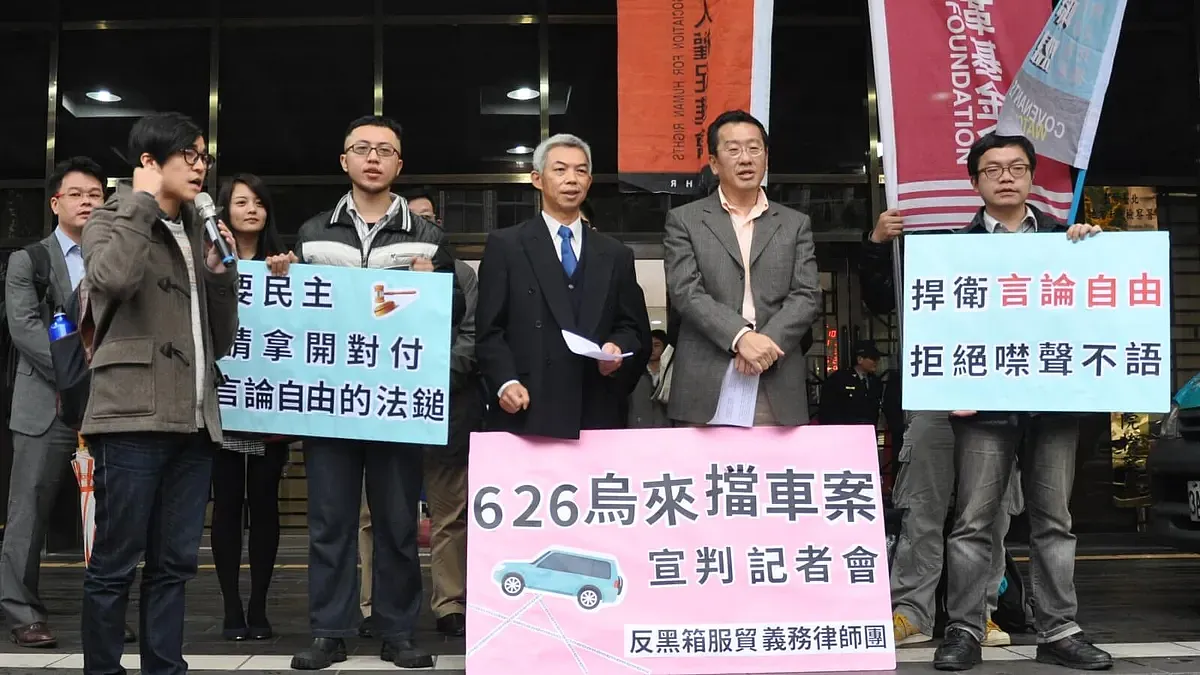
Just the day before the election, the Taipei District Court delivered its verdict on the "Wulai vehicle-blocking case," in which eight young people bound themselves with iron chains and hemp ropes, locking themselves to road dividers in an attempt to protest against Chang Chih-chun, Director of the Taiwan Affairs Office of the State Council of China, and to express their opposition to the government's cross-strait economic and trade policies.
The Taipei District Court's verdict was quite unusual. The judge held that all eight individuals committed a crime, jointly perpetrating the offense of compulsion because they infringed upon the rights and interests of road users. However, taking into consideration that "as citizens of the Republic of China, they were concerned with major cross-strait policy issues... in order to make the ruling authorities of the mainland region witness public opinion and respect the voices of our citizens, it can be recognized that their criminal motive was based on the public interest, and their purpose was also benevolent, bearing no relation to personal gain...", the judge therefore exempted them from punishment.
The judge seemed to be playing a two-handed strategy: on the one hand, rebuking them quite severely and even ruling that their actions constituted a crime; on the other hand, affirming that their actions were for the good of the country rather than for personal gain, thus exempting them from punishment. There are two possible interpretations of this approach.
First, the judge showed admirable courage, but stopped short of completing the deed. The judge actually wanted to let the students off the hook, but considering previous precedents of guilty verdicts, wanting to avoid attracting attention, or worrying about stirring up trouble, they had no choice but to adopt the approach of "open reprimand, covert release," striking a balance by blaming both sides equally.
Another interpretation is to believe that the judge harbored even better intentions and deliberately utilized legal technical means to make it more likely for the students to walk away unscathed. This is because if the students had been directly acquitted, the prosecutors would typically have filed a "mechanical appeal," and a more conservative higher court might have overturned the acquittal and convicted them. Furthermore, minor offenses cannot be appealed further, meaning a guilty verdict would be finalized directly at the second instance.
This would render the first-instance acquittal meaningless, and might also make the conservative judges of the second instance "unhappy" due to the adoption of an excessively liberal and protective stance toward the students, thereby galvanizing their resolve to render a guilty verdict. Handing down a guilty verdict allows prosecutors to "satisfy their requirements" and refrain from appealing. If only the students were dissatisfied and appealed, the appellate court would be bound by the principle of "prohibition of disadvantageous modification" and could only impose a lighter sentence, thereby better ensuring the students' safety.
A Multi-World Judiciary
The first interpretation above indicates that judges (and prosecutors alike) are under immense pressure within the system. When encountering cases that are even slightly political or sensitive, it is inevitable for them to factor in the trouble they might bring upon themselves. This shows that the judiciary is still unable to operate independently. Although no one may be directly interfering in individual cases, the supporting system that allows judges and and prosecutors to make independent judgments without having to worry at all about adverse consequences still appears fragile.
Moreover, both interpretations above also suggest that judges and prosecutors at different hierarchical levels may be people with different mindset across different worlds. Generally speaking (with exceptions, of course), the more grassroots-level judges and prosecutors are, the more liberal and open-minded their thoughts and practices tend to be, and the better they are at protecting citizens' fundamental rights. However, wanting to secure the outcome requires bypassing higher-level review, which might take some effort and trouble, and is not always successful.
Although the above analysis of the verdict's outcome does not necessarily fully match the actual reality in the judge's mind, it precisely offers a glimpse into the dilemma Tsai Ing-wen may face at a time when the public hopes for substantial judicial reform. Our judicial system has remained in a state of being unable to "grow up," because while it appears to be a single judiciary on the surface, it encompasses multiple different worlds within.
Whether Tsai Ing-wen's exceptionally high vote share can be used wisely after her inauguration on May 20 to introduce some impulses grounded in democracy and public opinion when deciding on judicial reform matters is worth watching. In particular, whether this high vote share can be translated into high legitimacy capable of shaking up the conservative forces within the judicial circles—who are typically also those currently holding greater power—so as to prevent deep-seated reactionary pushback, is the critical factor for whether reform can succeed.
※ Originally published at: PNN Public Television Service News Issue Center
This article is an AI-generated translation of the original Chinese text. In the event of any discrepancy, the Chinese version shall prevail.