
Reflecting on Judicial Reform and Acting Like a Little Tsai Ing-wen
Last edited: 2026-07-27
Photo Credit/Tsai Ing-wen's Official Fan Page
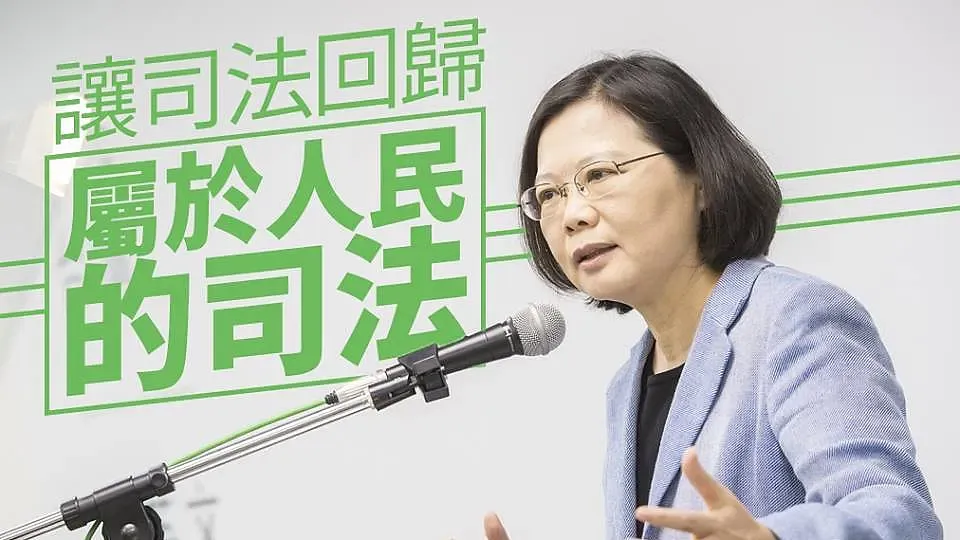
As the new parliament takes office, the new government is poised and ready to go. With the dust settled on the battle for the legislature's speakership, Tsai Ing-wen has subtly demonstrated her resolve to project a new image in response to external skepticism regarding old forces. When political power shifts through elections, both the legislative and executive branches welcome new personnel and fresh perspectives. High-level judicial personnel are bound to change as well in order to respond to new reforms and a new politics. Tsai's pre-election promise to convene a "National Judicial Reform Conference" sounds unexceptionable at first hearing, carrying on the expectations of the 1999 National Judicial Reform Conference, which lasted for three days and indeed "held many meetings and talked about many things."
However, what was severely criticized was precisely this kind of grandstanding conference characterized by "holding meetings without discussion, discussing without concluding, and concluding without execution." Three days later, it vanished like a magnificent burst of fireworks.
Sixteen years have flown by, and the judicial problems of that era seemingly still remain. Pulling out the checklist of issues from the original conference still feels remarkably fitting for the current situation. This is truly ironic, indicating that the judiciary has not made significant progress over the past sixteen years. Consequently, the public's bitter resentment toward the judiciary has only deepened. While the executive and legislative branches have undergone two party rotations, the judicial power remains completely immovable. The workload and pressure borne by judges and prosecutors seem increasingly heavy, yet this fails to even slightly alleviate public dissatisfaction with the judiciary. The judiciary has truly reached a critical juncture where reform is absolute and unavoidable.
More Than Just Holding Meetings
Tsai has promised to convene a "National Judicial Reform Conference." Yet, anyone who gives it a moment's thought would almost unanimously agree: absolutely do not repeat a "three-day grandstanding show" like the one in 1999. If it is merely that, judicial reform will be nothing more than another scam—a mere palliative for the people, offering the illusion of comfort without any real effect.
Adopting the format of a conference is certainly acceptable, but it must be sustained over a period of time. Whether through committees or continuous meetings, it should function more like a platform. Every effort must be made to broadly incorporate public opinions through the internet, local workshops, or even setting up booths to distribute questionnaires at courts and prosecutors' offices—the goal is simply to gather the people's views.
Precisely because the public are the actual users of the judiciary, failing to understand the customers' thoughts or market trends naturally prevents one from producing a good product. To achieve this, this platform can certainly no longer be confined to legal professionals from the four sectors of judging, prosecution, defense, and academia "playing behind closed doors," nor can it repeat the mistakes of 1999.
Furthermore, within the legal circle, where the problems lie has long been old news. Coupled with gathering public expectations, discussions on the platform must be more sharply focused on ways to solve problems. We need creative, effective, and feasible solutions, while truly casting aside institutional sectionalism and coordinating and reforming with the mindset of "treating the judiciary as a safeguard for Taiwan's long-term stability and peace."
This is the kind of reform that possesses high vision, breadth of mind, and foresight, and stands a chance of succeeding. It is also the original intention behind hoping the president would preside over its convening—to mediate between the Executive Yuan, Judicial Yuan, Examination Yuan, and even the Legislative Yuan—and is the only way to address issues at the final implementation level. Mere meetings and resolutions are useless; execution, tracking, and evaluation are required. Even when the president nominates a new Minister of Justice, President of the Judicial Yuan, or President of the Examination Yuan, such appointments should be guided by the willingness and ability to execute judicial reform policies.
Turning Judicial Reform into a Nationwide Movement
In fact, reform driven solely from the top down often fails. The reason is simple: within the judicial circle, those who are open-minded and willing to accept change are certainly not in the majority. Internal reform forces are limited, and external forces are usually necessary to shake the system. The Hung Chung-chiu case, which required uniting the people to change the military system, is a great illustration of this.
Moreover, pinning our hopes solely on the reform resolve of Tsai Ing-wen or top judicial officials is also severely limited. Perhaps we need not doubt their sincerity for reform; however, human energy and focus are limited. Whether judicial reform becomes a top priority depends fundamentally on how much attention and effort we, as ordinary citizens, are willing to invest. The more attention the public pays, the more it will become the focus of politicians' attention.
Of course, to build a sound overall judicial system, elevating the public's overall legal literacy is the fundamental solution. The concept of the rule of law is not merely the traditional notion of law-abidance; understanding constitutional principles, valuing due process of law, and pursuing a belief in safeguarding basic rights all underpin social order and serve as the fertile soil for a healthy judicial environment.
Ever since the January election, society has been charged with a palpable momentum. Let us reflect deeply, imagine ourselves holding the office of President Tsai Ing-wen, and turn judicial reform into a truly nationwide movement!
This article is an AI-generated translation of the original Chinese text. In the event of any discrepancy, the Chinese version shall prevail.