
JRF Newsletter
Justice Arrives for Hsu, Innocence Prevails—Waiting for the Blossoming of Justice, No Matter How Many Days It Takes
Last edited: 2026-08-30
Dear Friends,
The Hsu Tzu-chiang case has spanned nineteen years, with the retrial (ninth remand) preparation proceedings held on the first day after the Lunar New Year (February 24) to discuss the possibility of a "confrontation" between co-defendants. The trial proceedings will commence on the morning of Wednesday, March 4, during which Hsu's father will testify in court to argue the factual basis of this case.
This newsletter outlines the background and key issues of the Hsu Tzu-chiang case, inviting everyone who cares about the judiciary and the case to understand it together and participate in the court observation on Wednesday, March 4.
- Time: Wednesday, March 4, 09:30
- Location: Special Courtroom 1, Criminal Building, Taiwan High Court (2F, No. 127, Bo'ai Rd., Zhongzheng Dist., Taipei City)
What Happened?
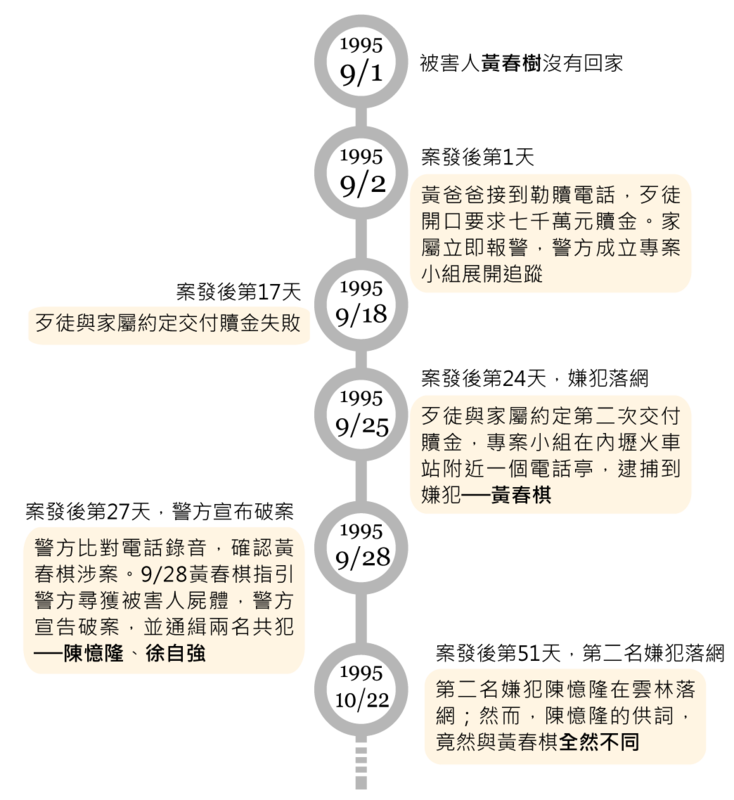
Contradictory Confessions of Co-Defendants
| Huang Chun-chi's Statement (1995/09/28) | Chen Yi-lung's Statement (1995/10/22) |
| Committed by 3 people (Huang Chun-chi, Hsu Tzu-chiang, Chen Yi-lung) | Committed by 4 people (Huang Ming-ch'üan added) |
| 1 vehicle (stolen car) | 2 vehicles (stolen car + Chen Yi-lung's car) |
| Hsu Tzu-chiang went up the mountain together and jointly buried the body | Hsu Tzu-chiang left halfway, returned to the scene to wipe off fingerprints |
| Chen Yi-lung committed the murder with a knife | Huang Ming-ch'üan committed the murder with a knife + destroyed the body with sulfuric acid (Sulfuric acid was purchased in advance by Hsu Tzu-chiang) |
| Returned home immediately after the crime; extortion calls began only two or three days later | After the crime, the three returned to Hsu Tzu-chiang's Guishan residence, summoned Hsu Tzu-chiang, and all four discussed extortion matters |
| Extortion calls were made by Huang, Chen, and Hsu | Extortion calls were not made by Hsu Tzu-chiang because Hsu Tzu-chiang knew the victim's family |
-
September 28, 1995: Huang Chun-chi stated to the police that
- He was invited by his cousin Hsu Tzu-chiang and friend Chen Yi-lung to go to Taipei to collect a debt.
- On the morning of September 1 at 9:00 AM, the three of them kidnapped Huang Chun-shu and drove a stolen car toward the mountainous area of Xizhi.
- Around 11:00 AM in the mountainous area of Xizhi, Chen Yi-lung unexpectedly murdered Huang Chun-shu.
- After the crime, he returned home first, and only two or three days later did he make extortion calls together with the other two.
-
October 22, 1995: Chen Yi-lung's statement
- This was a premeditated kidnapping involving four people: besides Hsu Tzu-chiang and Huang Chun-chi, there was also Huang Chun-chi's older brother, Huang Ming-ch'üan. The four began plotting in mid-August and lurked around the victim's Dazhi home waiting for an opportunity from August 29 to 31, but failed because they missed the chance.
- On September 1, the four of them committed the crime using two cars: one was a stolen car, and the other was Chen Yi-lung's own car. After kidnapping Huang Chun-shu, Hsu Tzu-chiang did not follow the others to the Xizhi mountainous area; instead, he got off halfway and returned to the Dazhi kidnapping scene to wipe off any fingerprints that might have been left on Huang Chun-shu's car.
- Huang Chun-shu was killed by Huang Ming-ch'üan in the Xizhi mountainous area. After killing Huang Chun-shu, Huang Ming-ch'üan also splashed the body with sulfuric acid, which was bought by Hsu Tzu-chiang.
- On the afternoon of September 1, the four discussed how to divide the spoils and the content of the extortion at Hsu Tzu-chiang's rented place in Guishan. Throughout the process, Hsu Tzu-chiang did not make any extortion calls because he knew the victim's family.
Flight and Facing Justice
-
September 29, 1995
Four days after Huang Chun-chi was arrested, Hsu Tzu-chiang saw news in the newspaper implicating him in the case. After discussing it with his family and fearing police torture, he began his life on the run.
-
October 6, 1995
Hsu Tzu-chiang submitted an alibi through his lawyer for the morning of the crime (September 1), before Chen Yi-lung's arrest. At 10:47 AM that morning, he was withdrawing money at the Guishan Post Office (No. 2-1, Fengmei St., Guishan Township, Taoyuan County), which is proven by photographic evidence.
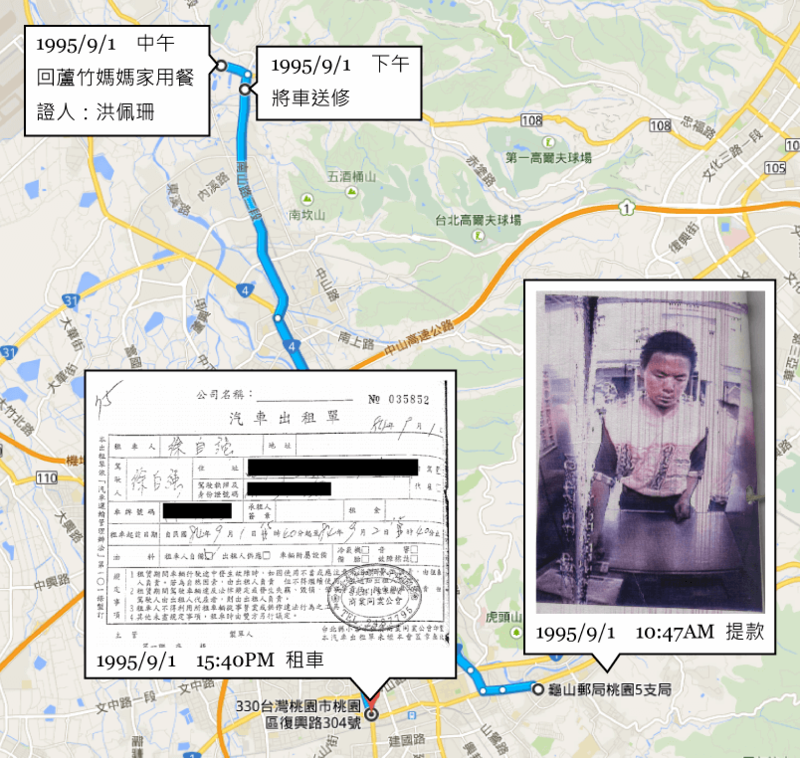
At noon on September 1, Hsu Tzu-chiang returned to his mother's home in Luzhu for a meal, which can be testified to by witness Hung Pei-shan. In the afternoon, he took his car for repairs, and around 3:40 PM, he rented a car in Taoyuan City, proven by a car rental slip. Hsu stayed in Luzhu for two days before returning to Guishan.
-
May 16, 1996
Huang Chun-chi and Chen Yi-lung were sentenced to death in the first instance. Fearing that the two might be executed leaving no proof of death, Hsu Tzu-chiang voluntarily surrendered on June 24, accompanied by his lawyer.
The Rollercoaster Death Sentences
Starting from the first instance, Hsu Tzu-chiang experienced six death sentences, none of which were finalized until April 27, 2000, when the Supreme Court upheld the judgment of the fifth retrial remand, finalizing Hsu Tzu-chiang's death sentence.
The court sentenced him to death based on:
-
Confessions of Co-Defendants
Hsu Tzu-chiang and Huang Chun-chi are cousins, and Chen Yi-lung is a business friend. Since Huang and Chen knew that kidnapping for ransom resulting in murder is punishable solely by death, they naturally would not monstrously and falsely accuse Hsu Tzu-chiang of involvement.
-
Rejection of Alibi
The court twice drove from the kidnapping location (Dazhi) to Hsu Tzu-chiang's rented house in Guishan. The first time, due to getting lost, it took over an hour; the second time, led by Chen Yi-lung, it took 45 minutes. Therefore, it was concluded that after kidnapping the victim in Dazhi, Hsu Tzu-chiang had enough time to return to the scene to wipe off fingerprints and then return to Guishan to go to the post office to withdraw money.
-
Favorable Witnesses Were Protecting Hsu Tzu-chiang and Are Unreliable
The testimonies given by Hsu Tzu-chiang's mother-in-law, wife, and mother proving that Hsu Tzu-chiang did not participate in the crime on September 1 were all statements protecting Hsu and cannot be used as favorable findings for him.
-
Hsu Tzu-chiang Rented Cars on September 18 and 21, Used During Ransom Collection
-
Premeditated Crime
The defendants and others prepared crime tools in advance such as sulfuric acid, handcuffs, gloves, and a small samurai sword, and dug a hole for burying the body, showing the crime was "premeditated," hence the death sentence.
Control Yuan Investigation Report
On February 8, 2001, the Control Yuan issued an investigation report pointing out numerous doubts in this case and hoping the court would reopen the investigation.
- The police clearly used torture and coercion; the confessions of Huang Chun-chi and Chen Yi-lung have major problems.
- If Hsu Tzu-chiang were truly involved, it is impossible he would rent cars in his own name twice on September 18 and 21 and return them in his wife's name. Generally, anyone knowing they are involved would obviously never do this.
- After the kidnapping, returning to the scene to wipe fingerprints and then rushing back to Guishan—could time really go this smoothly?
- The co-defendants stated that the four discussed together on the afternoon of September 1. How could Hsu Tzu-chiang's afternoon itinerary be unimportant?
Unredressed Grievances
Aside from the doubts raised in the Control Yuan report, the aforementioned guilty verdicts by the court sentenced Hsu Tzu-chiang to death based merely on the contradictory confessions of co-defendants and two car rental slips.
-
Self-Contradictory Confessions: There Was No Sulfuric Acid at All
In addition to the inconsistencies in the two defendants' confessions pointed out in the table above, the contents of the confessions also contradict scientific evidence.
Forensic pathologist Yang Jih-sung never mentioned in the appraisal report produced at the time of the crime (1995) that the victim's body had been splashed with sulfuric acid, and he replied to the High Court twice in 2005 and 2009, pointing out that the victim's skin "showed no corrosion or epithelial shedding, meaning there were no traces of sulfuric acid splashing" and "no traces of strong acid (such as sulfuric acid or hydrochloric acid) corrosion or skin peeling."
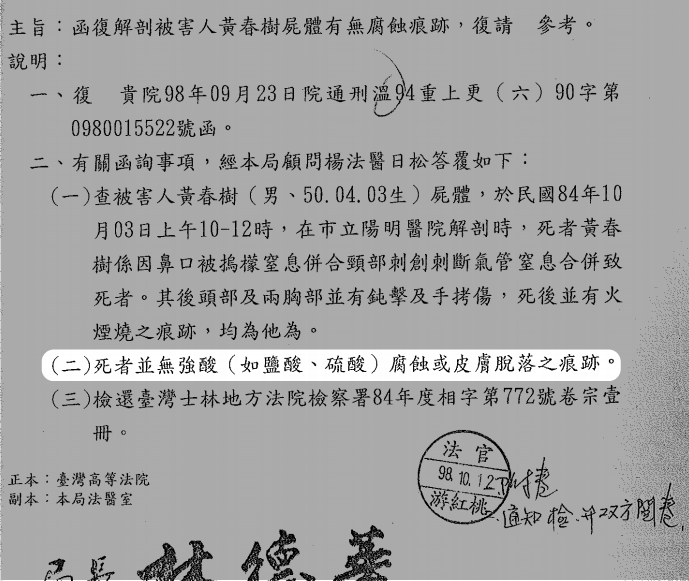
However, up until the sixth retrial remand, the court still held that: Hsu Tzu-chiang bought 3 bottles of sulfuric acid at an "unnamed pharmacy" in Guishan Township, Taoyuan County, for the purpose of destroying the body and eliminating evidence. Having bought "sulfuric acid or hydrochloric acid" that "did not exist at all" at an "unnamed pharmacy" at an "unknown time," A-chiang was sentenced to death six times, finalized once, and nearly became a soul under a gun. It was not until the seventh retrial remand that the court denied the "existence of sulfuric acid," yet still accepted other parts of the confession, concluding that A-chiang "only" participated in kidnapping for ransom and sentencing him to life imprisonment.
-
Insufficient Evidence
During the trial process, there were no communication records proving close contact between Hsu Tzu-chiang and the other two defendants, the extortion recordings did not contain Hsu Tzu-chiang's voice, and the documents of the "901 Project"—investigating the Huang Chun-shu kidnapping case formed by three units: the National Police Agency, the Taipei City Police Department, and the Neihu Precinct—all vanished into thin air.
-
Co-Defendants Recanted
- Co-defendant Chen Yi-lung called Hsu Tzu-chiang's mother on October 7, 1995, saying: Hsu Tzu-chiang did not participate in this case.
- After the fifth retrial remand finalization, co-defendants Huang Chun-chi and Chen Yi-lung both told Hsu Tzu-chiang's family that Hsu Tzu-chiang did not participate in this case, and Chen Yi-lung wrote a written confession to Hsu Tzu-chiang's mother.
Whatever Happened to the Presumption of Innocence?
According to Article 154 of the Code of Criminal Procedure: "A defendant shall be presumed innocent until proved guilty by a judgment of a court. Facts of a crime shall be established by evidence; no evidence, no crime."
-
Facts of a Crime Must Be Established by "Evidence"
Meaning speak only on the basis of available evidence.
-
Requirements of Judicial Yuan Interpretation No. 582
The confession of a co-defendant (1) must undergo witness cross-examination procedures; (2) cannot serve as the sole evidence for a guilty verdict. If the "evidence" used to establish criminal facts is a "co-defendant's confession," according to Grand Justices Interpretation No. 582, it must (1) undergo witness cross-examination procedures, and (2) have corroborating evidence other than the confession itself to prove the criminal facts.
-
A Defendant Shall Be "Presumed Innocent" Until Proved Guilty
This is the sovereign clause of evidentiary rules: the "Principle of Presumption of Innocence." The substance of the presumption of innocence is that a defendant shall be presumed innocent until proven guilty by law. Furthermore, "proof" must reach the degree of "conviction of a guilty judgment," meaning the degree where "there is no longer any reasonable doubt regarding the defendant's crime." Therefore, as long as there is any reasonable doubt regarding the defendant's guilt, the court should render a not-guilty verdict.
In the Hsu Tzu-chiang case, successive court trials relied solely on co-defendants' confessions that "did not undergo lawful cross-examination procedures," resulting in six death sentences and two life sentences. The crux of how the Hsu Tzu-chiang case is judged lies in whether the principle of "presumption of innocence" can be thoroughly implemented.
Retrial of the Hsu Case: Have the Problems Been Solved?
- May 26, 2005: The Supreme Court ruled to remand the Hsu Tzu-chiang case to the High Court for retrial.
- December 8, 2009: The sixth retrial remand pronounced judgment, and Hsu Tzu-chiang was still sentenced to death.
- November 25, 2011: The seventh retrial remand pronounced judgment, revoking the original death sentence and commuting Hsu Tzu-chiang to life imprisonment.
- May 18, 2012: The eighth retrial remand pronounced judgment, upholding the life imprisonment sentence.
- April 29, 2013: The Hsu Tzu-chiang case entered the ninth retrial remand.
Can Co-Defendants' Testimonies Be Utilized?
In trial proceedings after Interpretation No. 582, although co-defendants were summoned to court, they still did not undergo statutory cross-examination procedures, failing to meet the requirements of Interpretation No. 582.
| Legal Provisions | Evidentiary Validity of Statements Post-Retrial |
| Article 158-3, Code of Criminal Procedure The testimony of a witness who has not taken an oath shall not be used as evidence |
Sixth Retrial Remand: Huang Chun-chi and Chen Yi-lung remained silent in court Seventh Retrial Remand: Huang Chun-chi and Chen Yi-lung refused to answer in court Eighth Retrial Remand: Huang Chun-chi remained silent in court |
| Judicial Yuan Interpretation No. 582 A witness shall take an oath during trial and submit to cross-examination by the defendant before their statement can be utilized |
|
| Article 181, Code of Criminal Procedure A witness who may incriminate themselves or subject themselves to criminal prosecution or punishment by testifying may refuse to testify |
Justice Is Still on the Way
For these sixteen years, I have always been doing the same thing: constantly proving my own innocence.
The Hsu Tzu-chiang case has spanned nineteen years. In the first decade, the Control Yuan and the Council of Grand Justices successively expressed their views on this case; in the second decade, we sincerely hope the court will follow regulations, act with courage, and return a not-guilty verdict to an innocent person. Let there not be a third decade—the Hsu Tzu-chiang case needs our shared attention!
| Factors Supporting Innocence | Non-Compliant Evidence |
|
Co-defendant confessions not compliant with the law:
|
This article is an AI-generated translation of the original Chinese text. In the event of any discrepancy, the Chinese version shall prevail.