
JRF Newsletter
The Exclusion of the Other: The Society That Must Be Defended
Last edited: 2026-08-30
Dear friends,
From February 11 to February 12, 2015, six inmates at the Taliao Prison in Kaohsiung took hostages, issued several statements concerning correctional facilities and the judiciary, and then took their own lives, shocking society.
These statements all addressed long-standing issues within correctional facilities and the judicial field. In the past, however, these issues were not valued by society and were never properly examined. To prevent similar tragedies from happening again, it is necessary to gather the strength of everyone to care about these issues. This issue of the newsletter first highlights the relevant social contexts rooted in the statements of these six inmates, hoping that everyone can take this as a starting point to reflect on where our criminal policy is heading.
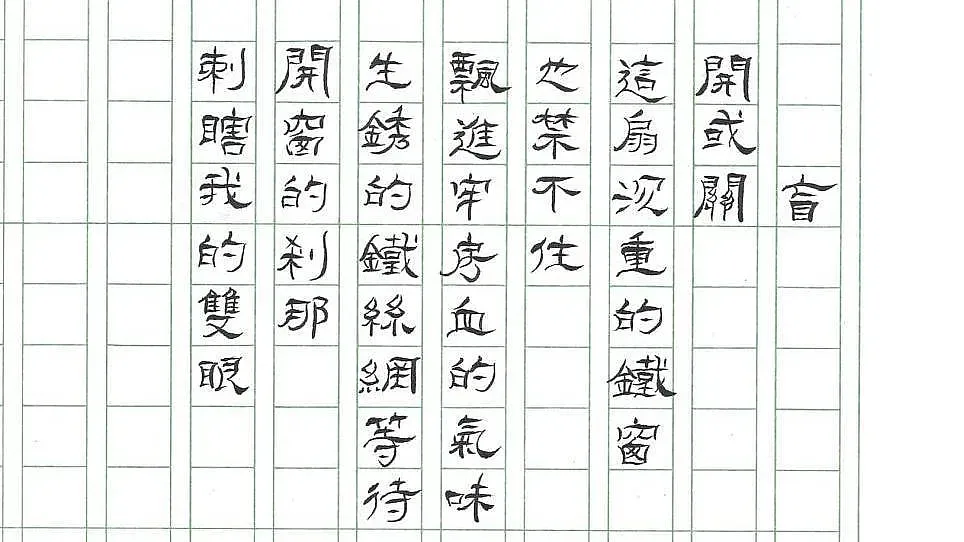
"Now, with cumulative sentencing for each offense, some people face prison terms of 40 or over 50 years... Under the three-strikes rule, parole cannot even be applied for..."
"The three-strikes law needs to be changed, give people some hope, okay?..."
"Chen Shui-bian can be released on medical parole on feigned illness, yet inmates in correctional facilities whose conditions are more serious than his cannot be granted medical parole? Why? Because we are criminals who deserve to be locked up until we die."
"Since you want to lock me up until I die, shouldn't you at least give us the ability to be self-reliant and self-sufficient? Working for a month yields only NT$200, which is not even enough to buy a set of underwear, and we still have to rely on financial support from our families. We have lost all human dignity, yet we continue to be a burden on our families. The only paths left are suicide and fighting to the bitter end."
"...The judge's discretionary power is based on the logic of a dictator. If he says you are guilty, you are guilty. Who told us to have criminal records, we deserve it. What is the presumption of innocence? That is just talk..."
Six inmates who took the warden and the chief of security of the Kaohsiung Prison hostage left behind these demands and took their own lives. While this highly dramatic hostage-taking incident has temporarily come to an end, what cannot end are the tragedies playing out every day from prisons to the courts. Yet these tragedies happen far too often, and most people feel they have nothing to do with them, leaving us numb and turning a blind eye...
Let's Start with Prisons!
According to media reports, the crimes and sentences of the 6 inmates who took the warden hostage are as follows: Cheng Li-te committed homicide, with a sentence of 28 years and 6 months; Chin Chu-sheng committed robbery, with a sentence of life imprisonment and 20 years of imprisonment; Chin I-ming committed banditry, with a sentence of 46 years; Wei Liang-ying committed drug offenses, with a sentence of 34 years and 3 months; Huang Tzu-yen committed drug offenses, with a sentence of 25 years; Huang Hsien-sheng committed drug offenses, with a sentence of 34 years and 2 months. All 6 of these inmates are long-term serious offenders who will either not leave the prison alive or will be in their old age upon release.
This is the reality of Taiwan's current criminal policy of "combining leniency and strictness." The so-called "combining leniency and strictness" criminal policy means that for minor offenses, "diversionary" practices are adopted as much as possible to avoid defendants serving prison terms; however, for those identified as serious offenders, severe punishments are imposed more harshly. This "punitive turn (heavy sentencing)" includes abolishing continuous offenses and adopting cumulative sentencing for each offense, as well as adopting the spirit of the three-strikes legislation2 to raise the threshold for parole.
The government has not proposed many supporting treatment measures for long-term inmates "manufactured" under heavy sentencing. They have no individualized treatment plans, and their only significance is their "absence" from society, and they may even be abandoned by their families, with no one willing to inquire about them. Such long-term inmates feel their lives are hopeless. Passively, they may choose suicide (such as the inmate surnamed Ch'en at the Taipei Prison who committed suicide with scissors); actively, apart from potentially resisting prison management at every turn (since they cannot get out anyway, they simply do not care about being unable to parole due to disciplinary violations), it may even culminate in today's hostage-taking and desperate struggle.
The lack of treatment measures accompanying the heavy-sentencing criminal policy is no accident. Rather, paradoxically, this is the "structural accompaniment" of the heavy-sentencing criminal policy. The reason why it is called a structural accompaniment is that the starting point behind the heavy-sentencing criminal policy is the "exclusion of the other": in order to maintain the sense of security of the general public, inmates are regarded as "others who endanger society" and are thoroughly excluded from society. This exclusionary mindset naturally tends to ignore social reintegration, because what everyone truly cares about is how to identify "scumbags who endanger society," what kind of danger these scumbags will cause, how it is possible to prevent them from endangering society again, and ideally, ensuring they never return to society at all.
Under such circumstances, it is hardly surprising to see conditions arise within correctional facilities such as "critically ill inmates finding it difficult to be released on medical parole" and "working for a month yielding only NT$200, which is not even enough to buy a set of underwear." Because under the logic of exclusion, people care more about "not letting these people out casually" and "not wasting taxpayers' money to support these people," and a certain degree of "sub-alternization" (these scumbags do not deserve to live human lives) is also an intentional or unintentional result. Furthermore, because this sub-alternization is accompanied by society's disregard or neglect of the plight of the excluded under the logic of exclusion, severe inequalities may even emerge within the group of excluded persons without receiving attention from the outside world. "Why could Chen Shui-bian be released on medical parole? A bunch of people in correctional facilities are sicker than him, why can't they be released on medical parole?" "Why did Yen Ching-piao's parole take only 4 days to go through all the processes from preliminary review to release, while my parole process takes 2 months?" Such voices circulate within correctional facilities, but how many of them are heard by the outside world and taken seriously?
The logic of exclusion appears not only in prisons; it actually already exists within the judicial system.
Let's Move on to Talk About the Courts!
"...Who told us to have criminal records, we deserve it. What is the presumption of innocence? That is just talk..."
In contemporary criminal law systems, the approach adopted is "act-based criminal law" rather than "author-based criminal law" (criminal offender law). This means that every single time, whether a criminal act is established must be individually examined to see if the evidence is sufficient, rather than locking someone up simply because they are a bad person. But what is the reality? When a defendant walks into the courtroom, they are very likely already carrying certain negative labels and being treated differently. A "criminal record" is a key factor. A "criminal record" not only records a person's past criminal acts, it also implicitly points to present and future criminal possibilities—that is, the behavioral tendencies of the "offender." While this holds meaning in criminal psychology, applying this psychological concept of crime to trials leads to filling in actually lacking evidence with prejudgments, thereby substantially violating the principle of the "presumption of innocence" (meaning that if someone is deemed a bad person, it is only natural that they also do bad things).
Taking the murder case involving Cheng Li-te, one of the 6 inmates who took hostages, as an example, the criminal act identified by the court was "incitement to commit murder." "Incitement" is a difficult act to prove because "incitement" implies that the instigator did not act personally, and the proof of "incitement" often falls upon the testimonies of the person who actually carried out the act and relevant circumstantial evidence (such as whether there were old grudges). Unfortunately, human testimony is inherently an unstable type of evidence; the person who actually carried it out might say one thing this court hearing and another the next, and it is difficult to truly grasp the reasons for their inconsistent statements. Therefore, if the judge believes that the defendant standing before them is a bad person, it is easy to use their own inner prejudgment to fill in the insufficient evidence.
Three of the 6 hostage-taking inmates (Wei Liang-ying, Huang Tzu-yen, Huang Hsien-sheng) were involved in drug offenses, and the mindset of "exclusion" is even more pronounced in drug-related cases. The reason these 3 inmates were sentenced to prison terms ranging from 25 to 34 years is that they were involved in the heavier drug offense of "drug trafficking." The vast majority of those suspected of drug trafficking are drug users or have prior records of drug use. They are often perceived as having no value to society (indulging in drugs and unwilling to labor) or as potential threats to social order (not only using drugs themselves, but possibly selling drugs to harm others, or even committing crimes to raise money for drugs). Once identified as drug offenders and labeled, the court may sometimes harbor the mindset of "even if clear evidence of drug trafficking is not caught this time, sentencing you is not unjust, because you must have engaged in other drug trafficking acts." Under such circumstances, situations may arise where multiple acts are bundled together and determined collectively3, minor offenses are upgraded to serious offenses4, or there is over-reliance on Article 17 of the Narcotics Hazard Prevention Act—which stipulates informing on superiors—prompting drug users to bite each other without clear physical evidence.
Constantly identifying "others," labeling them, and then excluding them—this is the tedious and utterly ordinary routine tragedy supporting this dramatic prison hostage-taking incident. Behind this routinized tragedy lie the subtle and pervasive desires and fears of modern society: the pursuit of safety, the fear of danger, and the attempt to control everything when not everything can be controlled. A wonderful and stable society is not only illusory, but also built upon the sacrifice of the excluded. Is it really impossible for you, or someone around you, to ever become one of the excluded? Not necessarily. Because the definition of the excluded is drawn by mainstream powerholders, and it is fluid and variable. Many people crying out of injustice also said they never thought they would be entangled in a judicial incident. And once labeled, jobs and families may be ruined. This is real and too agonizing to behold. Pointing out such a situation is precisely in the hope that more people can reflect: Is this truly the ideal social image we pursue?
Notes:
- Refers to adopting various alternatives to imprisonment, such as probation, fines, community service, etc., allowing defendants to receive treatment within society. The meaning implicit behind this approach is acknowledging that imprisoning inmates by isolating them from society and confining them together may be harmful to their reintegration into society, such as the loss of employability or learning more deviant values or lifestyles. To a certain extent, this also implies that punitive measures involving the long-term imprisonment of inmates are not meant to give them hope for reintegration into society, but rather to cast them out of society altogether.
- In the United States, habitual serious offenders facing a third strike are subject to life imprisonment without parole. See the legislative reasoning for the amendment to Article 77 of the Criminal Code promulgated and implemented in 2005.
- Refers to failing to examine the individual evidence of each criminal act in detail, but instead summarily piecing together the evidence of different acts and concluding that all these criminal acts exist. For example, on month o, day o, intercepted audio might contain suspected drug-trading jargon (such as suddenly mentioning "pipes" in a conversation, which is perplexing), but witness A denies it was a drug transaction; whereas regarding month x, day x, witness B testifies that the defendant sold drugs. The two matters are lumped together to convict the defendant of drug trafficking.
- In drug-related cases, the sentencing differences between assisting in drug consumption, transferring drugs, and drug trafficking are very large, but in cases involving small amounts of drug exchange, the boundaries between these three are sometimes very blurred. For example, the defendant might argue that they were also using drugs, and while buying drugs happened to help someone else get some, rather than selling drugs to them. The district court might rule it as assisting in consumption resulting in a few months, while the high court changing the conviction to drug trafficking could mean over a dozen years or even life imprisonment.
Further Reading
This article is an AI-generated translation of the original Chinese text. In the event of any discrepancy, the Chinese version shall prevail.