
JRF Newsletter
Overstepping Prosecutors and the Indifferent Evaluations Committee
Last edited: 2026-11-03
Dear Friends:
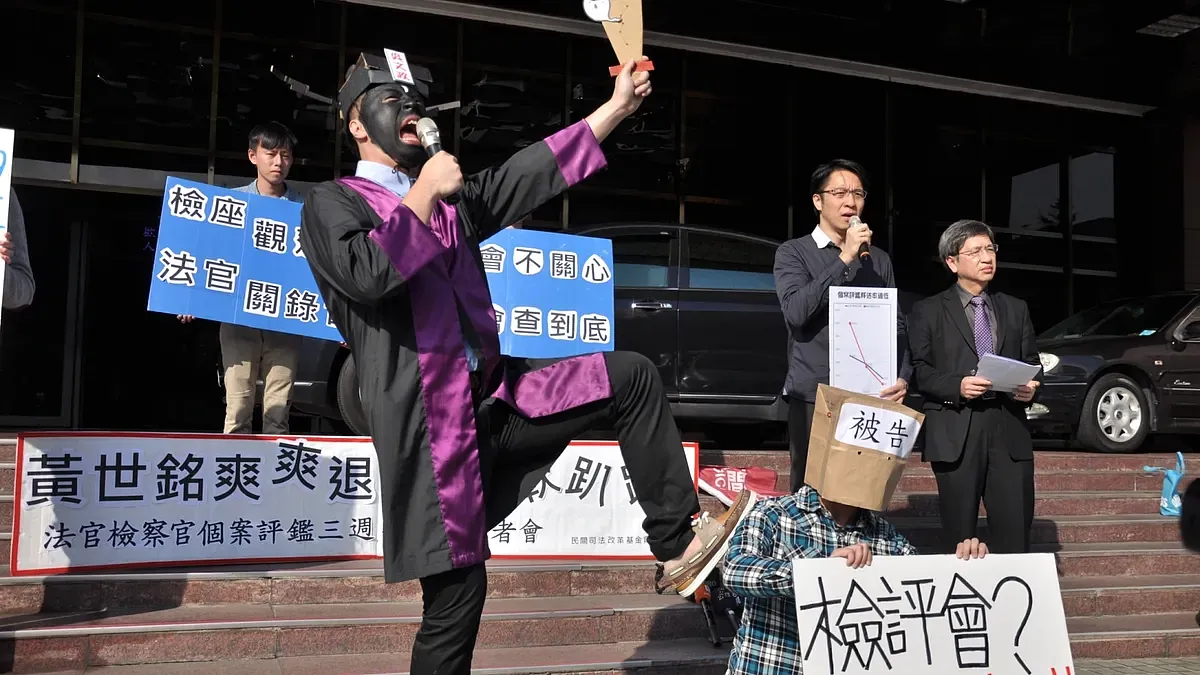
The Judicial Reform Foundation has established a Complaint Center to handle public reports against judges and prosecutors, with the aim of improving the professionalism and integrity of judicial personnel. This issue of the JRF e-paper shares an outrageous case involving a prosecutor who overstepped their authority, yet the Prosecutor Evaluation Commission dismissed the request for evaluation.
It has now been three years since the individual case evaluation system under the Judges Act was implemented on January 6, 2012, yet the path of evaluation remains arduous. For an analysis of the pros and cons, successes and failures of the case evaluation system's three-year anniversary, please see the JRF Complaint Center Work Report.
A Collision on a Pouring Rainy Night
In the early hours of June 30, amidst torrential rain, Mr. A was driving home when he collided with Ms. B, a pedestrian who suddenly rushed into the road. The injured Ms. B was rushed to the intensive care unit and transferred to a general ward two days later. On July 6, Ms. B took the initiative to contact Mr. A at the hospital to discuss a settlement and sign a Settlement Agreement. Mr. A's friend, C, was present as a witness during the signing. The Settlement Agreement stipulated that Ms. B would immediately accept a settlement payment of NT$66,000 and would no longer pursue civil claims or file criminal charges against Mr. A.
To Mr. A's astonishment and confusion, Ms. B subsequently filed a criminal complaint against him for negligent injury. This "negligent injury" case was handled by Prosecutor Chien of the Taiwan Taoyuan District Prosecutors Office.
The "Self-Righteous Bro" in the Investigation Hearing
During the investigation hearing, Ms. B told the prosecutor that she did not know at the time that it was a settlement agreement and settlement money. The prosecutor directly concluded that the settlement agreement signed in black and white by Mr. A and Ms. B was invalid, and on the spot coerced Mr. A into taking back the NT$66,000 settlement money he had already paid to Ms. B.
At that moment, Mr. A mustered the courage to ask the prosecutor, "Do I really have to take that money back?" (referring to the settlement money already paid to Ms. B). The prosecutor snapped back, saying that if he refused to take back the settlement money, they could help donate it out.
The prosecutor further stated: "In this situation, let me tell you! The court will not think that you have reached a settlement! I won't think you've reached a settlement either, because if there is a settlement, the court would feel that you are bullying the victim! . . . Now this money is yours, and if you don't take it back, if you don't take it, you just waive it!"
The prosecutor, possessed by the spirit of a self-righteous hero, did not ask Ms. B to seek civil remedies, did not investigate whether Ms. B was of sound mind at the time of signing the settlement agreement, and did not summon witness C to testify, but instead directly determined that the settlement was invalid! Furthermore, he had notified Ms. B in advance to bring the settlement funds to the hearing and ordered Mr. A to accept them on the spot.
The day after the hearing, the prosecutor indicted Mr. A for negligent injury.
The Core Issue
Regarding Prosecutor Chien's approach, JRF volunteer attorney Yang Shih-kang pointed out several flaws:
-
The Prosecutor Created the Dispute
The prosecutor's case progress record "prior to the hearing" stated: Because Ms. B filed a complaint in this case and it has entered the investigation procedure, in order to put an end to the dispute, please bring the NT$66,000 settlement money previously delivered by the defendant (Mr. A) to the hearing on the scheduled date.
From this, it is clear that returning the settlement funds during the hearing did not stem from the wishes of Ms. B or Mr. A, but rather from Prosecutor Chien's premeditated abuse of power to intervene in a civil dispute. If the prosecutor genuinely wished to "put an end to the dispute," he should have advised them to settle (resolve the dispute) rather than abusing his power to directly invalidate the legal effect of the settlement contract between the two parties (creating a dispute), arbitrarily interfering with private rights and creating further conflicts.
-
The Prosecutor Committed a Knowing Violation
During the hearing, Prosecutor Chien told Mr. A: "Whether you settle or not is a 'civil' matter, I don't care about that; what I am handling is whether you are criminally negligent or not"; "Civil, civil law is inherently separate from criminal law anyway! You may be innocent in criminal court, but you might still have to pay in civil court, and that is very common!"
Yet in the end, Prosecutor Chien himself determined that the settlement contract was not established, demanded on the spot that Mr. A take back the NT$66,000, and aggressively told Mr. A, "You guys simply haven't reached a settlement."
Doing what you know is legally prohibited—Prosecutor, are you alright?
-
The Prosecutor Overstepped Their Authority
A prosecutor's statutory duty is to investigate criminal cases in accordance with the law, specifically "investigating whether a defendant has committed a criminal offense." It is crystal clear that prosecutors have zero authority to intervene in determining the validity of a settlement contract between two parties, because settlement is a "civil matter."
Is there any legal authorization empowering prosecutors to intervene in the determination of civil settlements? Absolutely none! Even when this case later went to the Taiwan High Court for criminal appeal, the judgment explicitly noted: "...Whether there are grounds for revoking the settlement remains to be investigated and determined by a civil court; in accordance with the law, this court deems it inappropriate to make a direct determination at this time, which is hereby noted."
The self-righteous prosecutor was utterly slapped in the face by the judges of the Taiwan High Court's criminal division, making it appear exceptionally ironic.
The Evaluation Commission's Shielding
Regarding Prosecutor Chien's various actions that evidently overstepped his statutory investigative powers, the JRF requested an evaluation from the Prosecutor Evaluation Commission (PEC) on the grounds of violating Article 95, Paragraph 2 and Article 89, Paragraph 4, Subparagraph 2 of the Judges Act.
Regrettably, on October 27, 2014, the Prosecutor Evaluation Commission dismissed the JRF's request (103-Ying-Tzu Resolution No. 12 of the PEC). The PEC's reasoning was: "No evidence was found showing that the person subject to evaluation engaged in the aforementioned inappropriate interference with the private rights relationship of the parties, to the extent of affecting the sentencing of the subsequent presiding judge and seriously infringing upon Mr. A's rights and interests to receive a suspended sentence or a reduced prison term."
In plain English: Judging by the outcome, anyway, Prosecutor Chien's actions did not affect the court's sentencing of Mr. A, nor did they seriously impair Mr. A's rights and interests.
In the PEC's resolution, the issue of this prosecutor's abuse of power was completely unaddressed. Furthermore, Prosecutor Chien's act of forcing the revocation of the settlement directly influenced the court of first instance when determining guilt and sentencing, which explicitly stated in the judgment: "...the defendant denies the offense and has yet to reach a settlement with the complainant and compensate for the losses..."—thus stripping Mr. A of his right to a sentence reduction! The PEC's reasoning was clearly nothing more than an excuse to shield the prosecutor.
Volunteer attorney Yang Shih-kang stated with profound grief: When a prosecutor creates disputes, knowingly breaks the law, and oversteps their authority, the harm inflicted may only affect a specific defendant in a single case. However, when the Prosecutor Evaluation Commission turns a blind eye to a prosecutor who creates disputes, knowingly breaks the law, and oversteps their authority, it harms all the citizens who place their hope in the prosecutor evaluation system.
The Urgency of Systemic Reform
Reviewing the scorecard of the 2nd Prosecutor Evaluation Commission, 18 evaluation resolutions were rendered, among which 16 requests were dismissed as unfounded, amounting to an astonishing rejection rate of 89%.
An experience like Mr. A's is viewed by the PEC as a trivial matter not worth reviewing or punishing. The PEC's attitude undoubtedly pleases prosecutors greatly, leaving ordinary citizens to endlessly endure arbitrary and oppressive prosecutorial abuse of power. Such a PEC has deviated from the purpose for which the Judges Act established the individual case evaluation system, losing its function of monitoring and checking prosecutors.
On December 8, 2014, the Judiciary and Organic Laws and Statutes Committee of the Legislative Yuan reviewed the "Citizen Version of the Judges Act Amendment Draft." All reform demands raised by civil society were opposed to the end by the Judicial Yuan and the Ministry of Justice, leaving progressive reform a distant and uncertain prospect.
We solemnly call upon:
- Prosecutors to abide by legal regulations and conduct investigative actions within the scope of their statutory duties.
- The Prosecutor Evaluation Commission to earnestly fulfill its duty of supervision and evaluation, rather than turning a blind eye to flaws and shielding wrongdoers.
- Legislators to swiftly deliberate on the Citizen Version of the Judges Act Draft and reform the systemic ills of the current individual case evaluation mechanism.
Further Reading
This article is an AI-generated translation of the original Chinese text. In the event of any discrepancy, the Chinese version shall prevail.