
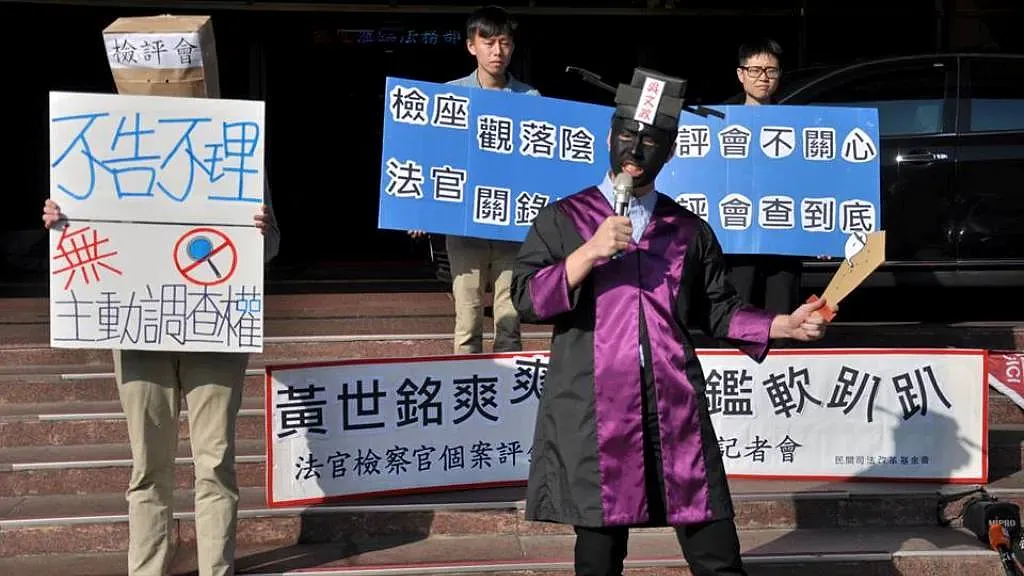
Don't Let Prosecutors Be Unhappy—The ProRAB Fails in Its Duties
Last edited: 2026-08-30
To gain a single man and lose a country, to embrace evil and abandon good, is no wise plan.
On October 27, 2014, the Prosecutor Reviewing and Attending Board (hereinafter referred to as the ProRAB) issued Resolution No. 12 of the 103rd Year (hereinafter referred to as the Evaluation Resolution) regarding the evaluated prosecutor Chien Tai-yu, stating that "no evidence was found of the evaluated prosecutor engaging in the aforementioned acts of improperly interfering with the private rights of the parties, thereby affecting the sentencing of the subsequently presiding judge and seriously infringing upon Mr. A's right to a suspended sentence or reduction of sentence." Consequently, the request for evaluation was decided to be unfounded. However, this evaluation resolution and its reasoning run counter to objective facts. If the ProRAB did not fail to review the case files and evidence amounting to a dereliction of duty, it is hard not to see it as having deliberately ignored the flaws out of favoritism and bias. The acts of Prosecutor Chien Tai-yu in improperly interfering with private rights and exceeding his authority in this case are detailed below:
The Prosecutor Created a Dispute
The case actually held two investigative hearings. Prior to the second hearing, Prosecutor Chien Tai-yu specifically recorded on the case progress sheet: "Note: As the complainant (i.e., Ms. B) has filed a complaint and entered the investigative procedure, to avoid controversy, please bring the settlement amount of NT$66,000 previously delivered by the defendant to the court on the day of the hearing." It can be seen that the return of the settlement funds in court did not originate from the intentions of Ms. B or Mr. A, but from Prosecutor Chien Tai-yu's premeditation. In other words, it is abundantly clear that the prosecutor actively intervened in and interfered with a private dispute. Furthermore, this interference with private rights was not directed toward counseling a settlement (resolving the dispute), but directly nullifying the validity of the settlement contract between the two parties (creating a dispute). The day after returning the settlement funds in court, Mr. A was indicted. The prosecutor's arbitrary interference with private rights bears unmistakable traces of deliberate manipulation. Regarding this, the ProRAB—composed of three prosecutors, one judge, three attorneys, and four scholars and public figures—did not utter a single word. If this was due to a failure to thoroughly review the case files and evidence, the ProRAB obviously enjoys the authority of investigation and evaluation while taking no substantive action, which constitutes a dereliction of duty. If this was a deliberate cover-up and thus turning a blind eye, it cannot be ruled out as an act of doing a favor and shielding wrongdoing. May we ask the members of the ProRAB: what is the reason for turning a blind eye?
The Prosecutor Acted Knowingly and Willfully
During the investigation, Prosecutor Chien Tai-yu repeatedly emphasized that civil and criminal matters are independent of each other, yet he stubbornly intervened in the civil dispute. As seen in the first investigative hearing on February 20, 2013, Prosecutor Chien Tai-yu explicitly stated: "Even if there really is a settlement and she hasn't withdrawn the complaint, for this crime subject to complaint, even if you guys really settled and she hasn't withdrawn the complaint, I still have to send it to the court according to the law!" In the second investigative hearing on March 14, 2013, he stated successively: "Whether to settle or not is a civil matter, I won't pay attention to you; what I'm dealing with is whether you are criminally negligent or not"; "Civil, civil matters are inherently separate from criminal law! You can be not guilty criminally while civilly you might have to compensate; these are very common!" In other words, Prosecutor Chien Tai-yu knew full well that civil settlement contracts cannot be assessed or recognized by criminal procedures. However, the case files, evidence, and transcripts objectively presented the prosecutor's hypocritical wrongdoing: Prosecutor Chien Tai-yu took the initiative to determine that the settlement contract was invalid and demanded in court that Mr. A take back the NT$66,000. When faced with Mr. A's questioning: "Isn't this related to civil matters?", "Must I take that money?", and "There was a settlement at the time", the prosecutor stated categorically: "You guys simply haven't reached a settlement," and even uttered contemptuous remarks such as "If you don't take it, waive it, or we'll donate it for you." In response, the ProRAB failed to hold the prosecutor accountable for his knowing and willful improper words and deeds. Instead, it whitewashed the situation by stating: "Because the complainant and the defendant did not fully understand whether a settlement was reached and the distinction between civil and criminal legal relations, leading them to repeatedly mention whether a settlement was reached and the settlement money...", exposing the ProRAB's willingness to use unique interpretive perspectives to excuse the prosecutor's misconduct for the sake of putting the matter to rest. The prosecutor acted knowingly and willfully, and the ProRAB is no less culpable.
The Prosecutor Exceeded His Authority
Article 47 of the Directions for Handling Criminal Litigation Cases by Prosecutorial Agencies provides: "When a prosecutor, ex officio or upon application, returns seized items or retained items, they should in principle be returned to the person entitled, but attention should be paid to reviewing the status of private rights in such items. If there is a dispute over private rights, the person applying for the return should follow statutory procedures to confirm the attribution of rights, and the prosecutor should not directly intervene in the determination of private rights (Article 142 of the Code of Criminal Procedure)." This explicitly stipulates that prosecutors shall not intervene in the determination of private rights when lawfully returning "seized or retained items." Conversely, upon what statutory authorization and provision did Prosecutor Chien Tai-yu rely when he demanded that the complainant Ms. B return the "settlement funds" while simultaneously intervening in the determination of private rights? If such conduct does not constitute exceeding authority, what kind of conduct ever would? The ProRAB first ignored the objective fact that the prosecutor indeed engaged in improper conduct, and further disregarded the fact that these actions had no basis in law whatsoever. It merely generalized that the investigative hearing on February 20, 2013 "showed no trace of exceeding authority," while completely avoiding any mention of the acts of exceeding authority during the investigative hearing on March 14, 2013. This was evidently a deliberate attempt to segment and interpret the events piecemeal, misplacing the focus of the evaluation review and giving irrelevant answers. Such vulgar and blatant tactics of downplaying the prosecutor's misconduct—turning major issues into minor ones and minor ones into nothing at all—are simply ironic. By contrast, the criminal second-instance judgment in this case specially added a note: "In addition, after the incident occurred, although the defendant previously wrote a settlement agreement with the complainant and paid the complainant NT$66,000, the complainant subsequently claimed that the settlement was a manifestation of intent made under the defendant's fraud, giving grounds for revocation, and returned the aforesaid NT$66,000 to the defendant. However, whether there are grounds for revoking this part of the settlement still awaits investigation and determination by the civil court. According to the law, this court should not prematurely make a determination, which is hereby noted." This makes the situation all the more ironic: three senior judges of the Criminal Division of the Taiwan High Court had no authority to determine the validity of the settlement contract, yet a prosecutor made such a determination during the investigative procedure? Comparing the two, ordinary citizens can easily see that the prosecutor's conduct has already "exceeded his authority," yet the eleven professional and senior members of the ProRAB deliberately used pretexts to let him off lightly, once again exploiting the prosecutor evaluation system and truly failing in their duties.
A prosecutor creating a dispute, acting knowingly and willfully, and exceeding his authority may only harm a specific defendant in an individual case. However, the ProRAB turning a blind eye to a prosecutor's creation of disputes, knowing and willful violations, and overreach harms all citizens who place their hopes in the prosecutor evaluation system. Prosecutor Chien Tai-yu's improper conduct is clearly objectionable, but Resolution No. 12 of the 103rd Year by the ProRAB is even more deeply disappointing. While the evaluation board may have the discretion to judge the severity of a prosecutor's disciplinary infractions, it certainly has no room for discretion regarding the mere existence or non-existence of a prosecutor's improper conduct. By defying objective facts to issue the aforementioned resolution—trading away the public credibility of the prosecutor evaluation system just to secure an outcome that exempts Prosecutor Chien Tai-yu from evaluation penalties—the ProRAB has lost the greater for the smaller and acted most unwisely. In summary, Resolution No. 12 of the 103rd Year by the ProRAB not only failed to perform the review function that the evaluation system ought to have, but also demonstrates that the ProRAB is derelict in its duties and bears unshirkable responsibility. Therefore, it is necessary to promote amendments to the Judges Act to allow more civic oversight forces to participate in the evaluation mechanism, so that the evaluation system can truly exert arousing and enlightening effects and move toward a more mature rule-of-law society.
Addendum: Prosecutors, Please Listen to Your Inner Voice
And Peter remembered the word of Jesus, which said unto him, Before the cock crow, thou shalt deny me thrice. And he went out, and wept bitterly.
Prosecutor Chien Tai-yu, your improper conduct in this case has been detailed above. Judging by the note on the case progress sheet, your subjective intent seemed to stem from the good intention of "avoiding controversy." However, your actions failed to produce the substantive benefit of pacifying the dispute. It truly makes one curious: did this kind of good intention stem from subjective arbitrariness, a misunderstanding of legal authorization, or the tradition of the working environment? This article suggests that only by tracing the root causes (by asking yourselves in your hearts, prosecutors) can we truly find the problem and seek remedies.
To take a step back, even if you, Prosecutor, interfered with private rights truly for the sake of quelling disputes, you clearly failed to fulfill your duty of investigation. According to the diagnosis certificate in the investigative file, Ms. B was admitted to the intensive care unit on June 30, 2012, transferred to a general ward on July 2, 2012, and the settlement agreement was signed on July 6, 2012. Looking solely at the timeline distribution, there is clearly room for doubt as to whether Ms. B signed the settlement while truly lacking clear consciousness. Moreover, since witnesses were present when the settlement was signed, you, Prosecutor, never summoned the key witnesses, and merely relied on two investigative hearings totaling approximately 30 minutes of questioning (which were not investigations directed at the settlement contract) to determine the validity of the settlement contract. Even setting aside the issue of exceeding authority for the moment, when your investigation was manifestly incomplete and you hastily jumped to conclusions while instructing the return of funds, were you not drifting further and further away from your initial intention of "avoiding controversy"?
The ProRAB's resolution is truly disappointing, and the public credibility of the prosecutor evaluation system has consequently vanished into thin air. Yet, viewed from another perspective, this also provides an opportunity for you, prosecutors, for self-reflection and rebirth. After all, we believe that the majority of judicial officers are conscientious and diligent, and none of us wishes to see individual cases bring shame upon all those who act with care and prudence. Therefore, we call upon you: prosecutors, please listen to your inner voice and do not repeat these mistakes; otherwise, we will inevitably meet again on the path of prosecutor evaluation.
This article is an AI-generated translation of the original Chinese text. In the event of any discrepancy, the Chinese version shall prevail.