
The Legitimacy of Prosecutors' "June 4 Sit-in"?
Last edited: 2026-07-27
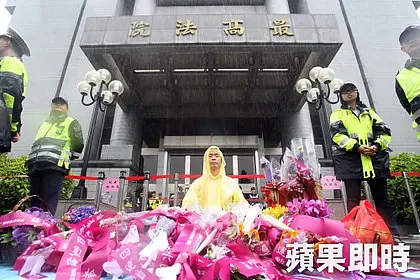
There are already many differing opinions regarding the criminal division resolutions of the Supreme Court. What this article is more willing to discuss is the issue of the legitimacy of Prosecutor Wu Hsun-lung's launching of the "June 4 sit-in" protest. Unable to conceal his disappointment, Prosecutor Wu wrote that, given the unreasonable attitude of some Supreme Court judges and their "what can you do to me?" stance, he decided to take further action to express his protest.
This is not child's play, nor should it be treated as such.
It is a major event for a prosecutor to personally appear in front of the court to sit in. This is no longer a matter of necessity regarding how prosecutors should choose actions in their "opposition" strategy (at the level of branch issues), but rather a matter of legitimacy regarding how constitutional power conflicts should strictly observe boundaries (at the fundamental level). Although it was emphasized that the sit-in protest was purely a personal action, Prosecutor Wu's speaking position and content, as well as the subsequent impact caused by prosecutors' righteous indignation, have made it difficult to separate the objective reality of whether he went to the court entrance to stage a sit-in protest in his personal name as "Wu Hsun-lung" or in the name of "Prosecutor Wu." In particular, it instigated over a thousand prosecutors to sign petitions in support. The so-called "Prosecutors' June 4 Movement," which aggregates the collective power of prosecutorial authority and applies social movement models to pressure the judicial power, is clearly not a private matter for a single individual.
Prosecutor Wu does not dispute that the separation of powers and checks and balances is a major principle of democratic rule of law; not only does the executive power require separation of powers and checks and balances, but the judicial power does as well. Prosecutorial power is a part of executive power, and continuous conflicts and contradictions between prosecutorial power and judicial power are necessary and difficult to avoid. According to the principle of ruling by law and the principle of the unity of state executive power, the only way to resolve conflicts and contradictions between state powers is to follow legal means under the constitutional system. This is vastly different from the fundamental rights guaranteed by the Constitution to individuals to resist infringements by unlawful public authority. Ignoring or failing to restrain the internal boundaries of state power, once boundaries are crossed, may seriously trigger a constitutional crisis. The "Central Science Park Phase II EIA Case," in which the Executive Yuan treated the final judgment of the Supreme Administrative Court as if it were nothing, is not a distant cautionary tale.
When prosecutors disagree with the legal interpretation of a Supreme Court resolution and actively step forward to stage a sit-in protest in front of the court, the severity of blurring the boundaries of power roles is essentially no different from the executive branch's passive disobedience of final judicial judgments. If Prosecutor Wu's sit-in protest is legitimate, not only should we not criticize the Environmental Protection Administration for refusing to comply with the Supreme Administrative Court's judgment, but we should even welcome the Minister of Environmental Protection going to the court entrance after work in a personal capacity to protest judicial injustice. Could other civil servants also follow suit?
Therefore, what must be seriously considered is: this may not be a trade-off regarding whether prosecutors have basic human rights and can use actions to express freedom of speech, but rather an issue of the misplacement of the constitutional system and professional ethics. Before sitting down, shouldn't one first stand firm and think about the legitimacy issue of this fundamental right and wrong?
※ This article is excerpted from "A Few Doubts Regarding the Legitimacy of Prosecutors' 'June 4 Sit-in'" by Lo Ping-ch'eng, published in full in Judicial Reform Magazine, Issue 90, published on June 30, 2012.
This article is an AI-generated translation of the original Chinese text. In the event of any discrepancy, the Chinese version shall prevail.