
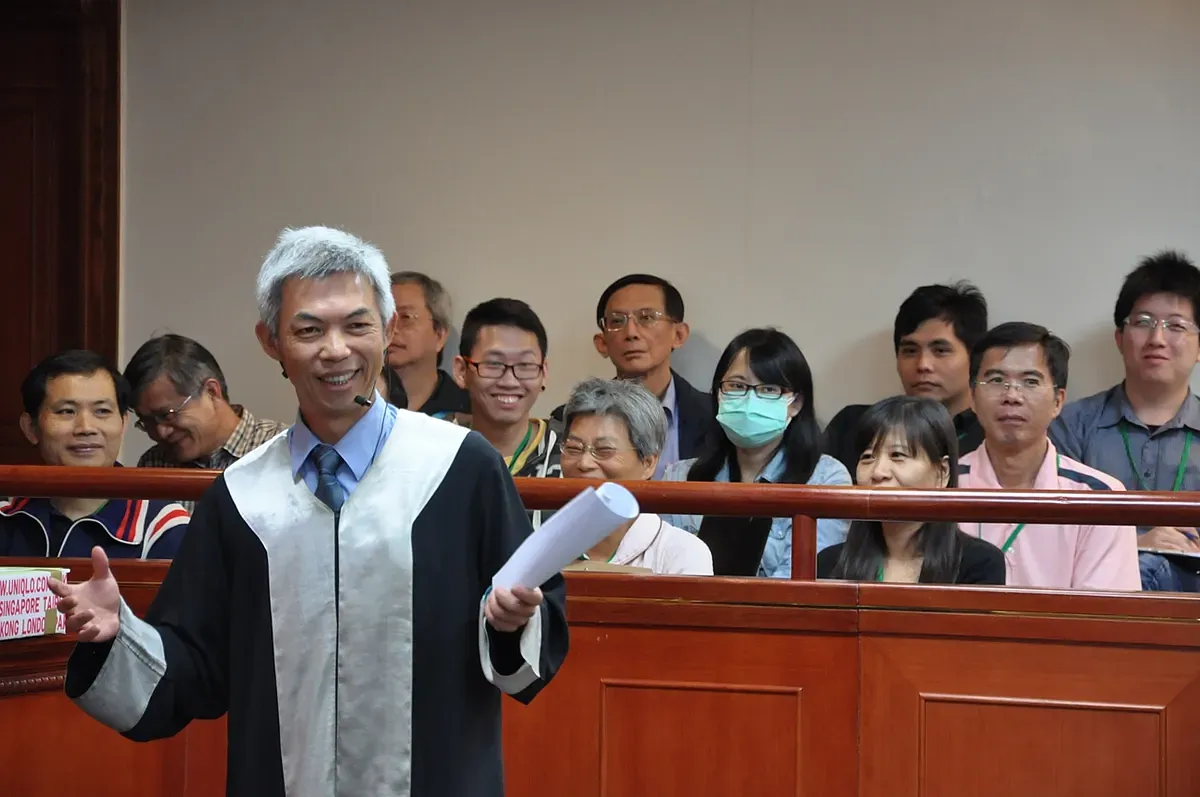
Deconstructing the Judicial Yuan's "Viewer-Judge System"
Last edited: 2026-08-30
When the Judicial Yuan's "viewer-judge system" fails to gain traction, its most common complaint against JRF is that we are "alarmist," having coined the catchy phrase: "They only let you watch, not let you judge; they let you speak, but what you say doesn't count." This phrase packs such a powerful punch that it has undermined public trust in the Judicial Yuan's policies, thereby hindering the rollout of the "viewer-judge system." However, this phrase was not coined by the JRF; rather, it was the takeaway shared by print journalists after visiting the Judicial Yuan's mock trials and comparing systems across various countries. We merely borrowed their success and used it as the headline for our press conference.
However, stating this is not an attempt to shirk responsibility, but rather a sincere reminder: had these two phrases not vividly pinpointed the problems inherent in the Judicial Yuan's "viewer-judge system," they likely would not have spread so widely. In this regard, the Judicial Yuan should display greater magnanimity in accepting criticism, give further thought to expanding the decision-making authority of citizens participating in trials, prepare appropriate supporting measures, and stop using "populist trials" to frighten the public. Only then will it act as a responsible administration.
Nevertheless, the flaws of the Judicial Yuan's "viewer-judge system" are not as simple as whether "the public has the right to vote." Below, we will discuss the goals set by the Judicial Yuan for implementing the "viewer-judge system" one by one. Furthermore, we will compare the jury system with the viewer-judge system, as the jury system sits at the opposite end of the spectrum and is the most suitable system to compare and discuss against the viewer-judge system. Finally, we will offer reflections on several common myths and criticisms to refine potential future discussions.
Clarifying the Purpose of the "Viewer-Judge System"
The Judicial Yuan naturally has certain objectives in promoting the "viewer-judge system." Its primary stated goal is to "clarify misunderstandings," meaning that because the public is too distant from the courts, participating in (observing) court trials will allow them to better understand the reality of judges' work. Second, it aims to "infuse" the legal sentiments of the general public into judgments, preventing too wide a gap between public opinion and judges' thinking. Third, it can foster reform within the current criminal procedure system. Finally, because public participation in the judiciary contributes to judicial democratization, it can help shape a civil society.
Generally speaking, the first point is a matter of course: simply by getting close to the courts, one will naturally gain a better understanding of them. This claim aligns with the poll we conducted in 2005, which showed that both citizens and lawyers hold a more positive impression as long as they have had actual contact with the courts. In short, while our courts may not measure up to the standards expected of a proper state under the rule of law, they are not nearly as terrible as the media and general public claim.
The second point is merely a matter of degree; the difference lies in whether the Judicial Yuan intends to grant citizens the right to vote and render verdicts, or whether it wishes to grant this power robustly or weakly. If robust, the public's voting outcome can directly bind the judges; if weak, the public's opinions serve merely as a reference for judges. Of course, there are also eclectic approaches, such as the one adopted in Japan, where any verdict of guilty or not guilty must simultaneously incorporate the opinions of both judges and citizens to be valid.
Regarding the third point, the Judicial Yuan's rhetoric conflates different things. We can hardly completely deny that the Judicial Yuan's objectives are entirely wrong; rather, the method adopted by the Judicial Yuan to promote the viewer-judge system was to "enact a separate law," motivated precisely by the desire to avoid amending any provisions of the Code of Criminal Procedure. Reaching today's impasse—where "some amendments are somewhat necessary"—looks more like the result of a struggle fought by legislators and civil society groups. In truth, we do not particularly care whether the Judicial Yuan, legislators, or civil society groups drive the amendment of the Code of Criminal Procedure. The key point is that public participation in trials must be accompanied by corresponding amendments; otherwise, it will spell disaster. As for the final point, public participation in the judiciary will naturally foster the formation of a rule-of-law society, though the degree of promotion will vary depending on the system adopted.
When comparing the jury system to the viewer-judge system, the jury system can achieve all four of these objectives much more effectively: What better way to understand the difficulties of being a judge than for citizens to adjudicate cases themselves? What better way to directly infuse the public's legal sentiments than through the public's own decisions? To enable citizens with absolutely no legal background to substantively conduct a trial, what system could possibly implement the exclusionary rule of evidence more effectively than the jury system? What system could better popularize, liven up, and centralize courtroom proceedings while simplifying lengthy, rambling judgments?
If the jury system can achieve the Judicial Yuan's desired objectives far better than the viewer-judge system, why does official authorities still forsake the former for the latter? The Judicial Yuan has advanced roughly three reasons. The first, most frequently cited argument is that using laypersons as judges is "unconstitutional"; unless the Constitution is amended, our judiciary is "restricted" to professional judges. The second is that it is incompatible with our legal culture and exceptionally difficult to reconcile. This argument implies that our legal system—particularly our criminal procedure system, modeled after Germany and Japan and adopting an inquisitorial system—fundamentally clashes with the adversarial nature of the jury system. The final point is that the jury system is too costly, and judicial resources are limited.
The first is the most frequently cited reason, yet it is also the most bogus and hardly requires exhaustive refutation; one need only look at how jury systems operate normally across Anglo-American nations to see that calling it unconstitutional is sheer deception. At worst, we could actually amend the Constitution—it is a matter of choice, not capability. The second point is worthy of thorough subsequent discussion. The third point, in our view, defies meaningful discussion. The reason is that if we look solely at a "single trial proceeding," the jury system is naturally costly; however, as everyone knows, it is impossible to convert all cases currently entering the court system entirely to a jury system—screening mechanisms will inevitably be applied. Therefore, such a comparison is entirely meaningless.
Furthermore, the Judicial Yuan has never conducted empirical research on how many judicial resources introducing a jury system would actually add. Above all, financial cost is not the primary concern; the jury system possesses unique functions and benchmark value. If it can truly optimize the aforementioned four objectives, and if the government spends a bit more money to genuinely elevate judicial quality and human rights protections while burnishing its governance achievements, why wouldn't we welcome it? Money has a price, but justice is priceless, isn't it?

Taiwan Has Long Walked the Path of the "Jury System"
Accordingly, the point most worthy of careful discussion is the second: Is introducing a jury system truly incompatible with our legal system? Let us state our conclusion first. In fact, ever since our country substantially amended the Code of Criminal Procedure in 2003 to introduce an "eclectic adversarial system," we had already taken a major step forward toward a litigation framework centered around the "jury system."
After 2003, we began to embrace the concept of "evidentiary capability" and adopted the rule excluding illegally obtained evidence. Although somewhat of a chimera, we also began practicing the "cross-examination" system and gradually demanded that prosecutors fulfill their burden of proof. Even judges who lived through different eras—those accustomed primarily to written dossier reviews versus those practicing cross-examination—unanimously agree that summoning witnesses to court is indeed more conducive to uncovering the truth and safeguarding judicial human rights.
We had already preliminarily introduced an "adversarial" litigation system, hoping that during trials, the confrontation between prosecutors and defense counsel would allow judges to retreat to the second line, avoiding frequent outbursts of anger and steering clear of suspicions that they are acting as both players and referees. This allows the court, at least in form, to gradually manifest the "appearance" of "fairness."
In fact, even in Anglo-American nations that employ jury trials, adjudications by professional judges still account for the vast majority. Rather than raising alarms and claiming that introducing a jury system would be "incompatible" with our legal system, it is more accurate to say that these countries adopt a "dual-track system," and Taiwan would merely be introducing another "possibility of institutional choice." In particular, if citizens possess the "right to choose procedure"—opting for professional judges to adjudicate if they wish, or turning to a jury if they distrust professional judges—with both tracks running concurrently, who could claim that this would "clash" with the original legal system?
The true, major impact of implementing a jury system would be to trigger a different ideological "paradigm shift" within our criminal procedure system. Only by implementing measures designed to prevent the jury's mental impressions from being tainted—such as the "single charge sheet principle" (dossier separation), the exclusionary rule of evidence, and the presiding judge's authority to rule on objections—can one truly realize how badly contaminated a judge's mental impressions already are under the system of dossier transmission. Judges are human beings, and the institutional requirements and protections we demand to keep a jury's mental impressions untainted should likewise be extended to judges. Otherwise, demanding that judges remain neutral and emotionless is merely asking them to act as saints devoid of human passions. Perhaps someone out there can manage it, but they are a minority.
Moreover, the fact that jury trials necessitate continuous trial sessions allows the judiciary to genuinely experience the profound gravity of delayed proceedings. Needless to say, after experiencing the meticulous adjudication of jury trials, we would no longer have to witness the absurd spectacle of higher courts casually overturning lower courts' factual determinations after many years.
Most importantly, to enable juries lacking legal expertise to understand, deliberate, and render verdicts, the constituent elements of criminal offenses must inevitably be amended to be more precise and comprehensible (ah—isn't this precisely what the principle of "statutory clarity of penalties" demands?), and the criminal procedure must likewise become more plain-language and fluent (doesn't this precisely promote legal education and civil society?). Needless to say, trial proceedings must be "for real," rather than resembling the current mutual collusion that "truly makes a mockery (of the people)."
Of course, we are not naive enough to believe that introducing a jury system will solve all of our country's judicial problems. Although juries render verdicts under the jury system, judges—who control the proceedings—still exert considerable influence over the jury. This also means that the caliber of judges will remain the decisive factor in the success or failure of the judiciary.
Meanwhile, the heightened costs driven by the meticulous adjudication of jury trials must be supplemented by supporting measures such as plea bargaining, legal aid, and high-quality legal defense. We must emphasize that even if the "viewer-judge system" is viewed merely as an "experiment," its current design amounts to nothing more than a tasteless experimental setup—halfhearted, indecisive, timid, lacking in overarching vision, and devoid of a central ideology. It fails to move the public.
If one wishes to reap the fine reputation of judicial reform while demanding a process that saves time, trouble, and effort, how can there be such a thing as a free lunch in this world? If the Judicial Yuan truly believes that a "system of public participation in trials" is an inevitable trend, it should boldly introduce and simulate various nations' systems, followed by careful evaluation and responsible policy decisions. Empty rhetoric claiming that "every system has its pros and cons," while refusing to even attempt comparisons and simulations of the pros and cons of various systems, only deepens the public impression that the viewer-judge system is merely a mediocre treasure cherished out of bias, too cowardly to step into the ring.
This article is an AI-generated translation of the original Chinese text. In the event of any discrepancy, the Chinese version shall prevail.