
Lay Participation in Trials Should Not Be Reduced to People Watching a Play: The Judicial Yuan’s Version of the "Lay Assessor System" Requires Reconsideration
Last edited: 2026-07-27
This Wednesday (the 31st), the Legislative Yuan will deliberate on the Draft Regulations for the Trial Implementation of Lay Assessor System. If forced to stretch the definition, one might barely call it a "system of lay participation in trials," but strictly speaking, it hardly qualifies at all. Analyzing it from different angles reveals its true nature.
Lay Jury, Lay Assessor, Lay Observer: Mixing Up the Systems
Systems of lay participation in trials can be broadly categorized, based on the depth of public intervention, into the jury system implemented in Anglo-American jurisdictions and the lay assessor system (Schöffengericht) implemented in Germany and Japan. The lay assessor system currently promoted by Taiwan's Judicial Yuan has a slight blended flavor, but the degree of public intervention is the weakest of all.
Under the jury system, laypeople form a jury to render judgments, and verdicts of guilty or not guilty are directly decided entirely by the public. Within the jury system, judges can only preside over the trial proceedings and determine the sentence after the jury has found the defendant guilty. The seats of the jury and the judge are completely separated, and deliberations cannot mutually interfere. This design is intended to achieve the separation of powers and mutual checks and balances.
The lay assessor system implemented in Germany and Japan is a slight compromise, where the antagonism between the public and judges is relatively low. This is because, compared to Anglo-American countries, the publics in Germany and Japan deeply trust professional judges—a point that differs significantly from our country. Consequently, they do not mind a complete lack of strict segregation between judges and the public, nor is it strictly necessary to design a mechanism for the separation of powers and checks and balances. Thus, unlike the jury system, it does not strictly prohibit judges from interfering with or influencing the independent judgment of lay assessors.
Taking Japan's "saibanin" (lay judge) system as an example, the public and judges not only sit together in the courtroom but can also discuss the case together. However, because legally untrained citizens trust judges, their thinking is easily led by the nose by the judges. Nevertheless, lay assessors at least enjoy the right to vote; therefore, in rare cases where a judge cannot persuade the lay assessors, the lay assessors can still use their voting power to overturn the judge's view.
Of course, Japanese citizens actually rarely challenge court judgments (in reality, they rarely challenge authority at all), and the general public feels alienated from the judiciary (which is quite similar to us). The purpose of Japan's implementation of the saibanin system is not to curb "dinosaur judges" (judges detached from societal norms), but rather to "promote legal education" through this means and narrow the distance between the judiciary and the public.
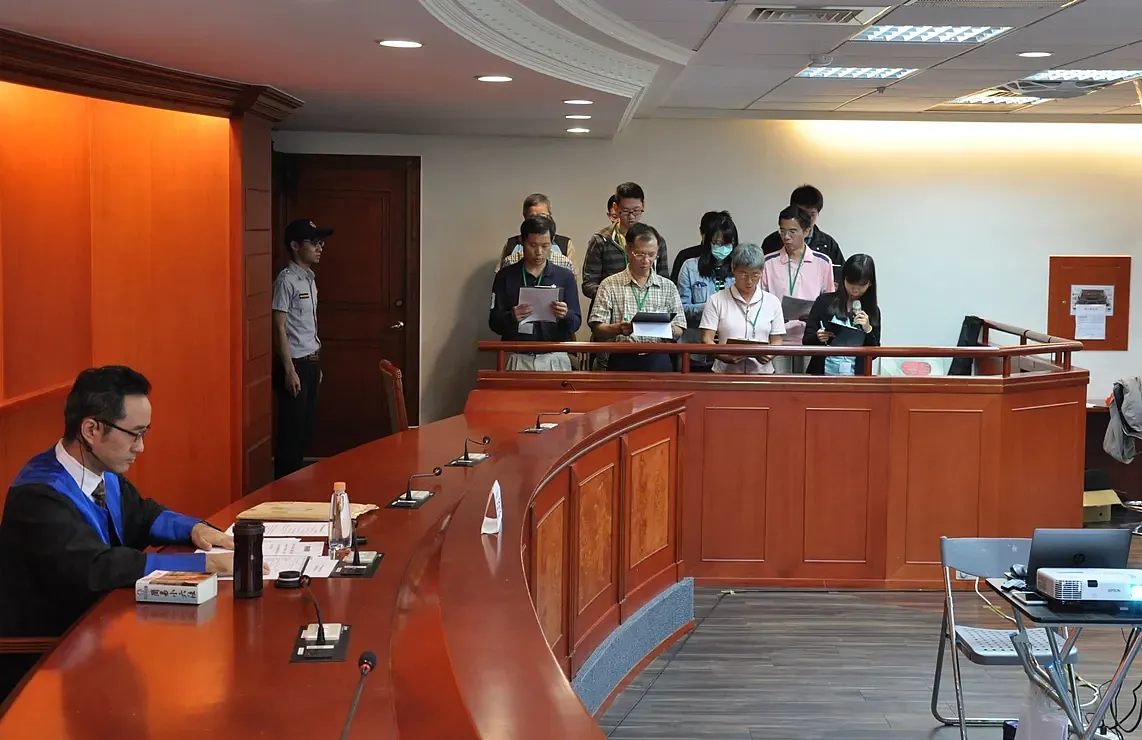
The lay assessor system that Taiwan's Judicial Yuan intends to promote this time is the "weakest" design on the spectrum. The citizens participating in the trial have no voting power. Although they can speak and express opinions, these are merely provided for the judge's "reference." Given the extreme distrust of judges among our citizens, we ought to have adopted the Anglo-American "jury system" to check and balance judges through the separation of powers. In fact, the Judicial Yuan's planning still allows judges to retain nearly complete control; fundamentally, it is a system design that shows "zero sincerity."
Such a system cannot bring judicial judgments closer to public opinion. Because the lay assessor system retains the approach of the Japanese saibanin system—allowing judges and citizens to sit and deliberate together—it effectively preserves the opportunity for judges to influence the public. Since the judges' powers are not weakened, when judgments fail to align with public opinion, they are not necessarily challenged and rejected by the public. The Judicial Yuan's lay assessor system lacks sincerity. This is the main reason why many civil society groups oppose the lay assessor system.
The Judicial Yuan Unwilling to Shed Authority: The Public Has Only the Right to Voice Opinions, Not the Right to Vote
Another problem triggered by the lay assessor system is that citizens spend a vast amount of time coming to court only to "glance at flowers while on horseback" (merely going through the motions), without substantially participating in the trial. The Judicial Yuan states: "From start to finish, right and wrong—let the people have their say!" The reality is: no matter what the public thinks or says, if it differs from the judge's view, it is simply met with a polite "thank you for your feedback."Our country's lay assessor system is uniquely created in the world, patched together by referencing various nations. From the Judicial Yuan's website, one can see official self-praise trumpeting how the system is "tailored to our national conditions" and grants citizens the rights to question defendants and witnesses and to interact with judges. But when all is said and done, having only the right to express opinions without the voting power to decide means the assumption is that citizens lack the capability and literacy to conduct trials alongside judges.
Citizens can interact and discuss with judges, yet cannot participate in the final trial decision. Could it be that realizing popular sovereignty and democratizing the judiciary is merely using the lay assessor system to quench thirst with dried plums? The typical argument for denying citizens the power to adjudicate claims that the voting right violates Article 80 of the Constitution, which establishes the principle that "judges shall try cases independently in accordance with law." However, the "people" in a system of lay participation in trials are "lay judges," and the Constitution does not state that judges must exclusively be professional jurists. Does this mean countries implementing jury systems do not have judges trying cases independently?
For lay participation in trials to truly have meaning, we must believe that the public possesses the ability to distinguish right from wrong and are self-responsible individuals. Various opposing arguments are invariably wrapped in a thick atmosphere of elitism. On the surface, this assumes that the public is easily swayed by social public opinion into populism. On a deeper level, it reflects an inability to break free from authority—the mindset that higher official rank equates to greater knowledge. Without first becoming an official, are individuals truly unqualified to resolve disputes?
Please Approach Policy with a Responsible Attitude: The Judicial Yuan Should Not Rush to Pass the Lay Assessor System
This mindset often reflects what is criticized about certain judges: standing high above, unable to connect with the sentiments of the people. Isn't this precisely why we wish to introduce laypersons? Systems in various countries have their pros and cons; combining their strengths is human nature. A makeshift vehicle is not entirely unacceptable, provided it runs smoothly. Lay participation in trials is a direction worth striving for and represents a major judicial reform. For the Judicial Yuan to rush its implementation simply to claim political achievements is truly alarming.
Trial implementation creates a "one country, two systems" scenario (Editor's note: The Judicial Yuan selected the Shilin and Chiayi District Courts for pilot testing). The scope of application is limited solely to serious crimes, yet the Yuan is completely unwilling to grant citizens the right to choose procedures, treating the public essentially as guinea pigs in an experiment. Furthermore, even during the stage of operating mock trials, it "exclusively honors" the lay assessor system while "dethroning" other systems, completely turning a deaf ear to the Legislative Yuan's moderate suggestion to "please try out other versions as well."
The public may find it hard to believe that after holding only a few mock trials where everyone is still groping in the dark (with the vast majority of courts remaining completely inactive), the Judicial Yuan is rushing to have such a monumental bill submitted and passed. The problem with the lay assessor system is that the Judicial Yuan still harbors deep distrust toward the public, unilaterally increasing the burden on judges. In the end, the public gets only a superficial taste ending in frustration, while judges face heavier workloads and complaints abound. Public trust in the judiciary remains unimproved, yet the banner of lay participation in trials has been stigmatized by the Judicial Yuan.
This article is an AI-generated translation of the original Chinese text. In the event of any discrepancy, the Chinese version shall prevail.