
JRF Newsletter
The Presumption of Innocence That Cannot Leave the Classroom—Court Observation of Hsu Tzu-chiang's 9th Remand Trial
Last edited: 2026-08-30
Dear Friends,
Ten years ago, the Hsu Tzu-chiang case successfully reopened following the delivery of Judicial Yuan Interpretation No. 582.
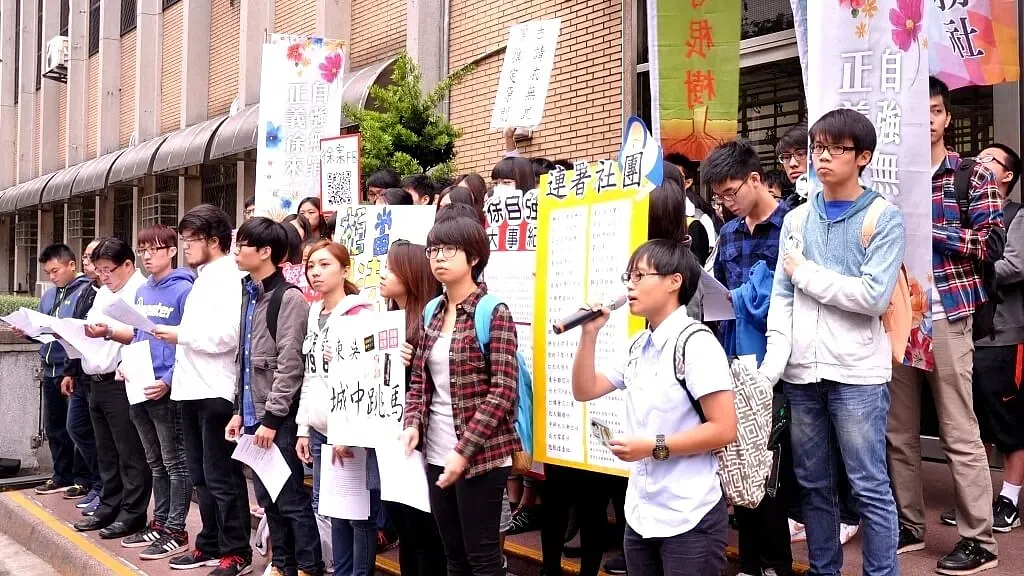
Ten years later, on Wednesday, November 12, Hsu Tzu-chiang's 9th remand trial was held. Student associations supporting Hsu also held a press conference at 9 a.m. that day, calling on the judiciary to bravely render a judgment based on the presumption of innocence. This issue of the JRF e-newsletter shares a volunteer's court observation reflections. On Tuesday, December 23, at 2:20 p.m., the preparatory proceedings for Hsu's 9th remand trial will be held once again. Furthermore, we will host a symposium marking the 10th anniversary of Interpretation No. 582 on Saturday, December 27. We invite friends who care about judicial reform to join us.
On Wednesday, November 12, Hsu Tzu-chiang's 9th remand trial was held, and we held a press conference at 9 a.m. that morning to show our support for Hsu Tzu-chiang. Carrying the banner of Soochow University's Downtown Campus Vaulting Horse Club, we walked to the High Court's criminal court building. Looking around without catching a glimpse of A-chiang, I felt a minor sense of disappointment, as I had originally hoped to give him an encouraging hug before the trial. A massive tour bus came into view—the Providence University Legal Aid Club, who had rushed all the way from Taichung through wind and dust, had arrived. Seeing them step off the bus one by one made my eyes sting with warmth. Just one week before midterms, having a whole tour bus full of people travel from Taichung to Taipei for court observation filled me with deep admiration and emotion.
After the press conference, we entered the courtroom and looked at A-chiang's face as he sat in the defendant's seat. Seeing A-chiang smile happily, I couldn't help but smile along with him. I figured he must have felt the warmth being transmitted to everyone. I then looked ahead toward the judges' bench. It was so far away from the public seating area, so high and mighty. Our judiciary, and the justice we look forward to, remain so out of reach and lofty for A-chiang and for everyone—resembling a stubborn, towering wall standing right before us.
The trial began. The bailiff shouted in a resonant and imposing voice, "All rise," and the judges entered the bench and took their seats. The judges followed procedure by asking A-chiang for his personal details, the crime he was charged with, and so on. The judge asked A-chiang: "Hsu Tzu-chiang, why are you appealing?" A-chiang replied in a somewhat faint voice: "Because I didn't do it." Hearing A-chiang's voice, I suddenly realized that no matter how many years one spends as a defendant, and no matter how many people support him, nothing can erase the inner fear of the judiciary and wrongful imprisonment, nor the habit of getting used to being wronged. Standing beneath the massive judicial system, we are all as small and fragile as specks of dust.
The judge invited defense counsel to begin presenting arguments. Attorney Lin Yung-sung (林永頌) laid out the doubts in the case, the favorable evidence investigated, and even Interpretation No. 582 almost entirely and completely from beginning to end. The presiding judge rested his chin in his hand and listened quietly, occasionally whispering to the accompanying judge sitting next to him, while the prosecutor across from them frowned and occasionally lowered their head to flip through the case files.
Next, Huang Chun-chi (黃春祺), sitting in the witness stand, took the floor. The judge likewise first asked for his personal details, and then asked him: "Huang Chun-chi, are you willing to testify today and take an oath?" Huang Chun-chi replied in an almost inaudible voice: "I am not willing." Although his refusal to testify was not unexpected, my tiny hope shattered along with his words. At that moment, Attorney Lin Yung-sung asked him: "Then are you willing to make a statement regarding the part where you were tortured?" A glimmer of hope immediately ignited in my heart; if he were willing to testify about the torture, then the admissibility of his previous confession would be called into question. Yet he still shook his head and whispered softly: "I am not willing." My heart was once again doused with cold water.
Finally, the lawyer requested the judge to summon three witnesses, and the prosecutor spoke up. The prosecutor stated: "Your Honor, I have a few points to add. Regarding the witnesses requested by the lead attorney, two have already appeared in court to testify. Pursuant to Article 196 of the Code of Criminal Procedure, is there no necessity to summon witnesses once again? Furthermore, regarding the examination of the defendant Hsu Tzu-chiang's self-submitted mobile phone, there are doubts regarding its admissibility. How can it be proven that this mobile phone, kept by Hsu Tzu-chiang himself, is indeed the phone he used at the time? Please consider its admissibility, Your Honor. Additionally, in the defendant Huang Chun-chi's mobile phone which was seized and sent for appraisal, the identification showed Hsu Tzu-chiang's pager number; please pay attention to this point, Your Honor. Moreover, regarding whether this appraisal complies with the provisions of Article 206 of the Code of Criminal Procedure, please also take it into discretion, Your Honor." The accompanying judge replied to her: "Regarding the mobile phone, we will ask the appraisal agency to clearly investigate what the number displaying Hsu Tzu-chiang on the screen represents. Once the appraisal results come out, we will ask defense counsel to come review the case files." Finally, the presiding judge announced that the case was pending further instructions and that the trial would be resumed on another day. From start to finish, this trial hearing lasted a mere forty minutes. It left behind a sense of emptiness and powerlessness.
After the trial concluded, we returned to Soochow University for the post-trial debriefing session. The JRF executive director asked if anyone had questions, and a few of them left a deep impression on me. A classmate asked: "Shouldn't there be a presumption of innocence? Why did it seem today in court as though we had to present evidence of A-chiang's innocence? Why does a defendant need to prove their own innocence?" Another classmate asked: "Why did the prosecutor remind the judge about the application of legal provisions? Isn't that something the prosecutor shouldn't be doing?" The executive director gave everyone a very realistic yet helpless response: "Yes, strange isn't it? But this is legal practice—our judicial practice. Judges act more like prosecutors, actively investigating cases, while prosecutors act more like judges, passively hearing trials." Attorney Lin Yung-sung also responded: "I have encountered clients who understood the law quite well, and they would all ask me, 'Isn't there a principle of presumption of innocence? Why do I still have to keep finding evidence to prove my innocence?' I would answer them that legal practice is all about the presumption of guilt; the presumption of innocence is something found in textbooks."
Indeed, In such a chaotic judicial system incapable of introspection, judges play the role of prosecutors, and the presumption of innocence remains a principle that cannot step out of the classroom. Even so, we must still carry hope and strive forward, just as Professor Hu Po-yen (胡博硯) said at the conclusion: "The last press conference for Su Chien-ho's (蘇建和) acquittal was held here at Soochow, and we hope that next time it will be A-chiang's turn to hold a press conference for his acquittal right here!"
Hsu Tzu-chiang, innocent!
This article is an AI-generated translation of the original Chinese text. In the event of any discrepancy, the Chinese version shall prevail.