
JRF Newsletter
Why Do Evidences Lie? — DNA Testing Errors in the Chiang Kuo-ching Case
Last edited: 2026-08-30
Dear friends:
October 10 is National Day, and it is also the birthday of Chiang Kuo-ching.
However, Chiang Kuo-ching was born on National Day, yet died at the hands of the state. Significant errors occurred during the forensic identification in this case; however, not a single one of the erroneous testing agencies or personnel was held accountable, nor were any corrective measures adopted. Although Chiang Kuo-ching's innocence has been recognized, his name has yet to be fully vindicated. We demand that the state courageously confront its mistakes and pursue both criminal and civil liability for the unlawful and derelict military officers.
On the eve of National Day, please review and continue to follow the Chiang Case with us. The Chiang Case is not yet over…
The primary argument underlying the judgment that wrongfully convicted Chiang Kuo-ching of sexual assault and murder—ultimately resulting in his execution—was none other than Identification Report No. (85) Kuo-Chun-I-Chien-Tzu 85-04 issued by the Forensic Science Center of the Ministry of National Defense's Military Law Bureau, along with the Investigation Notification No. (85) Lu-(4) 85208534 dated October 7, 1996, issued by the Investigation Bureau of the Ministry of Justice, which was cited in the aforementioned report. These documents served as critical evidence relied upon by the military court at the time to wrongfully convict Chiang Kuo-ching and sentence him to death.
Is the Chiang Kuo-ching Case a Paradigm of Scientific Investigation?
A polygraph expert from the Investigation Bureau stated: "In the rape and murder case of the young girl at the Air Force Operations Command, the Air Force Headquarters sent four suspects for testing. Through polygraph testing, I eliminated three of them, and the remaining one showed deceptive responses—he indeed turned out to be the killer!" Facts have proven that the person identified as a liar by the polygraph expert of the Investigation Bureau—Chiang Kuo-ching—was actually an innocent person who was wrongfully executed. If the application of polygraph testing is unrestrained, it will become an assassin of human rights.
Why Was Chiang Kuo-ching Tortured?
Polygraph testing, combined with forensic medicine and semen DNA evidence, marked the beginning of Chiang Kuo-ching's nightmare. September 30, 1996, was a critical day. According to the Control Yuan's corrective measure document, intensive interrogation began starting on September 30, 1996. On that day, Chiang Kuo-ching failed the polygraph test, which was also the date the forensic identification report was issued.
The Control Yuan's corrective measure document on the Chiang Kuo-ching case noted: "...Until he was transferred to the Investigation Bureau of the Ministry of Justice for a polygraph test on the 30th of the same month, which showed an emotional fluctuation response, Li Fu-kuo of the Investigation Bureau of the Ministry of Justice identified it as deception, and that the soldier Chiang was implicated. Intensive interrogation by the counterintelligence team thus commenced on the exact same day...."
Fatal Scientific Evidence
- Polygraph Evidence: As mentioned in the previous paragraph, only four suspects were tested, and Chiang Kuo-ching happened to be the one who failed the test, leading to his subsequent intensive interrogation.
- Semen Evidence: The Investigation Bureau identified semen from blood stains on a tissue paper, yet used a "blood" testing reagent to test for "semen." This was evidently an identification conducted using incorrect testing methods.
- The Investigation Bureau examiners and others used the "anti-human hemoglobin serum passive cutaneous anaphylaxis test" or "anti-human hemoglobin serum immunoprecipitation assay" to confirm semen stains; however, this assay is a method used to determine whether bloodstains are human blood, rather than a method for identifying semen.
- The correlation between using blood testing reagents to test for semen and the result of wrongful execution: The Air Force Operations Command judgment stated that the defendant wiped the victim's lower body with tissue paper during the act, resulting in stains containing the victim's blood and the defendant's semen, which matched the characteristics of Exhibit 11-1 bearing blood wipe marks. This result is certainly unsurprising, because testing bloodstains for semen with a blood testing reagent will forever yield a positive reaction.
- Result of the Investigation Bureau's identification report: "The mixed DNA profile presented by Exhibit 11-1 includes the victim's DNA and the profile of suspect '18J'." Facts have proven, as shown in the figure below, that the specimen was neither semen nor did it match Chiang Kuo-ching's profile.
- Forensic Evidence:
DQα
LDLR
GYPA
HBGG
D7S8
GC
Victim
3,3
BB
AA
BB
AA
AB
Exhibit (11-1)
1.1,3,4
BB
AB
AB
AB
ABC
Suspect (18J)
4,4
BB
AA
AB
AB
AC
- The forensic identification report endorsed the Investigation Bureau's finding that the tissue paper contained Chiang Kuo-ching's semen (cited in the September 30, 1996 forensic report and the October 7, 1996 Investigation Bureau test notification).
- Where is the bizarre murder weapon? Preliminary results from the external examination and autopsy showed no stab wounds, yet the forensic report featured a murder weapon despite the absence of stab wounds, ultimately forcing the identification of the murder weapon as a "blade-shaped blunt foreign object." Was it truly hard to be a forensic pathologist, or were things being made hard for the forensic pathologists?
Presidential Outrage? Official Indifference?
On January 29, 2011, media reported on the wrongful execution case of Chiang Kuo-ching. President Ma Ying-jeou demanded: "Conduct a comprehensive review, do not fear exposing our dirty linen in public, and absolutely do not allow a miscarriage of justice like this to happen again." However, the military legal personnel who tortured Chiang Kuo-ching have already left office or retired, and the identification agencies at the time—the Forensic Science Center of the Ministry of National Defense and the Investigation Bureau of the Ministry of Justice—along with those who provided the aforementioned pseudoscience evidence, currently hold prominent positions. If no review and reform are undertaken, how can we prevent another miscarriage of justice from recurring under the same testing personnel, the same testing methods, and the same analytical logic, even if the temporal and spatial environments differ? If pseudoscience evidence is not eradicated, you and I could both appear in the next tragedy.
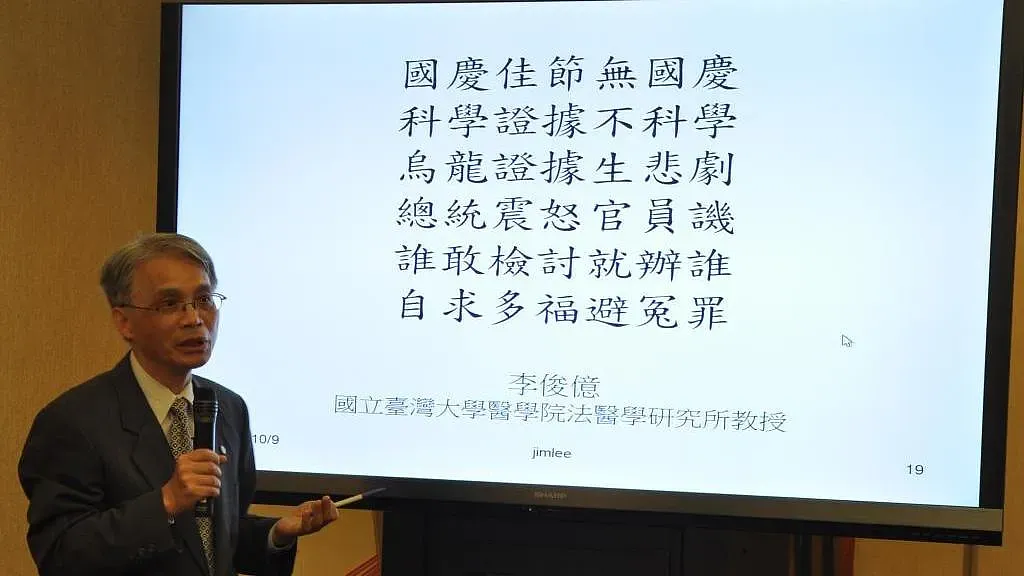
※ This article is compiled from the remarks by Professor Li Chün-i (Graduate Institute of Forensic Medicine, College of Medicine, National Taiwan University) at the "Why Do Evidences Lie? Press Conference"
This article is an AI-generated translation of the original Chinese text. In the event of any discrepancy, the Chinese version shall prevail.