

JRF Newsletter
Filing Grievances Against Judges and Prosecutors, Wrongful Conviction Rescue Series: Judicial Bullying of the Vulnerable and Reform Need Your Support
Last edited: 2026-11-03
Injustice anywhere is a threat to justice everywhere.
An elderly woman with white hair sat right in the middle of the courtroom, staring at the "Motion to Withdraw Appeal" on the table. It was handed to her by the judge as soon as the court session began. The case number and her name had already been filled in, and circles were carefully drawn in the blank spaces where the judge instructed her to sign and date. The summary court had sentenced the elderly woman to 20 days of detention on the grounds of embezzling a water heater and a washing machine. She had no idea why taking back things she had used for many years constituted a crime. Full of hope, she filed an appeal, seeking only to redress the injustice, but she never expected that at the very first court session, the judge's first words would be to demand that she withdraw her appeal. Terrified, she could only shake her head, and shake her head again. She no longer remembered how the court session ended, but the judge's parting remark, "Then I don't care about you anymore!," left an unforgettable impression on her1.
When a social worker referred the elderly woman to JRF, everyone who heard about it was filled with indignation. In a clearly controversial case, the judge did not even bother to investigate, apparently coaxing and deceiving a vulnerable defendant into withdrawing her appeal simply to reduce their workload. If the person appearing in court were a high-ranking official or noble, would the judge still dare to do this? A case considered insignificant in the eyes of a judge can have a severe impact on an individual. The elderly woman, who was originally eligible to apply for a national ID card, lost her qualification. At 70 years old, she has no low-income subsidy, no pension, no health insurance, and no housing. The only way to help her is to file a motion for a retrial to overturn the guilty verdict. Over the three years since the implementation of the Judges Act, JRF has filed numerous similar individual evaluation cases and successfully disciplined a few judges2, yet these actions still seem hard-pressed to shake deep-seated judicial malpractice.
On July 3 of this year, the white-haired elderly woman returned to the same courtroom, but she was no longer alone. This time, she was accompanied by pro bono lawyers, and more than a dozen volunteers sat behind her to conduct court observation. The presiding judge was no longer indifferent; instead, they conducted a careful inquiry and listened attentively, allowing the elderly woman to experience what justice ought to look like. A month later, the ruling initiating a retrial was delivered to the elderly woman, and she wept with joy3. A 20-day detention, converted into a fine, amounts to no more than 20,000 NTD. Simply for the pro bono lawyers to register with the Keelung Bar Association and pay the fees for this case cost more than 20,000 NTD, not to mention JRF's administrative costs. The scale of a case has never been our standard for deciding whether to provide assistance. Wrongful convictions and unsuited judges or prosecutors are two sides of the same coin. To nip problems in the bud, minor injustices suffered by the people should be treated as major matters by the judiciary.
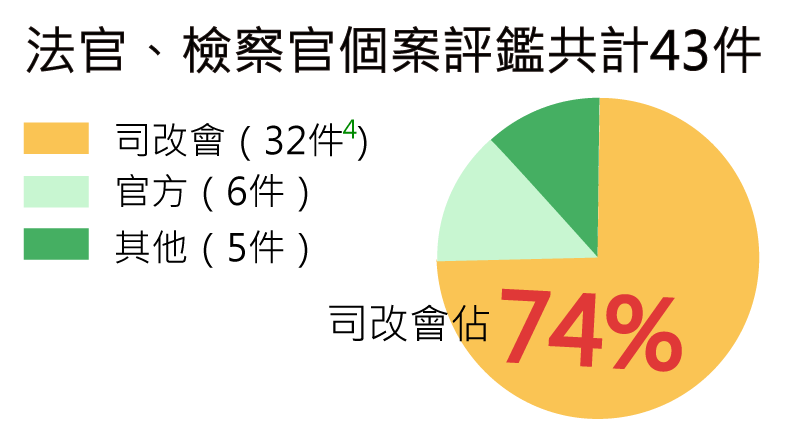
Over the three years since its establishment, JRF's Complaint Center has filed a total of 32 evaluation cases, accounting for 74% of all cases accepted nationwide by the Judges Evaluation Commission and Prosecutors Evaluation Commission. Such achievements are hard-won and made possible with the assistance of many volunteers. For three years, only two full-time staff members have handled grievance cases from across the country. We hope to do better and more, so that the Complaint Center can serve more people in need. We need your generous support!
If the judiciary is allowed to bully the vulnerable, justice is merely an empty promise. Reform needs your power; please donate to support the realization of justice!
Footnotes
- See Lin Wei-Ting, "'Minor' and 'Giant' in the Judicial System," *Judicial Reform Magazine*, Issue 102, August 13, 2014.
- See Judges Evaluation Commission Decision Ping-Tzu No. 1 of the 101st Year; Decision Ping-Tzu No. 6 of the 102nd Year; Decision Ping-Tzu No. 4 of the 103rd Year.
- After the retrial of this case was initiated, it was tried by the Keelung District Court under Case No. 103-Chien-Shang-Tsai-Tzu No. 1, with the first court session held on September 25, 2014.
- Judge and prosecutor evaluations have been implemented for two years and eight months since January 6, 2012, with JRF filing approximately one case per month on average.
This article is an AI-generated translation of the original Chinese text. In the event of any discrepancy, the Chinese version shall prevail.