
JRF Newsletter
Victory for Eggs! Looking at the State Compensation Case of "Occupy Wall Street" Participant Scott Olsen
Last edited: 2026-08-30
Dear friends,
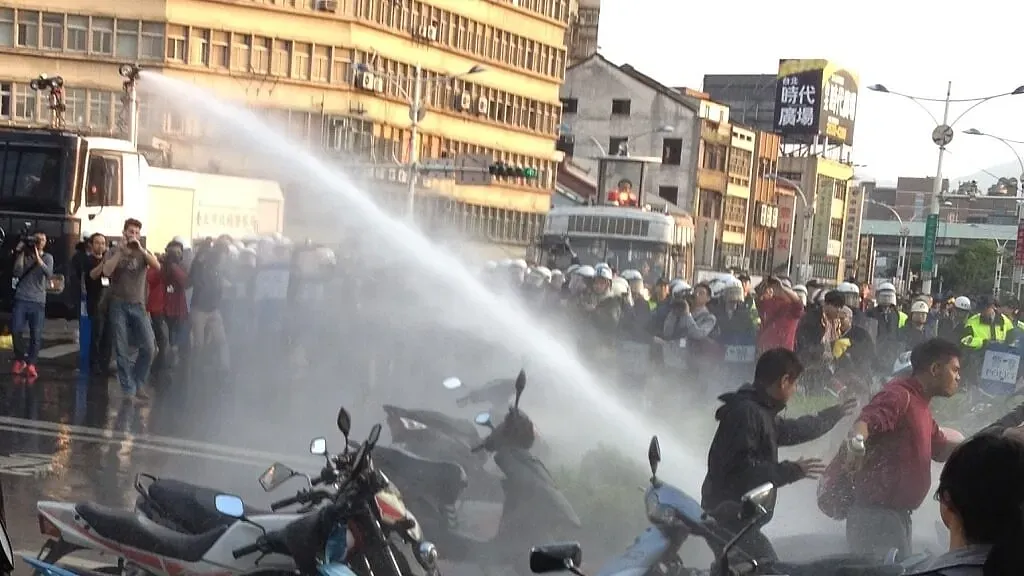
On the night of March 23, citizens and students inside and outside the Executive Yuan were forcefully dispersed by the police, leading to bloody conflicts. Many citizens who were injured as a result have bravely stepped forward to denounce state violence, and the cases are currently still under trial.
A similar scenario unfolded during the "Occupy Wall Street" movement in the United States, where the Oakland police used improper methods to disperse crowds, resulting in injuries. Following the incident, the Oakland City Government commissioned an external team to investigate and produce an independent report on police misconduct. In contrast, in Taiwan, the relevant authorities have yet to take active measures to clarify the true picture of the March 23 bloody conflict.
Pursuant to the Enforcement Act of the Two Covenants, Taiwan applies Article 7 and Article 21 of the International Covenant on Civil and Political Rights, which prohibit torture and guarantee the freedom of peaceful assembly. General Comment No. 20 further requires the state to conduct prompt and impartial investigations into allegations of torture.
This issue of our e-newsletter shares with you the state compensation case of Scott Olsen from the U.S. "Occupy Wall Street" movement.
When faced with police abuse of power and violent dispersal of demonstrators, are people left with no choice but to swallow their grievances and accept being beaten? Scott Olsen in the United States successfully obtained a settlement of 4.5 million USD (approximately 135 million NTD) from the Oakland City Government to compensate for the irreparable harm caused to him by police violence.
In September 2011, the "Occupy Wall Street" movement in New York ignited, and protests against social injustice and the greed of international conglomerates erupted in the form of occupation actions across the United States. The city of Oakland, California, was no exception.
On the night of October 25, 2011, during the "Occupy Oakland" demonstration, protesters confronted police outside the cordon line, continuously chanting slogans, waving flags and banners, without attacking or charging at the police. 24-year-old Olsen stood quietly about 15 yards outside the cordon line, holding nothing in his hands. Suddenly, smoke, flashes, and gunshots filled the air as police began using tear gas and bean bag rounds to disperse the crowd. Amidst the chaos, Olsen, who had remained standing upright without making any movement, was struck in the head by a bean bag round and collapsed to the ground. Surrounding people quickly rushed toward Olsen to offer assistance, but police officer Robert Roche actually threw a flashbang at the injured Olsen and the crowd surrounding him to disperse the crowd.
A bean bag round is a cloth or nylon bag filled with small lead or rubber pellets, typically fired from a shotgun. It has low lethality but causes intense pain and bruising. Olsen, bleeding profusely from his head after being struck by the bean bag round, was still conscious upon being sent to the hospital, but was unable to answer any questions from others (including his name). The bean bag round had caused fractures to his skull and cervical spine, as well as permanent brain damage. Olsen, a former Marine who had served two tours in the Iraq War prior to his injury, worked as a computer systems personnel at Opswat in San Francisco. However, due to the illegal and violent acts of the police, he has suffered severe impairment to his memory, concentration, and language skills from which he has yet to recover, and has accumulated massive medical debts.
Oakland police initially flatly denied seeing Olsen fall, and also denied throwing a flashbang at the fallen Olsen and the crowd assisting him. The Oakland City Government subsequently commissioned a team led by outsider Thomas Frazier to produce an external independent investigation report (Damning Report) regarding police misconduct during the "Occupy Oakland" events. However, the report pointed out that according to relevant video footage from that day, the police claim that no one saw Olsen fall was completely untenable.
The report further fiercely and detailedly criticized the Oakland police, including improper dispersal plans for the demonstration, improper use of external personnel, failure to comply with the department's crowd control policy, and severe negligence in the criminal investigation of the Olsen incident. In an attempt to cover up such an unfavorable investigation report, the city administrator used various methods to try to modify and delete the report's contents, which was sternly rejected by Frazier.
Robert Roche, the officer who threw the flashbang, was identified in 2012 by a journalist, Jacob Crawford, who recognized his badge number through video footage. The Oakland police subsequently fired Roche. However, the identity of the police officer who shot Olsen remains unidentified to this day. Despite this, Olsen retained attorney Jim Chanin to file a lawsuit for compensation against the Oakland City Government in December 2012. After more than a year of litigation, to avoid incurring higher legal fees and compensation amounts, the Oakland City Government decided on March 21, 2014, to settle with Olsen for 4.5 million USD, with 1.8 million paid by the government and the remainder covered by the insurance company.
His retained attorney stated that the compensation "could restore Olsen to the state he was in before the injury," yet Olsen can hardly return to the past, either psychologically or physically. Although he has obtained a massive settlement, the fear Olsen expressed in a recent interview is worth deep reflection by all law enforcement personnel: "When I talk to police officers now, most of the time my inside is shaking."
This article is an AI-generated translation of the original Chinese text. In the event of any discrepancy, the Chinese version shall prevail.