
JRF Newsletter
Mastering the Art of "Being" a Judge on the Very First Try! 2014 JRF Summer Student Camp
Last edited: 2026-07-27
Dear Friends,
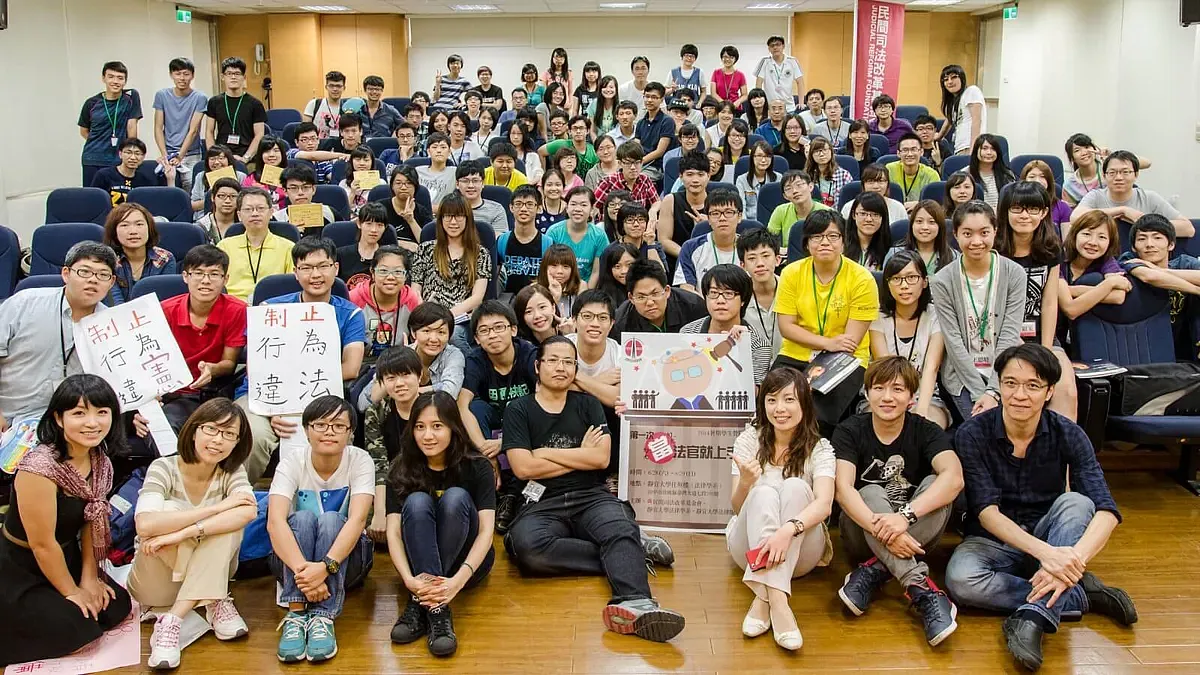
This year's JRF Summer Student Camp was successfully concluded over two days from June 28 to 29.
In addition to letting participants experience the operation of a jury firsthand, this camp carefully selected ten Judicial Yuan Interpretation cases, having campers in various groups explore the underlying issues. Ultimately, through theatrical performances, all participants were able to quickly understand the core controversies of each Interpretation.
This issue of our e-newsletter shares campers' reflections, consultation attorneys' analyses of the Interpretations, and entertaining behind-the-scenes footage of the campers' performances. We look forward to your participation in next year's JRF camp to jointly nurture a new generation of seeds for judicial reform.

Mastering the Art of "Being" a Judge on the Very First Try!
◎By Chang Ting-chia, Group 10 of the JRF Summer Camp / Freshman, Department of Law, National Taiwan University
Participating in this camp organized by the JRF truly taught me so much. It made me realize how narrow the world I originally lived in was and allowed me to witness many different perspectives.
The mock trial on the first day of the camp roughly gave us the experience of a jury, deciding whether the defendant was guilty or not. Actually, at first, I didn't hold a very favorable view of juries. Because I once watched a Japanese court drama that left a deep impression on me: when two attorneys were defending a murderer, the general public believed the murderer was guilty and deserved to die, and even deeply looked down upon the defense attorneys. After assaulting one of the attorneys in a mob, the other attorney indignantly uttered the following words during the court session:
The true devil is precisely the infinitely inflated public opinion, the kind-hearted citizens who are convinced they are good people and violently gang up on a dirty stray dog that has fallen into a sewer... If public opinion wants to sentence someone to death, then sentence them to death. Because after all, this whole series of lawsuits is nothing more than a national movement aimed at hanging a person we dislike, a movement to relieve the boredom of our dreary lives, isn't that right, Prosecutor? What on earth are you five judges sitting up there for? If public opinion can decide everything, then there is no need for this architecture bogged down in formalities and solemn procedures, nor do you need arrogant old men and old women. The verdict is definitely not decided by the public's questionnaire, but by the five of you in our country with profound knowledge. Please make your judgment upholding your convictions as the pinnacle of the judiciary.
Even though these words were dramatic, they are also thought-provoking. Today's judiciary often faces pressure from public opinion, but should a case be judged simply based on what public opinion thinks? Can public opinion really just kill a person like that? And what kind of people make up this so-called public opinion? It must be admitted that the majority of people in the wider society do not have the ability to distinguish right from wrong; they almost blindly follow the views of so-called opinion leaders without genuine and thorough deliberation. Of course, there is also the issue of information asymmetry, where the public only receives fragmented information given by the media, making it difficult to gain a comprehensive understanding of an event. Therefore, I strongly disagree with the act of collectively bullying others using public opinion. Public opinion is not supreme and inviolable; determining whether a person is innocent or guilty should be carried out through a much more cautious approach. Synthesizing the above, I initially believed that professionally trained judges were more trustworthy than so-called public opinion.

However, after sharing sessions by attorneys Chiu Hsien-chih and Li Hsuan-yi, my perspective gradually changed. Although a jury represents public opinion, its process is extremely cautious. As long as even one person has doubts about the verdict, an effective verdict cannot be reached; it is by no means arbitrary. Another aspect that made me realize the value of a jury is this: if one person holds a dissenting opinion, how the others must strive to persuade that person within a limited time—this is the true essence of democracy. It is not a compromise under the coercion of power, but rather, through the collision of various values, compelling people to repeatedly reflect on whether what they believe is right or wrong. Doing so helps foster civic virtue and gives citizens a greater willingness to participate in public affairs, perhaps even helping to alleviate the widespread political apathy of many people today.
As for the violence of public opinion that I had constantly worried about, the attorneys also provided relevant data: when people hold the power to control another person's life and death (though not arbitrarily or dictatorially), they deliberate much more prudently, so the proportion of guilty verdicts is not high. This was reflected in Group 10, to which I belonged; the members reached a unanimous not-guilty verdict from the very beginning—because everyone thought the evidence was insufficient, judging the defendant not guilty under the presumption of innocence. Based on the information found by other group members at the time, most judges in such opportunistic sexual assault cases mostly rule based on the victim's accusations without being as cautious as we simulated jurors were. This further echoed what the attorney said and deepened my confidence in the jury system.
In Taiwan's current judicial environment, the public's sense of distrust has become severe. It is indeed necessary to incorporate the jury mechanism into consideration rather than stopping at the stage of quasi-jury observation.

Only a Free Media Can Foster the Maturation of a Civil Society
◎By Attorney Ch'en Pin-an / Taiwan Environmental Lawyers Association
I am very glad that the Judicial Reform Foundation invited me to participate in this year's JRF Student Camp. At the camp, I served as a consulting attorney. While team leaders guided team members acting as jurors in their discussions, I sat to the side, waiting for their questions while flipping through the opinion, reasoning, concurring, and dissenting opinions of Judicial Yuan Interpretation No. 689, racking my brain over how to explain the contents of Interpretation No. 689 to team members more than a decade younger than me that evening. In this Interpretation, the Justices attempted to clarify how to strike a balance between the boundaries of news reporting freedom and the right to privacy. However, both concepts of freedom of the press and privacy are highly abstract and truly difficult to explain clearly.
Fortunately, my team members listened very attentively as I explained what freedom of the press and the right to privacy are, and they deeply discussed the various issues touched upon in Interpretation No. 689: What does the Social Order Maintenance Act, a legal norm left over from the martial law era, signify? What are the boundaries of freedom of the press, which is hailed as the fourth estate? What is the scope of privacy protection for public figures versus ordinary individuals? How can public authority (the police) intervene in disputes between private individuals?
Former Grand Justice Hsu Tzung-li wrote these words in his partial concurring and partial dissenting opinion for this Interpretation: "In short, the media ecosystem in contemporary society may be deplorable, but in any case, only a free and open media can foster the emergence of a public sphere and the maturation of a civil society. This member always harbors an unfaltering hope that Taiwanese society will ultimately move toward that direction."
Indeed, setting aside legal theory for a moment, why do we still emphasize that news media, as monstrously deplorable and bloodthirsty as they currently are in chasing sensationalism, should possess freedom of the press—and value it so highly?
What on earth is freedom?
Actually, living in this world is like living in a massive prison, where everything seems pre-set. As days go by, it is hard to feel what freedom is. Perhaps freedom is like air; we enjoy freedom every day just as naturally as we breathe air every day, yet we fail to cherish it. Unfortunately, in this era of tightening politics, we have begun to lose freedom. Just like losing air, we begin to struggle, struggling hard against the injustices of the government and conglomerates. We know that people's protests are becoming increasingly fierce; to win back a sliver of freedom, we use words to express different opinions and use our bodies to defy the law and collide with the system.
Former Grand Justice Hsu Yu-hsu once said: "If you cannot speak freely, you will not think freely." To think freely, we need the protection of freedom of speech. Furthermore, to gather or influence the opinions of others and hope our views can be conveyed to them, we need to use the media to disseminate our voices.
In this era where conglomerates and governments act arbitrarily relying on absolute power, the freedom of the news media to transmit information free from interference is our sharp weapon against injustice and an important foundation for mobilizing social power. Although we must tolerate some monstrously bloodthirsty media also enjoying freedom of the press, only by allowing people to read freely, write freely, and think freely can Taiwanese society move forward, become a mature civil society, and realize the free and democratic society that everyone deeply yearns for.
This article is an AI-generated translation of the original Chinese text. In the event of any discrepancy, the Chinese version shall prevail.