
JRF Newsletter
June 26 Anti-Torture Day: The Long and Arduous Road of Accompanying Interrogations
Last edited: 2026-08-30
 ◎Photo by Huang Kuo-cheng
The exhausted figures of pro bono lawyers at the Taipei District Prosecutors Office
Dear Friends:
Yesterday (June 26) was a busy day for many.
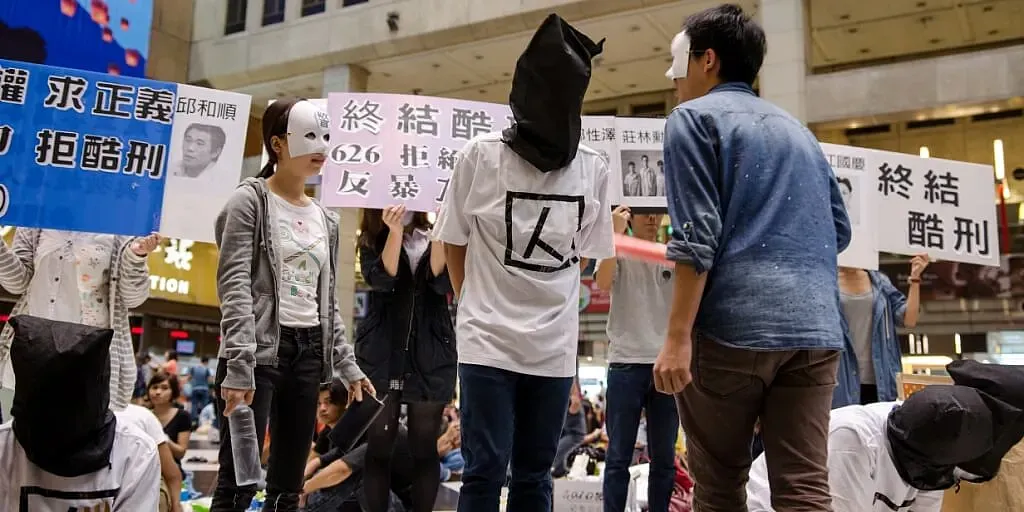
June 26 is the International Day in Support of Victims of Torture. In the morning, the Judicial Reform Foundation initiated a petition for the Chen H-sun case, asking the Judicial Yuan to review the judgment. The petition was endorsed by 54 legal scholars nationwide, and together with several rescue organizations and scholar representatives, they went to the Judicial Yuan to publicly submit a statement of reasons for the petition review, demanding that the government fulfill its responsibility to prevent torture and miscarriages of justice.
On the same day, due to the Wang-Chang meeting, multiple protests and demonstrations broke out throughout the day. Pro bono lawyers rushed to police stations and prosecutors' offices to accompany people during interrogations, wrapping up their missions only in the early hours of the following morning.
This issue of the newsletter takes the events of June 26 as its theme, introducing the International Day in Support of Victims of Torture and how the JRF organized pro bono lawyers to participate in the anti-CSSTA movement.

International Day in Support of Victims of Torture: Seeking a Glimmer of Hope in Front of the Court
June 26, 1987, marks the entry into force of the United Nations Convention against Torture and Other Cruel, Inhuman or Degrading Treatment or Punishment. To commemorate this, the day was designated as the International Day in Support of Victims of Torture. This Convention is an extension of Article 7 of the International Covenant on Civil and Political Rights, which prohibits the subjection of anyone to torture or to cruel, inhuman or degrading treatment or punishment.
What is torture? Article 1 of the Convention against Torture defines it as any act by which severe pain or suffering, whether physical or mental, is intentionally inflicted on a person for such purposes as obtaining from him or a third person information or a confession, punishing him for an act he or a third person has committed or is suspected of having committed, or intimidating or coercing him or a third person, or for any reason based on discrimination of any kind, when such pain or suffering is inflicted by or at the instigation of or with the consent or acquiescence of a public official or other person acting in an official capacity. It does not include pain or suffering arising only from, inherent in or incidental to lawful sanctions.
The most common form of torture is undoubtedly the abuse of defendants during criminal police investigation procedures, or the unlawful treatment of criminal convicts. Under our criminal procedure system, comprehensive regulations have been established to prevent the former, such as the notification of rights upon arrest; the prohibition of interrogation of defendants through violence, threats, inducement, fraud, fatigue interrogation, or other improper methods; the prohibition of nighttime interrogation; and the requirement that within 24 hours from the time of apprehension or arrest, a court must intervene to review whether detention is necessary.
It is evident that although our country has not signed the Convention, institutional developments still strive to eradicate torture. However, some of these institutional changes have been triggered by bloody lessons. For instance, the Wang Ying-hsien case led to the amendment of Article 27 of the Code of Criminal Procedure, granting defendants the right to retain counsel at any time. Another example is the Hung Chung-ch'iu case, which made it possible to reform the long-standing military confinement system.
Nevertheless, one should not assume that torture has been completely eliminated from our judicial practice. Chen H-sun, Taiwan's longest-detained death row inmate, was accused of involvement in the kidnapping and murder of Lu Cheng and K'o Hung Yu-lan. However, a Control Yuan report concluded that the confessions in this case were obtained through torture and coercion, and the police officers involved were convicted by final judgment. Furthermore, former UN Special Rapporteur on Torture Professor Manfred Nowak, after visiting Chen H-sun, pointed out that the judgment in this case violated international human rights conventions. Despite this, judges across successive trials still sentenced Chen H-sun to death. Such judgments ignored the fact that the confessions were obtained through torture, overlooked discrepancies in the co-defendants' confessions and inconsistencies between witness testimonies and the defendant's confessions, and even lost crucial physical evidence while it was under police custody.
The Convention against Torture has been signed by 155 countries worldwide since its entry into force, and the "prohibition against subjecting anyone to torture" has become a peremptory norm (jus cogens) in international human rights law, binding even non-signatory states without exception. The judgment in Chen H-sun's case involves grave flaws violating the prohibition of torture, drawing widespread public attention. On June 26, 2014, International Anti-Torture Day, an unprecedented number of 54 public law professors specializing in constitutional and criminal law jointly petitioned to submit this judgment to the Judicial Yuan for review in pursuit of a remedy and to uphold judicial impartiality. The Judicial Yuan must not turn a blind eye to this poignant appeal and demand!

"25231178" Is No Longer Just a Phone Number
◎Chan Li-yen / Department of Mathematics, National Taiwan University, JRF Volunteer
Opening the memo app on my phone, there is a line reading "02-25231178". During the anti-CSSTA movement, participants likely heard the megaphone at the site blaring: "If you are taken away by the police, please remember the following number to seek pro bono legal assistance at the scene..." Friends inside the legislative chamber definitely saw pro bono lawyers taking shifts around the clock inside the chamber. That's right! Behind all of this was the participation of the Judicial Reform Foundation.
Based on my own experience participating in this movement, hearing the megaphone back then evoked not just the realization that I might get arrested coming here today, but also a sense of reassurance—feeling that "if I really get busted, professionals will have my back." It was a very contradictory feeling. At the same time, it left numerous questions and curiosities in my mind, as someone lacking in legal knowledge and understanding of lawyers.
After the March 18 Movement, driven by a slight sense of indignation toward society and curiosity as to why my standing up against the CSSTA and the black-box operation was somehow connected to "judicial reform," I came to the JRF office. I learned that besides setting up a 24-hour hotline for a pro bono lawyer team, the JRF was also uniting lawyers and the victims injured on March 24 to file lawsuits against state violence. I also slowly began to understand what the JRF has consistently been doing and the direction of its efforts. This short essay was written after interviewing JRF Deputy Executive Director Chen Yü-fan, who was in charge of organizing the March 18 pro bono legal team.
Hoping that citizens arrested because of this movement could have lawyers accompanying their interrogations
This movement, both in terms of turnout and duration, was the largest in recent years. Ever since March 18, news of forced dispersal at the protest sites kept coming, and for most people participating in this movement, getting arrested and taken to a police station meant it was extremely difficult to find a lawyer to arrive in a short time. Facing such massive protests and dispersals, the JRF immediately established an emergency interrogation-accompaniment contact platform. The JRF secretariat went on 24-hour standby, always ready to coordinate pro bono lawyers to accompany interrogations at police stations, while pro bono lawyers took turns on duty inside the legislative chamber to cope with potential conflicts at any moment.
The JRF continued to recruit more lawyers to participate, and soon over 400 enthusiastic lawyers joined. I think this tremendous force embodied the lawyers' desire to safeguard the rights of citizens arrested by the police for participating in this movement. The JRF and the pro bono legal team hoped that every citizen taken to a police station because of this movement could have a lawyer accompanying their interrogation.
At first, I was puzzled: why is lawyer accompaniment during interrogation so important, to the extent that people spare no effort to do it? Looking back at past judicial miscarriages of justice, we see that many defendants in wrongful convictions were often coerced into false confessions at police stations. By the time they reached prosecutors and judges and wanted to retract their confessions, it was often dismissed as a retroactive retraction, given that judges frequently believe that "initial statements carry the most weight." This added numerous difficulties for the JRF when conducting wrongful conviction rescue work. Even in this day and age, it is hard for us to imagine that torture still exists. Indeed, physical torture is virtually nonexistent now. However, police officers' guidance and instigation during interrogation records, asking citizens to save themselves the trouble, and even intimidation, still occur incessantly. Especially when resisting state power, we can imagine how public authorities might treat these individuals.
There is one thing I think is worth exploring further. On the night of the March 24 Executive Yuan clash, a massive wave of calls poured into the JRF, hoping the JRF could send lawyers to the protest site. But thinking about it carefully afterward, even if the lawyers had reached the site, what could they have done? Everyone knows lawyers couldn't stop the police from beating people. Then why did the citizens at the scene yearn so much to have lawyers by their side? I think these lawyers implicitly carried another meaning: they made these students and citizens participating in the occupation movement feel backed up, that there was supportive power behind them, giving people a sense of security. At the same time, this clearly reflects our distrust of legal power—our distrust of law enforcement personnel or the judiciary. This is precisely why lawyer accompaniment during interrogation is important: besides avoiding unreasonable or even illegal interrogations at police stations, when people generally distrust the judiciary, having legal support at the very first step when facing legal proceedings is a good thing for both the parties involved and the judiciary as a whole.
State violence cannot be brushed aside
After the retreat, the JRF's pro bono lawyers and the victims injured on March 24 united to file a lawsuit against state violence. Because the target of the lawsuit was the state itself, they chose the path of private prosecution. Lacking the prosecutor's investigative powers, this is a very long, arduous, and highly uncertain path. When I first learned that the JRF was doing this, I felt like I had met a group of lunatics. I used to think that those violent police officers and commanding high-ranking officials would absolutely never face consequences. Even if they did, responsibility would likely be passed around until some low-ranking grunt was used as a scapegoat, and then things would remain business as usual next time—the disproportionate and illegal exercise of public authority would continue as before. I remember when Chen Yün-lin came to Taiwan in 2008, citizens were also beaten and injured by the police back then. Only one of those lawsuits resulted in state compensation, where the victim suffered severe head injuries, while all others were dismissed. And what about this time? The government has not changed! Grassroots personnel must still blindly obey orders from higher-ups; failing to act brings scolding, while acting poorly matters not, and may even lead to promotions.
Yet, do we have the qualification to be passive? If no one holds anyone accountable in the face of state violence, what will our future look like? Beyond holding higher-ups accountable, another crucial point of this lawsuit is: to let the violent police officer know that he is not just a tiny cog in the machine, to tell him that if he breaks the law, he will be held accountable afterward, and to tell him that every single one of us possesses the ability for independent judgment—that he could choose to carry away a non-resisting citizen instead of beating him.
After coming to the JRF, I witnessed the passion and perseverance of the legal team. I heard lawyers tell me that events will gradually be forgotten by people over time, that the litigants will slowly return to their original lives, and their once-firm determination might gradually wane. If even the lawyers adopt a passive attitude at this moment, then who else is left to tell the public authorities that you cannot do this? Who else is left to protect our future from being treated with state violence?
Where do we go from here in the future?
Following this anti-CSSTA movement, perhaps precisely because the JRF had such a platform connecting protesters and lawyers, the JRF had the opportunity to network with many other organizations. This included a group of psychiatrists and psychological counselors who had participated in the medical team inside the legislative chamber. They were deeply concerned that citizens inside and outside the chamber or at other protest sites, enduring prolonged exposure to a high-pressure environment of uncertainty—especially after March 24—might exhibit symptoms of post-traumatic stress disorder. Directors from the Documentary Workers Union also collaborated with the JRF, hoping to document every scene of the lawyers, the pro bono legal team, and the JRF during and after this movement.
Just as students returned to campus and everyone gradually returned to their normal lives, the JRF's mission was only just beginning. Aside from the lawsuits against the state, how should this platform—originally established to connect protesters and lawyers—move forward? If continuous protests break out again in the future, will the JRF still have the resources to maintain the 24-hour hotline? To this end, the JRF currently hopes to digitize the communication bridge to increase communication efficiency, and naturally expects to expand opportunities for lawyers to participate in social movements. However, if this platform continues in the future, given that the legal team's caseload is nearing saturation, is it appropriate, or does the JRF still have the capacity, to continue supporting every citizen in social movements who needs legal assistance? Where is the JRF's next step? I suppose the JRF may already have the answer to this, and I believe that on the path toward "building a judiciary trusted by the people," the JRF will never be absent.
Opening the memo app on my phone once more, "02-25231178 3/24/14" is no longer just a phone number or a memory...
For me, March 18 was like having a dream—a dream I could never have imagined before. It was precisely this dream that made me question my previous way of understanding the world and made me want to re-understand this society. By a stroke of fate, I came to the JRF, and only then did I gradually realize that there has always been a group of people striving for their ideals, constantly speaking out against judicial injustices. They are rational yet driven by impulse, they learn amidst social changes, and they will keep moving forward.
This article is an AI-generated translation of the original Chinese text. In the event of any discrepancy, the Chinese version shall prevail.