
A Regret That Came Too Late
Last edited: 2026-08-30
On the evening of September 7, Lu Cheng, a death row inmate whose conviction was based solely on a confession without any scientific evidence, was executed by firing squad, taking all unresolved doubts with him. Even though the Control Yuan had already initiated an investigation into the case, and despite the presence of fingerprints and hair samples whose owners remained unidentified, nothing could stop the Ministry of Justice from carrying out his execution with lightning speed. In the few hours between receiving the execution notice and the carrying out of the sentence, Lu Cheng could only repeatedly cry out, 'I am innocent, I did not do it!' Yet, no matter how piercing his cries of injustice were, they could not reverse the speed at which the Ministry of Justice carried out the death penalty. Just like that, all doubts were buried deep in the earth along with his death.
Ever since Lu Cheng's family members and defense counsel began traveling everywhere to petition and cry out against injustice, and since members of the Legislative Yuan, the Taiwan Association for Human Rights, and the Control Yuan successively stepped in to express concern, the investigative procedures of this case and the evidentiary standard used to sentence him to death have been the focal point of controversy. The conviction we uphold is this: What kind of judiciary is Taiwan actually trying to build for itself? Is it a judiciary that resorts to the death penalty at every turn? A judiciary that can sentence people to death without scientific physical evidence? Or is it a judiciary that truly complies with due process and leaves no innocent person wrongly accused while letting no guilty person escape? However, before any of this could be clarified, Lu Cheng was executed by firing squad, rendering all these efforts meaningless. We cannot help but ask: Even for a death row inmate, is demanding a judgment free of doubt not an obligation of the judiciary? Since when has the way our judiciary faces doubt been to accelerate the execution of the death penalty?
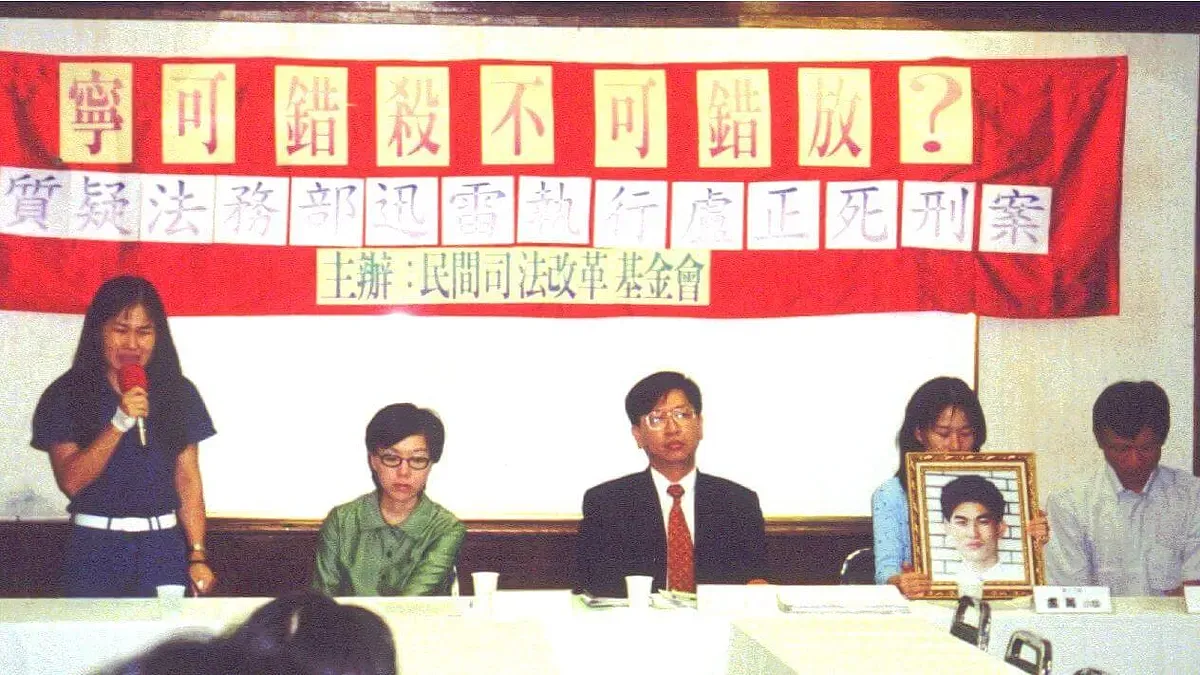
On August 2, the Taiwan Association for Human Rights formally held a press conference calling on the Prosecutor-General to file an extraordinary appeal regarding the doubtful points of the case, emphasizing that the death penalty must not be hastily executed prior to conclusive evidence; especially facing the fact of illegal police interrogation, the judiciary should grant him another chance at a fair trial. Furthermore, in this case, the fingerprints and hair found on the tape used to bind the corpse were determined to belong to neither the victim nor Lu Cheng, clearly indicating the involvement of other parties, yet the prosecutors failed to investigate the matter despite repeated delays. Therefore, after petitioning the Control Yuan, Control Yuan Members Liao Chien-nan and Ku Teng-mei officially formed an investigative team to launch an inquiry, and formally issued an official document to the Supreme Prosecutors Office requesting to review the case files to facilitate verification. During this period, they also contacted the Ministry of Justice by telephone (and subsequently issued an official document) to inform them of the necessity of investigating this case, hoping to gain the cooperation of the Ministry of Justice and the prosecutors' office to clarify the numerous doubts surrounding the case. Yet, just as the Control Yuan applied to conduct the investigation, the Ministry of Justice and the prosecutors' office not only delayed responding and refused to submit the case files for the Control Yuan's investigation, but instead swiftly executed Lu Cheng's death sentence. We cannot help but ask: Can the judiciary's deprivation of a person's life not be more cautious and truth-seeking? Is rendering a death sentence free from doubt not an obligation of the judiciary? Could it be that someone is afraid to face the truth of the case, and therefore wishes to use the death penalty to put a premature end to a questionable case?
This is not the first case involving rescue efforts by the association that has led to a death execution, but it is the one that has dealt the most profound blow. The previous instance occurred during Cheng Chung-mo's tenure as Minister of Justice. It was only when visiting Minister Cheng that we learned the person being rescued had been executed the previous evening. The accompanying representatives from the Taipei Bar Association, the Association for Human Rights, and volunteer lawyers were choked with emotion and unable to speak. It was precisely because of this incident that we pushed for the establishment of the 'Directions for the Execution of the Death Penalty,' giving Taiwan's death penalty executions at least a baseline procedural standard operating procedure (even if far from satisfactory). Ever since that incident, we have continuously heard whispers indicating that ever since the Su Chien-ho death penalty case, the Ministry of Justice has been very sensitive about whether anyone intervenes to rescue individuals in death penalty cases. As soon as a rescue group steps in, they accelerate the execution of the death penalty, and naturally, our organization has been placed at the top of their blacklist.
Even so, we have always firmly believed that these were merely unfriendly rumors and that the Ministry of Justice would not be so obtuse—especially after the regime change, when the new administration was largely in the hands of politicians with legal professional backgrounds, which gave us even more confidence in the new administration's attitude toward handling death penalty cases. Alas, Lu Cheng's case completely overturned this confidence and made people wonder whether the whispers coming from correctional institutions might actually be a well-intentioned warning.
Lu Cheng, who served four years of compulsory military service as a police officer, came from a typical mainland-origin military family; his father was a professional soldier, and his older brother was a police officer. Elder Mr. Lu is the typical patriotic, honor-bound old gentleman. When we first met him, he trembled and spoke in a heavy hometown accent: 'If my child had died defending the country, I would not utter a single complaint, because that would be my glory. But now, he was unjustly put to death...' Before he could finish his sentence, he burst into tears, sobbing uncontrollably. Looking at his 80-year-old body burdened with liver disease, we do not know how the judiciary can face him.
Lu Cheng has already been executed; all efforts are now meaningless to him. The veteran forensic doctor who performed the physical examination prior to his death remarked to the family afterward, 'I have never seen a death row inmate executed like this. Ever since receiving the execution notice, he acted like he had gone mad, shouting about his innocence. He refused to wear the clothes given to him, wearing only a pair of underwear, and kept shouting: "I didn't do it! I am innocent!" He truly came into this world with nothing and left with nothing, taking nothing away with him.' Hearing this, the family felt as though their hearts were being cut to pieces, yet it also solidified their determination to continue investigating this case after his death. The purpose of pursuing this is not to bring their beloved family member back to life, but to ensure that the next family does not have to endure such a tragedy. As legal reform workers, we can only feel ashamed for the judiciary. Facing a land in Taiwan where 'no one dies, no progress is made,' our heartache and anger are often interpreted as shielding bad guys and holding biased stances. However, none of this affects our steadfast belief that the judiciary must uphold procedural justice. Our wish is simple and clear: we hope that this land of Taiwan will soon emerge from barbaric judicial violence, and no longer mistakenly believe that the judiciary is omnipotent, nor that sacrificing the lives of a few people to pander to the public psychology is worthwhile. We hope the judiciary can truly become a servant of justice and a refreshing rain for the disadvantaged.
The hasty execution of this death penalty case not only risks killing an innocent person and letting the true mastermind go free, but more importantly, we worry whether the execution of this death penalty case signals that Taiwan is about to enter a period of judicial authoritarianism where it is better to mistakenly execute an innocent than to let a guilty person escape. Will our worries come true? Is the judiciary more willing to execute a questionable death row inmate than to humbly face potential errors? Although everything is in the past for the deceased, we will strive to document the details of this case. In the future, this death penalty file will record the mottled blood and tears of Taiwan along the path of judicial reform.
Facts Established in the Final Judgment of the Lu Cheng Case
In December 1997, because he was in urgent need of funds, Lu Cheng plotted to abduct Chang Chun-tzu, the wife of his high school classmate, in order to extort Tseng Chung-hsien, Chang Chun-tzu's husband. On the 17th and 18th, he drove his personal sedan to the front of the advertising firm jointly operated by Tseng Chung-hsien and Chang Chun-tzu to secretly observe Chang Chun-tzu's movements. Around 4:00 PM on the 18th, he tailed and tracked Chang Chun-tzu as she went out on errands. At 5:00 PM that same day, when Chang Chun-tzu was waiting for a green light at the intersection of Tacheng Road and Kuomin Road in Tainan City, he walked up to her, pretended to bump into her by coincidence, and falsely claimed he wanted to give her a ride to collect an advertising fee from Cheng Chao-ming. Chang Chun-tzu then parked her scooter near a secluded alley close to Chintang Bridge on Tacheng Road in Tainan City and got into Lu Cheng's vehicle. At this point, Lu Cheng retrieved a shoelace he had prepared in advance from the back seat and, taking advantage of Chang Chun-tzu's lack of attention, strangled Chang Chun-tzu—who was sitting in the front passenger seat—from the back seat with the shoelace, causing Chang Chun-tzu to suffocate and die. Lu Cheng first abandoned the corpse in a sugarcane field opposite the Tainan City Mortuary. Fearing discovery, he then wrapped tape around Chang Chun-tzu's head and face, bound her hands and feet, and drove toward the Chinan Highway in Lungchi Township, Tainan County. Around 8:00 PM that same day, he abandoned Chang Chun-tzu's corpse in the bushes by the cliff alongside the industrial road. Immediately driving back to Tainan City, he discarded Chang Chun-tzu's handbag into a roadside trash can. At approximately 9:30 PM that same day, he went to Shengli Street in YungKang City and used a public payphone to contact Tseng Chung-hsien's mobile phone to carry out the extortion. Tseng Chung-hsien then reported the matter to the police. Around 4:00 PM the following day (the 19th), a passerby discovered Chang Chun-tzu's corpse and reported it to the police.
After nearly a month of investigation, the police considered Lu Cheng to be heavily implicated and requested Lu Cheng to accompany them to the Fifth Precinct of the Tainan City Police Department to assist with the investigation on January 16, 1998. However, after more than thirty hours of exhaustive interrogation, Lu Cheng finally confessed to the crime. After being prosecuted by the prosecutor and entering judicial proceedings, although Lu Cheng retracted his confession during the first-instance trial, stating that he had been coerced by the police into making a false confession, he was nevertheless convicted and sentenced to death through three instances of trial. Furthermore, his motions for retrial and extraordinary appeals were both dismissed.
Summary Table of Evidence Contested in the Lu Cheng Case
| Evidence / Person | Doubts | Remarks |
|---|---|---|
| Fingerprint Identification | Three fingerprints collected from the tape binding the victim were identified as belonging to the victim, while two fingerprints have yet to be matched to anyone. The fingerprints collected from the victim's helmet and the public telephone used for extortion also did not match Lu Cheng. | The family filed a criminal accusation against the owner of the fingerprints, demanding the police and prosecutors track down the real culprit, but the prosecutor closed the case without action and refused to continue the investigation. |
| Hair | Results not identified | Obtained from the tape binding the victim; could not be identified at the time, but can be identified with current equipment. |
| Shoelace (Murder Weapon) |
The forensic doctor of the Tainan District Prosecutors Office, the Taiwan High Prosecutors Office Forensic Center, and the handling prosecutor all considered the murder weapon to be a "single-strand twisted object," which did not match the characteristics of a shoelace as a "multi-strand twisted object." | Only the Forensic Science Research Institute of the Ministry of Justice claimed it "could match" as the murder weapon. |
| Blood Type Identification | Blood type is Type B, which does not match the defendant Lu Cheng's Type O. | Cigarette butt collected from the corpse-abandonment scene. |
| Call Records of Witness Cheng Chao-ming | Witness Cheng Chao-ming denied being with the defendant on the day of the incident and claimed he never paged the defendant. However, after applying for the court to retrieve the call records, it was confirmed that Cheng Chao-ming had continuously paged the defendant nine times after 3:00 PM that afternoon. | High school classmate of the defendant Lu Cheng and the victim's husband Tseng Chung-hsien; originally also targeted by police as a suspect. |
| Extortion Telephone Call | The victim's husband Tseng Chung-hsien stated that a "strange man" speaking "standard Mandarin" made the extortion call. However, since Lu Cheng and Tseng had been classmates and friends for over ten years and interacted frequently, how could they not recognize Lu Cheng's voice? | - |
| Lu Cheng's Niece | She testified that on the evening of January 18, Lu Cheng helped her sign her family contact book and watched variety shows together, and did not go out to make extortion calls. | She was staying at Lu Cheng's home as a boarder, so family contact books were always signed by Lu Cheng or his wife. |
| Pan Min-chieh | Pan testified that when she rushed to the police station, Lu Cheng indeed cried out his innocence to her and informed her he had been subjected to torture. The court failed to investigate or adopt this favorable testimony for the defendant. | Wife of the high school teacher of Lu Cheng, Tseng Chung-hsien, and Cheng Chao-ming; claimed to have psychic abilities. Present since the first police interrogation as a third party who was neither a police officer nor had anything to do with the case. |
| Tsai Su-hsia | Tsai testified that during the time of the incident, Lu Cheng indeed brought his son to Tsai's home, serving as Lu Cheng's alibi. The court dismissed this testimony merely as protective shielding statements. | Lu Cheng's sister-in-law |
This article is an AI-generated translation of the original Chinese text. In the event of any discrepancy, the Chinese version shall prevail.