
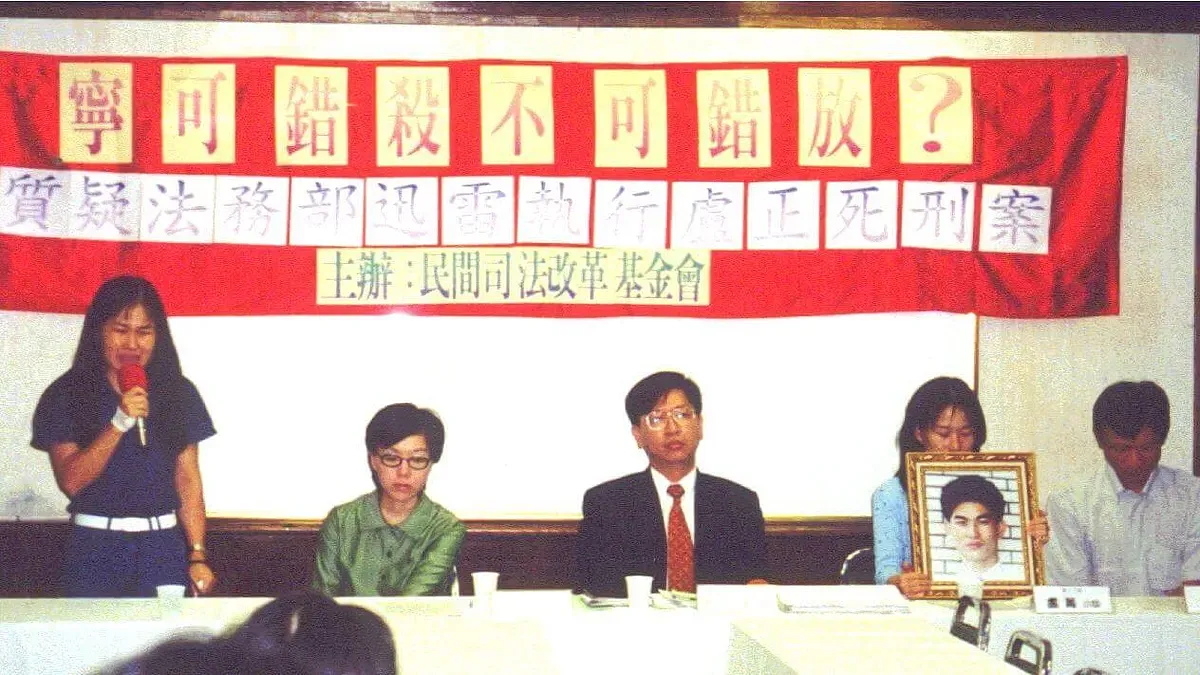
Better to Execute an Innocent Than Let a Culprit Go? Questioning the Ministry of Justice's Hastened Execution of Lu Cheng
Last edited: 2026-07-27
On the evening of September 7, Lu Cheng, a death-row inmate whose conviction rested solely on a confession without any scientific evidence, was executed by firing squad while myriad doubts still surrounded his case. Even though the Control Yuan had initiated an investigation into the case, and despite fingerprints and hair samples of unknown ownership remaining untested, nothing could stop the Ministry of Justice from carrying out his execution with lightning speed. In the hours between receiving the execution notice and the carrying out of the sentence, Lu Cheng could only repeat: "I am wronged, I didn't do it!" Yet no matter how shrill his cries of injustice were, they could not reverse the speed of the Ministry of Justice's execution. Just like that, all the doubts were buried deep in the earth along with his life.
Ever since Lu Cheng's family members and defense attorneys began traveling everywhere to petition and cry out against this injustice, and since legislators, the Judicial Reform Foundation (JRF), and the Control Yuan successively intervened with concern, the investigative procedures of this case and the evidentiary standard used to sentence him to death have been the focal points of controversy. The conviction we uphold is: What kind of judicial system does Taiwan ultimately want to build for itself? A judicial system that casually resorts to the death penalty? A judicial system that can sentence people to death without scientific material evidence? Or a judicial system that truly conforms to due process and leaves no room for error? Yet, before all these matters could be clarified, Lu Cheng was executed by firing squad, rendering all these efforts meaningless. We cannot help but ask: Even for a death-row inmate, is demanding a judgment free of doubt not an obligation of the judiciary? When did our judiciary begin responding to doubts by accelerating the execution of the death penalty?
On August 2, the JRF formally held a press conference calling upon the Prosecutor-General to file an extraordinary appeal regarding the suspicious aspects of the case, asserting that the death penalty must not be executed hastily in the absence of conclusive evidence; especially in the face of the fact that the police conducted unlawful interrogations, the judiciary should grant him another chance at a fair trial. Furthermore, the fingerprints and hair found on the tape used to bind the corpse were determined to belong neither to the victim nor to Lu Cheng, clearly indicating that other individuals were involved, yet the prosecutors' office failed to investigate the matter despite repeated delays. Consequently, following petitions to the Control Yuan, Control Yuan Members Liao Chien-nan and Ku Teng-mei officially formed an investigative team to probe the matter and formally issued an official document to the Supreme Prosecutors Office requesting to review the case files to facilitate verification. During this period, they also contacted the Ministry of Justice by telephone (and subsequently issued an official document) to inform them of the necessity of investigating this case, hoping to obtain the cooperation of the Ministry of Justice and the prosecutors' office to clarify the numerous doubts surrounding the case. Yet, while the Control Yuan was applying for the investigation, the Ministry of Justice and the prosecutors' office not only delayed responding and refused to submit the case files for the Control Yuan's investigation, but instead swiftly executed Lu Cheng's death sentence. We cannot help but ask: Can the judiciary's deprivation of a person's life not be more cautious and truth-seeking? Is rendering a death sentence free of doubt not an obligation of the judiciary? Was someone perhaps afraid to face the truth of the case, and thus chose to use the death penalty to bring a suspicious case to a close?
The execution of Lu Cheng not only resulted in the possible wrongful execution of an innocent person and the possible failure to bring the true culprit to justice, but more importantly, we worry whether the execution of this death penalty case signals that Taiwan is about to enter a judicial-authoritarian era where it is "better to mistakenly execute an innocent than to let a culprit go."
Faced with a moment when everything is irremediable, we can only put forward the following demands with heavy and angry hearts, hoping that this death penalty case will earn Taiwan's judicial system a stricter standard of evidence and a judicial process that places greater value on life.
- We demand that the Minister of Justice explain the review results of the death penalty in Lu Cheng's case, and why the case files could not be provided to the Control Yuan for investigation, yet the death penalty was executed before the doubts were clarified?
- We demand that the Ministry of Justice establish a provision in the Guidelines for the Execution of Capital Punishment requiring the suspension of death penalty executions for cases currently under investigation by the Control Yuan, and that execution procedures be confirmed only after the investigation results are finalized.
- We request the Control Yuan to explain its application procedure for investigations: Why was Lu Cheng's death penalty executed by the Ministry of Justice while the Control Yuan was still investigating?
- We request the Control Yuan to ascertain whether there was any dereliction of duty by personnel during the execution process of Lu Cheng's death penalty, and whether the death penalty review procedure was complete.
- We request the Control Yuan to continue investigating the suspicious points of this case, particularly holding relevant personnel accountable for the police's illegal interrogation past legal hours.
- This Foundation will refer this case to the Judicial Yuan's Final Judgment Review Committee to ascertain whether there are flaws in the judgment results of this case and whether a thorough investigation was carried out to the best of its ability.
Finally, we make a solemn and heavy-hearted appeal: Ever since the new regime took office, anti-organized-crime campaigns have become one of its primary policy goals. We certainly welcome the judiciary striking down dark forces and organized crime to uphold justice, but no matter how vigorous the anti-organized-crime policy may be, it must not override the due process of the judiciary, nor should it infringe upon the judiciary's basic value of respecting life. Otherwise, not only will it fail to build an upright and clear just society, but it will instead drive Taiwan backward into an era of draconian officials who care nothing for justice and only look at performance metrics.
Brief Overview of the Facts of Lu Cheng's Case(Facts Determined by the Final Judgment)
In December 1997, because he was in urgent need of money, Lu Cheng plotted to kidnap Chan Chun-tzu, the wife of his high school classmate, in order to extort Chan's husband, Tseng Chung-hsien. On the 17th and 18th, he drove his personal sedan to monitor Chan Chun-tzu's movements in front of the advertising company jointly operated by Tseng Chung-hsien and Chan Chun-tzu. Around 16:00 on the 18th, he trailed and followed Chan Chun-tzu as she went out on errands. At 17:00 that day, when Chan Chun-tzu was waiting for the traffic light at the intersection of Dacheng Road and Kuomin Road in Tainan City, he approached her, pretending to run into her by coincidence, and falsely claimed he wanted to give Chan a ride to collect advertising fees from Cheng Chao-ming. Chan Chun-tzu then parked her scooter in a secluded alley near Jintang Bridge on Dacheng Road, Tainan City, and got into Lu Cheng's car. At this point, Lu Cheng retrieved a shoelace he had prepared in advance from the back seat of the car and, taking advantage of Chan's lack of preparedness, used the shoelace from the back seat to tighten it around the neck of Chan Chun-tzu, who was sitting in the front seat, causing Chan to suffocate and die. Lu Cheng first abandoned the corpse in a sugarcane field opposite the Tainan Municipal Funeral Parlor, but fearing discovery, he wrapped Chan Chun-tzu's head and face with adhesive tape, bound her hands and feet, drove toward Chinnan Highway in Lungchi Township, Tainan County, and at around 20:00 that same day, abandoned Chan Chun-tzu's corpse in the bushes on the cliffside beside the industrial road. He then drove back to Tainan City and discarded Chan Chun-tzu's handbag in a roadside trash can. At around 21:30 that same day, he went to Shengli Street in Yung캉 District and used a public payphone to contact Tseng Chung-hsien's cell phone to carry out extortion. Tseng Chung-hsien then reported the matter to the police. Around 16:00 the following day (the 19th), a passerby discovered Chan Chun-tzu's body and reported it to the police.
After nearly a month of investigation, the police deemed Lu Cheng heavily implicated and invited Lu to the Fifth Precinct of the Tainan City Police Bureau to assist with the investigation at 14:20 on January 16, 1998. However, after more than 30 hours of exhaustive interrogation, Lu Cheng finally confessed to the crime. After the prosecutor indicted him, the case entered the judicial system. Although Lu Cheng retracted his confession during the first instance trial, stating that he had been coerced by police torture into making a false confession, he was still sentenced to death through a three-instance final judgment. His retrial and two extraordinary appeals were rapidly dismissed.
Suspicious Points of Lu Cheng's Case
1. Unlawful Detention → Violating Article 8 of the Constitution and Paragraph 1 of Article 156 of the Code of Criminal Procedure
From the time the defendant Lu Cheng arrived at the authorities at 14:20 on January 16, 1998, until 21:30 on the evening of January 17, after more than 30 hours of exhaustive interrogation, he was forced to confess to the crime. The prosecutor was aware of the unlawful detention from beginning to end, a fact confirmed by judges at all trial levels, yet all intentionally ignored and failed to discuss it.
2. Determination of the Murder Weapon → Violating Scientific Investigation and Evidentiary Rules, While Evidence Favorable to the Defendant Was Not Adopted
- Seized Shoelace
The forensic pathologists of the Tainan District Prosecutors Office, the Taiwan High Prosecutors Office Forensic Center, and the handling prosecutor all determined that the murder weapon was a "single-strand cord-like object" and ruled out the seized shoelace as the murder weapon (because the shoelace was a multi-strand cord-like object). The court judgment arbitrarily concluded that the seized shoelace was the murder weapon in this case, which clearly contradicts the forensic identification results. As for the Institute of Forensic Medicine of the Ministry of Justice, it merely stated that it could possibly be the murder weapon, but also noted that a telephone wire was likewise possible, failing to confirm it as the murder weapon in this case. Furthermore, although the Tainan Branch of the Taiwan High Court requested three forensic experts to determine whether the shoelace was the murder weapon, the matter was left unresolved.
- Seized Fingerprints
None of the fingerprints collected from the victim's safety helmet, the public payphone used for extortion, or the adhesive tape binding the victim's corpse matched Lu Cheng's fingerprints (Inspection Report of the Tainan City Police Department Fingerprint Room).
- Seized Cigarette Butt
The identification result showed the blood type was Type B, which did not match the defendant Lu Cheng's Type O blood (Inspection Report of the National Police Agency, Ministry of the Interior).
3. Unlawfully Obtained Confession → Violating Articles 98, 100-1, 100-2, and 245 of the Code of Criminal Procedure
The contents of the video and audio recordings of Lu Cheng's confession show that a medium drafted notes throughout the process to instruct Lu Cheng on how to answer questions, violating the principle of non-disclosure of investigations; the audio recording contents show that the entire interrogation process stemmed from illegalities such as coercion, inducement, and deception (audio recording transcripts of the Tainan Branch of the Taiwan High Court); furthermore, continuous recording and filming were not conducted throughout the process in accordance with the law.
4. Search and Seizure Record
The prosecutor led a team to search Lu Cheng's home at around 23:00 on the night of January 16, but did not discover any positive evidence to prove Lu Cheng's crime. This further proves that the shoelace was not the murder weapon. Otherwise, if Lu Cheng were as clever as the prosecutors and judges claimed—being able to cleverly discard other tools of the crime and destroy fingerprints—why would he foolishly keep the primary "murder weapon," the shoelace?
5. Call Records of Lu Cheng's Pager
Witness Cheng Chao-ming denied being with the defendant on the day of the incident and claimed he never paged the defendant. However, after applying for the court to retrieve the call records, it was confirmed that after 15:00 that afternoon, Cheng Chao-ming consecutively paged the defendant nine times. On one hand, this proves the defendant was not lying, and on the other hand, it prompts an inquiry into whether Cheng's lying was subject to specific pressure or driven by other reasons. Yet the court adopted the testimony of a dishonest witness to issue a judgment unfavorable to the defendant, which is evidently biased.
6. Testimony of the Victim's Husband, Tseng Chung-hsien
Regarding the extortion call, Tseng stated it was made by a "stranger" speaking "standard Mandarin." However, Lu Cheng and Tseng had been classmates and friends for over ten years, visiting each other frequently and knowing each other well; how could he possibly fail to recognize Lu Cheng's voice? This clearly shows the true culprit was someone else.
7. New Witness Providing an Alibi
During the application for retrial, the defendant presented a new witness—Lu Cheng's niece—to prove that at 21:30 on the evening of January 18, Lu Cheng had helped her sign her "family contact book" and watched television programs together, proving that at that time Lu Cheng could not possibly have made an extortion call to Tseng Chung-hsien from a public payphone a 15-minute drive away.
8. Favorable Testimony of Witness Pan Min-chieh Not Adopted
- Pan testified that when she rushed to the police station, Lu Cheng indeed cried out to her that he was wronged and informed her that he had been subjected to torture. The court neither investigated nor adopted this testimony favorable to the defendant.
- Pan testified that the police indeed used the inducement of "being treated as a voluntary surrender" to entice Lu Cheng into submitting and confessing. The court was fully aware of the police obtaining confessions through inducement, yet refused to adopt it.
- Pan testified that when Lu Cheng led the way to verify the crime scene during the simulation of the crime process, he indeed led them the wrong way. The court failed to adopt this testimony favorable to the defendant.
9. Testimony of Witness Tsai Su-hsia
Tsai testified that during the time of the incident, Lu Cheng indeed brought his son to Tsai's home, which serves as an alibi for Lu Cheng. Without any basis, the court simply dismissed it as defensive testimony and refused to adopt it.
Summary Table of Evidentiary Controversies in Lu Cheng's Case
| Evidence / Person | Doubt | Remarks |
|---|---|---|
| Fingerprint Identification | Three fingerprints collected from the adhesive tape binding the victim were confirmed to belong to the victim, while two fingerprints have yet to be identified as belonging to anyone. None of the fingerprints collected from the victim's safety helmet and the public payphone used for extortion matched Lu Cheng. | The family filed a complaint against the owner of the fingerprints, demanding the police and prosecutors investigate the true culprit, but the prosecutor closed the case and refused to continue the investigation. |
| Hair | No identification result produced | Obtained from the adhesive tape binding the victim. Identification was not possible at the time, but current equipment can now perform testing. |
| Shoelace (Murder Weapon) |
The forensic pathologists of the Tainan District Prosecutors Office, the Taiwan High Prosecutors Office Forensic Center, and the handling prosecutor all considered the murder weapon in this case to be a "single-strand cord-like object," which did not match the characteristics of the shoelace being a "multi-strand cord-like object." | Only the Institute of Forensic Medicine of the Ministry of Justice stated it "could conform" to being the murder weapon. |
| Blood Type Identification | The blood type was Type B, which did not match the defendant Lu Cheng's Type O blood. | Cigarette butt collected from the corpse abandonment site. |
| Call Records of Witness Cheng Chao-ming | Witness Cheng Chao-ming denied being with the defendant on the day of the incident and claimed he never paged the defendant, but after applying for the court to retrieve the call records, it was confirmed that after 15:00 that afternoon, Cheng Chao-ming consecutively paged the defendant nine times. | He, the defendant Lu Cheng, and the victim's husband Tseng Chung-hsien were high school classmates and originally targeted as suspects by the police. |
| Extortion Phone Call | The victim's husband Tseng Chung-hsien claimed it was a "stranger" speaking "standard Mandarin" who made the extortion call, but Lu Cheng and Tseng had been classmates and friends for over ten years, visiting each other frequently and knowing each other well; how could he possibly fail to recognize Lu Cheng's voice? | - |
| Lu Cheng's Niece | She proved that on the evening of January 18, Lu Cheng helped her sign her family contact book and watched variety shows together, and did not go out to make extortion calls. | She was lodging at Lu Cheng's home, so Lu Cheng or his wife usually signed her family contact book. |
| Pan Min-chieh | Pan testified that when she rushed to the police station, Lu Cheng indeed cried out to her that he was wronged and informed her that he had been subjected to torture. The court neither investigated nor adopted this testimony favorable to the defendant. | The wife of the high school teacher of Lu Cheng, Tseng Chung-hsien, and Cheng Chao-ming, reputed to possess medium-like abilities. She was present from the first police interrogation as a third party who was neither a police officer nor had any relevance to the case. |
| Tsai Su-hsia | Tsai testified that during the time of the incident, Lu Cheng indeed brought his son to Tsai's home, serving as an alibi for Lu Cheng. The court dismissed it as defensive testimony and refused to adopt it. | Lu Cheng's sister-in-law |
Control Yuan Gazette
This article is an AI-generated translation of the original Chinese text. In the event of any discrepancy, the Chinese version shall prevail.