
The Supreme Court Must No Longer Be Allowed to Act Unlawfully and Unconstitutionally
Last edited: 2026-08-30
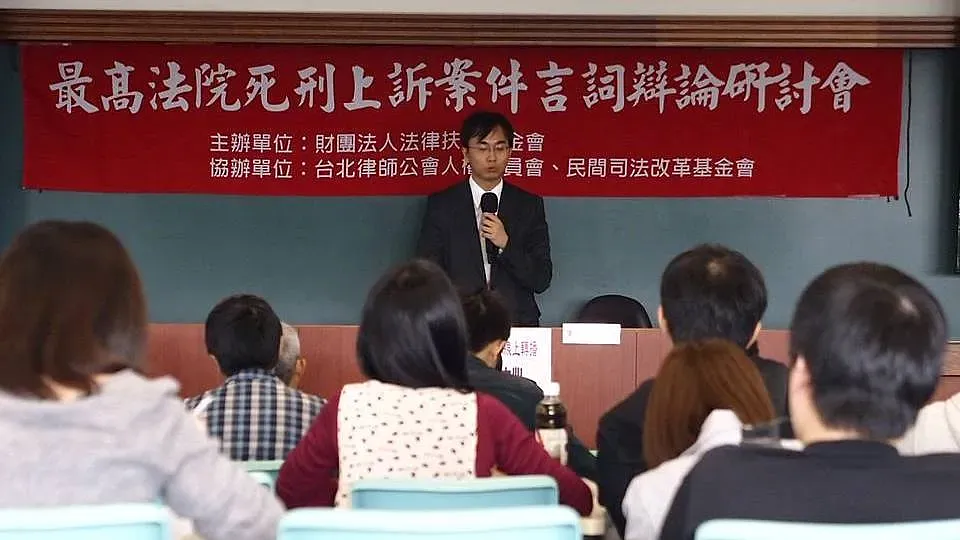
Finally, a lawyer could no longer bear it and rose up to 'rebel' against the unlawful and unconstitutional actions of the Supreme Court.
Last Friday, the Supreme Court held oral arguments for the second appeal in the Hsieh Yi-han robbery and murder case. True to its 'custom' in over a dozen previous death penalty debates, it adamantly refused to let the defendant appear in person. A sentencing debate that determines a defendant's life or death is conducted as though the defendant were a 'stranger,' unable to plead her own case.
Inside the courtroom, judges, prosecutors, defense counsel, and even members of the public gallery were all in their places, yet the defendant was absent. Even for someone accused of monstrous crimes, it was like a well-rehearsed play with complete lighting, stage design, and props, but lacking a main character. She has vanished already, even before the gunshot rings out.
Paragraphs 6 and 11 of Article 379 of the Code of Criminal Procedure explicitly stipulate that, 'except where otherwise provided, conducting a trial without the defendant appearing on the trial date' and 'failing to afford the defendant the opportunity to make a final statement' shall be deemed a judgment that naturally violates the law. The same applies to final judgments of the third instance, for which extraordinary appeals may be filed, with effects extending to the defendant (the 8th Supreme Court Resolution of 2002). However, the power to petition for an extraordinary appeal is monopolized entirely by the Prosecutor-General, who is unwilling to file one on behalf of death row inmates, leaving no way to examine its legality. Not to mention that Grand Justices' interpretations have repeatedly emphasized the 'right to be heard' constructed by due process of law; sentencing someone to death without hearing the defendant's statements and arguments is undeniably an unconstitutional judgment.
As a 'court of law,' when facing appeals against death penalty judgments, the Supreme Court consistently avoids debating legal controversies and criminal policies, and refuses to elevate the level to constitutional debates (doing nothing more than paying lip service to the fact that parties may apply for constitutional interpretation). Instead, it repeatedly belittles itself by conducting only 'sentencing debates' at the level of a court of fact. Aside from losing the stature of a supreme court of law, if it only conducts sentencing debates, there is even less reason not to give the defendant an opportunity to speak. It is like a doctor prescribing medication remotely without looking, listening, smelling, or asking the patient—is that not a quack? Even with a medical license, such a doctor would be penalized for violating the National Health Insurance Act. Yet judges who take human lives using the same method can sit comfortably in the Supreme Court? Rather than saying no one is available to supervise and correct them, it is more a matter of society's indifference toward 'heinous' individuals, thereby permitting and letting go.
On the one hand, the Supreme Court emphasizes that a court of law does not need to mutatis mutandis apply the rule that defendants must appear at the trial date for debates in a court of fact. On the other hand, it evades the obligations of a court of law and usurps the functions of a court of fact, clinging exclusively to empty abstractions regarding 'prospects of reform' during sentencing debates. How can the legal system tolerate a supreme chameleon shifting shapes at will? Furthermore, this time the Supreme Court invoked Article 392 of the Code of Criminal Procedure as its basis, failing to realize that this provision addresses default judgments where the defendant appears but the lawyer does not, and that this very basis proves the defendant's 'right' to appear in person during oral arguments—a right the Supreme Court cannot simply brush away. As for citing the practices of the supreme courts of Germany and Japan to claim that defendants do not need to appear, that is even more absurd. If they genuinely believe foreign legal systems are viable, why not swiftly align with Germany and abolish the death penalty early on, or at least petition the Grand Justices on the unconstitutionality of the death penalty? Not to mention that in Germany, while defendants do not need to appear for purely legal disputes, they certainly have the right to appear when debates involve the defendant's criminal facts or sentencing. As for Japan's long-standing hollow practice of not allowing defendants to appear, which has repeatedly drawn criticism for the 'emaciation of death penalty debates,' could this actually be the hidden agenda of our Supreme Court: nothing more than a play with a predetermined ending?
If this cannot be justified legally, perhaps the considerations are practical. Are there no special prisoner transit corridors, a shortage of bailiffs for escort and custody, or court clerks who do not type fast enough? Compared to a human life, can these serve as excuses? Even if the previous administration was unwilling to make improvements, did they not just change to a new President with an excellent reputation for integrity and administrative capability? Administration has always served adjudication; since when have we allowed adjudication to compromise human lives just to accommodate administration? And what about the power of administrative supervision? If judges fail to attach reasons (over a dozen judgments in the past two years have provided no reasoning whatsoever) and stubbornly insist on acting illegally by denying the defendant the right to appear and argue—if such a situation occurred during a sentencing debate in the first or second instance, would the court president dare to sit idly by and do nothing? Isn't the power to initiate judicial self-regulation held precisely by the court president?
If the Supreme Court evades legal and constitutional debates and only provides sentencing debates, then it must have the courage to face the defendant! Unwilling to see the defendant? Then uprightly conduct genuine legal debates and show us what the true stature of a court of law is!
※ This article was published in the Apple Daily on Nov. 16, 2015
This article is an AI-generated translation of the original Chinese text. In the event of any discrepancy, the Chinese version shall prevail.