
Judges, Please Let Go of Your Fragile Egos
Last edited: 2026-07-27
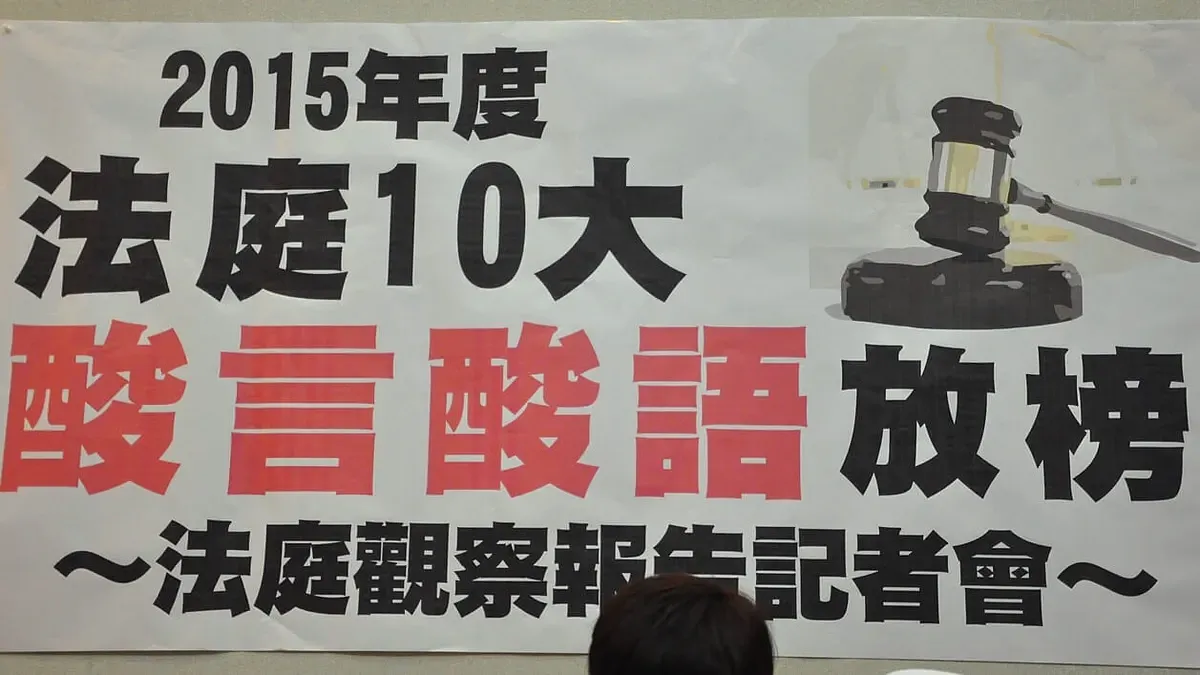
Recently, the Judicial Reform Foundation (JRF) released its 2015 Courtroom Observation Report, listing the "top ten sarcastic remarks" made by judges and preparing to submit four judges whose cases were relatively severe for judicial evaluation. This reportedly sparked considerable backlash within the judiciary. Before responding to this backlash, it is necessary to explain that our action this time has been even more refined and restrained. For twenty years, the JRF has continuously conducted courtroom observations. Before the establishment of the judicial evaluation system, for civil society's monitoring to have any teeth, our approach was to directly hold press conferences and name-and-shame. Consequently, our chairperson and executive director were once even self-prosecuted for defamation by judges of the Taiwan High Court. We took it in stride, and that incident eventually became one of the triggering cases for Judicial Yuan Interpretation No. 509.
This time, we closely observed over twenty judges, yet selected only four for evaluation, and further resolved not to make their names public. This decision was weighed upon the realization that while these judges indeed had poor courtroom demeanors—perhaps due to poor personal emotional control, or perhaps out of an intense subjective desire for perfection driven by earnestness—there were no clearly malicious motives discernible. Therefore, we chose to withhold their names and leave further investigation to the Judge Evaluation Commission. If we merely wanted to humiliate the judiciary, we would not have deliberated so carefully. Out of more than twenty filtered down to seven, and then from seven down to four, we still insisted on withholding their names despite repeated questioning by reporters. If even this approach is unacceptable to judges, it essentially amounts to a rejection of any and all oversight. Our adoption of a more refined and delicate approach is a basic demonstration of our shared care for the judiciary, as well as the starting point for opening up communication and dialogue.
Criticisms and Responses
Initial reactions of backlash from judges can generally be divided into systemic criticisms and personal-targeted criticisms. The first targeted voice is "He/She is not that bad." This involves matters of fact and standards. Facts must be investigated; what the JRF can do is to continuously observe, discuss, and filter after receiving recommended lists from lawyers across various regions, and finally assign specialists to conduct a final confirmation of the shortlisted names.
Now that we have the Judge Evaluation Commission, we believe that as long as the judges' courtroom conduct is investigated, the truth will come to light. The JRF is not an official entity and lacks investigative powers; we can only do our utmost to fulfill what we can and should do. Historically, if investigated cases show no poor courtroom demeanor, or if the conduct was truly isolated and minor, we would withdraw our request. Precisely because this is a simple matter of factual investigation, it will be clarified once examined.
However, a judge's courtroom demeanor also touches upon the question of standards. What legal insiders take for granted does not mean the public is accustomed to it or will silently endure it. Taiwan has increasingly become a society that dares to challenge authority; only the law and reasoning can genuinely convince people. Relying merely on official might to suppress others may silence people temporarily, but it does not mean they will not resist later. Judges must psych themselves up to accept public scrutiny for every word and action in an open courtroom, and they should not harbor wishful thinking.
The second voice lies somewhere between the personal and the systemic: "They are hardworking judges; there are even worse judges who haven't been caught." Indeed, the function of courtroom observations is limited; we can only see a judge's surface demeanor, and "slackers" or judges with integrity issues are not easily uncovered this way. Furthermore, without understanding the full picture of a case, perhaps the judge was provoked to anger by a lawyer or a party, and the prosecutor and defense counsel may have exhibited even worse attitudes and performance.
Demeanor and diligence should be treated as separate matters. Can a hardworking judge therefore claim the right to abuse their demeanor and act arbitrarily? Comparing the attitudes of judges, prosecutors, and lawyers should also be dealt with distinctly. The Taiwan Judges Association's advocacy for three-way cross-evaluation is something we warmly welcome. Perhaps the ultimate result will show that judges have the highest demeanor and legal literacy among the three, with lawyers sent for disciplinary action and prosecutors sent for evaluation—that would be fine, but it still does not justify a judge's poor demeanor.
What is truly saddening is that judges with poor demeanor universally harbor a paternalistic mindset of "I am doing this for your own good." This is naturally tied to the "ideal judge image," which is the overarching issue of how judges are selected, trained, and self-positioned. The public certainly welcomes judges showing greater care and consideration, but they should not lecture legally unversed citizens like undisciplined children. Judges are not prosecutors; the presumption of innocence must be painstakingly maintained. Civil cases are services paid for by the people, and family law matters require an understanding that everyone has their own difficult circumstances to navigate—do not smuggle in your own overly decisive, triumphant worldview. Judicial solicitude and paternalism are separated by only a thin line.
The final general criticism is that the top ten sarcastic remarks we selected lacked context, were taken out of context, and amounted to a smear against the judiciary. However, these top ten remarks were all selected from words spoken by judges inside the courtroom, representing the most exaggerated ten statements. The fierce backlash from judges may stem from a belief that things were not that bad, and since they themselves have more or less uttered similar remarks, they find it unreasonable to be referred for evaluation.
As mentioned earlier, we do not expect judges to be saints, and we understand that everyone experiences emotional fluctuations. We emphasize that, out of a desire to safeguard the judiciary, we maintain our boundaries. "Uttering these few sentences" is not the primary reason for our referral for evaluation; the four targeted judges exhibited "continuous and habitual" poor demeanor. No matter how much one rationalizes their starting points and benevolent motives, we feel the public should not be treated this way, nor can their behavior be easily justified.
Furthermore, there are subsequent procedural safeguards in place, including the Judge Evaluation Commission, the Control Yuan, and the Disciplinary Court. Coupled with our complementary resolution not to publicize the judges' names, we believe this calibration of scale complies with the principle of proportionality and causes no unnecessary harm to the judiciary or the individual judges. If the reactions of the media and the public are not sympathetic to the judges' plight, but instead filled with cheers and applause, perhaps judges should calm down and consider whether their communication with the media and the public has gone wrong, or if their ideas are simply too wishful, remaining entirely oblivious to how far removed they are from the general public?
Expectations and Actions
We understand that the true difficulty facing the judiciary may not lie in judges' attitudes. Moreover, filing complaints may not be the best way to resolve the issue of judicial demeanor; the root problem—excessive caseloads that hinder the improvement of ruling quality and cause immense work pressure for judges—must be addressed first.
Yet, as the old saying goes, this still does not justify poor judicial demeanor. Our expectations for judges are higher: we do not want hardworking and emotionally steady judges to have their image dragged down by those with poor demeanors, nor do we want them to lower their standards by comparing themselves to slackers, and we are even more averse to judges comparing their attitudes to prosecutors who intimidate people behind closed doors in interrogation rooms. We hope judges will possess a grand vision and constantly strive upward.
The power wielded by judges is an independent judicial power, and such immense authority is entrusted by the people, not derived from their test-taking prowess, let alone bestowed by superiors. The image of the judiciary belongs to fairness and justice; judges should not merely obsess over administrative evaluations and the unreasonable, unlawful, or even unconstitutional outdated views of appellate courts. Judges are the very group of people who can truly check state organs against arbitrary abuse of power, and indeed, they are the only effective body that can spur prosecutors to progress.
The JRF is not the Judicial Yuan; our criticisms and suggestions are merely part of the advocacy agenda we have set. Judges should adopt a broad perspective, correcting their faults if they have them, and guarding against them if they don't. Even if the Judicial Yuan sets the agenda, judges should realize that their own judicial reform agenda ought to be set by themselves. Stop treating yourselves as minor staff members devoid of influence, sense of direction, or idealism. Otherwise, others will treat you precisely as minor staff members.
Whether it is the issue of excessive caseloads, administrative evaluations, or the rigid terminology and formatting of judgments, judges should set a judicial reform agenda suited to themselves and no longer easily be swayed by judicial administrative directives. View yourselves as public intellectuals, break the curse of self-isolation, and at the very least strive to improve your own working environment. Our expectations for judges are high precisely because judges are the guarantee and conscience of the rule of law state. Unite quickly, carry out bold and resolute reforms, and cast away those trivial and fragile glass hearts.
※ This article was published on Nov. 15, 2015, PNN PTS Public News Agency
This article is an AI-generated translation of the original Chinese text. In the event of any discrepancy, the Chinese version shall prevail.