
JRF Newsletter: The 2016
The 2016
Last edited: 2026-07-27
 ※ During the book exhibition, make a "loose-change simple donation" at the event venue to receive a free copy of Practice Together
To promote their ideals and issues, NGOs often publish books to raise public awareness. However, publishing is typically not the core business of NGOs; constrained by manpower and resources, it is difficult for them to establish market channels or have their books featured in mainstream bookstores.
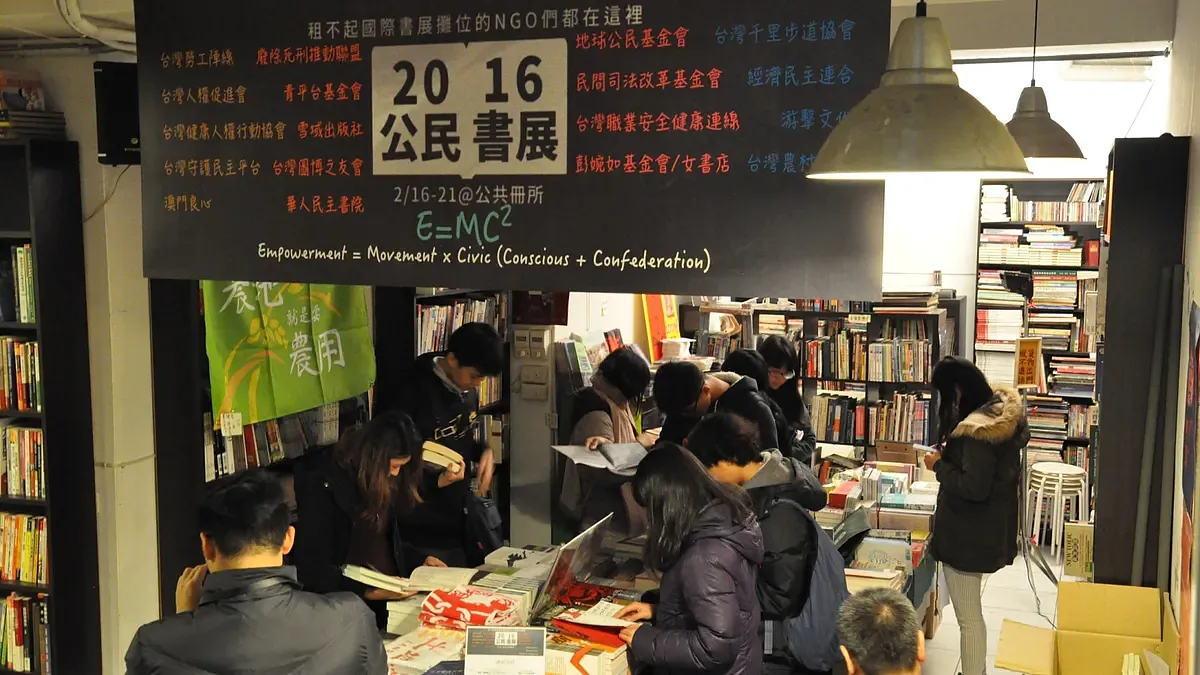
In the past, the Taipei International Book Exhibition invited NGOs to participate, allowing the reading public to access NGO publications, but unfortunately, such invitations have ceased in recent years. Therefore, several NGO groups organized the event titled "NGOs Who Cannot Afford a Booth at the International Book Exhibition Are Here: The 2016 Civil Book Fair." From the 16th to the 21st, daily from 10:00 AM to 9:00 PM, publications from various NGOs were exhibited at the independent bookstore "Libratory." Naturally, the Judicial Reform Foundation did not miss out.
At the book fair, we exhibited volumes 1 to 3 of Grand Justices, Give an Explanation!, which compiles past constitutional interpretations made by the Grand Justices, as well as Grand Justices, Give No Explanation!, a book covering highly controversial and valuable constitutional issues on which the Grand Justices did not issue interpretations. This series exposes how Taiwan's judicial system has gradually improved through successive Grand Justices' interpretations, while also shedding light on issues that the Grand Justices evaded and dared not address. In addition, we featured Wrongful Convictions, a book on real-life miscarriage of justice cases. Co-translated and overseen by the JRF, this book uses the stories of wrongful convictions to prompt reflection on our attitudes toward crime and truth.

In addition to physical books, the JRF also set up a tablet at the book exhibition to showcase our free online e-books. Many JRF publications serve the public interest and act as handy reference guides that can be kept at home and consulted frequently. For example, 99 Ways to Protect the Rights of Ordinary Citizens is an excellent book detailing Taiwan's Code of Criminal Procedure and the various rights of parties involved. Regrettably, after several years, these books have gone out of print and are difficult to purchase. Therefore, over the past year, the JRF has worked diligently to convert some of our previously published books into free e-books, making them available online for everyone to read for free. Readers can download these books and read them in iBooks or Google Play Books.
Currently, the JRF's most popular e-book is 99 Ways to Protect the Rights of Ordinary Citizens, which has been read approximately 55,000 times and downloaded over a thousand times in the past year. Our second most popular e-book, Rescuing the Defendant: A Police Station Tactical Handbook for Lawyers, has been read by over 13,000 people in the past year. Moving forward, we will continue our efforts to list these publications on online bookstores such as iBooks and Google Play so that everyone can access these books for free.

JRF's e-books are released under a Creative Commons Attribution-ShareAlike (CC BY-SA) license. Traditional copyright typically asserts "All Rights Reserved," meaning that transmission or reproduction requires authorization from the copyright holder. This often deters ordinary people from making casual use out of fear of copyright infringement, which in turn indirectly restricts others from accessing the work. In contrast to conventional copyright, Creative Commons introduces the concept of "Some Rights Reserved," leaving the remaining permissions open for public use. Under the licensing terms adopted by the JRF, as long as the author's name is attributed and the content is released under the same Creative Commons Attribution-ShareAlike license, these published e-book contents may be reproduced, distributed, transmitted, and modified (including for commercial use). We believe that through Creative Commons licensing, by openly allowing other users to reproduce, transmit, and distribute our works, more people will have the opportunity to engage with the JRF's ideals for judicial reform.

Alongside the book exhibition, Libratory also hosted a series of civil lectures. On Friday, February 19, at 14:00, the JRF hosted a screening and post-screening discussion of the documentary "Exercises Given by Hsu Tzu-chiang" at Libratory. In addition to Hsu Tzu-chiang (徐自強), the victim of a wrongful conviction, the event invited the documentary's director, Chi Yueh-chun (紀岳君), to share his insights and experiences in documenting Hsu's case.
Director Chi shared that he had previously understood the case through the internet and media reports, and found it hard to believe that Hsu Tzu-chiang was innocent. However, after truly engaging with Hsu's case and coming to fully understand the events that transpired, he discovered a lack of definitive evidence implicating Hsu. This realization made him abruptly aware that his previous preconceived notion was precisely the "presumption of guilt." He believes that this attitude toward crime is precisely why many wrongful convictions occur. Through this film, he hopes to guide everyone in understanding the 20-year-long Hsu case so we can collectively confront and reflect on our attitudes toward judicial reform.
- Time: Friday, February 19, 14:00
- Location: Libratory, Basement, No. 24, Taishun St., Da'an Dist., Taipei CityMap
- Panelists:
- Chi Yueh-chun (紀岳君) / Director
- Hsu Tzu-chiang (徐自強) / Wrongful Conviction Victim
We look forward to everyone joining us to tackle the exercises given to us by Hsu Tzu-chiang!
This article is an AI-generated translation of the original Chinese text. In the event of any discrepancy, the Chinese version shall prevail.