
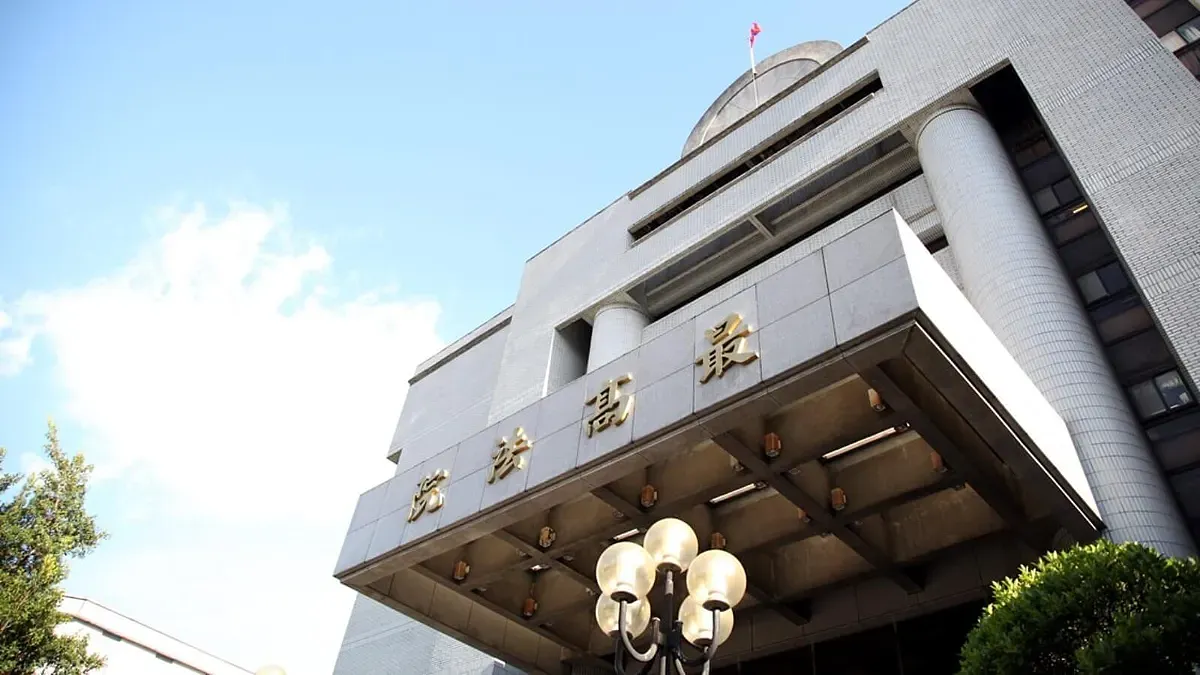
The "House of Cards" Play Performed at the Supreme Court
Last edited: 2026-07-27
Imagine a scene from "House of Cards." President Francis calls the President of the Judicial Yuan (Wait, wasn't he the Chief Justice of the Federal Supreme Court in the show, rather than the Judicial Yuan President? What a strange system!) into his Oval Office to ask his opinion on the candidate for the Supreme Court President. Oblivious and unaware that the President already has someone in mind, the Judicial Yuan President keeps rambling on. Francis stops him with a gentle, affectionate yet stern expression, and begins to unleash his silver tongue. Appealing to emotion, reasoning with logic, dangling benefits, and finally, if coercion is rejected, threatening with force. The Judicial Yuan President finally understands the situation and accepts reluctantly. Though burning with rage, under the calculated political maneuvering and wheeling and dealing of Francis, he has no choice but to swallow it. The audience applauds enthusiastically. Kevin Spacey, that master actor, brilliantly portrays the politician whose insincerity masquerades as sincerity while meticulously wielding political intrigue and authority. It is truly wonderful. Of course, the above is merely a fictional plot.
In the real world, the Judicial Yuan recently (10/16) issued a "short-short" press release that is full of flavor. Two sentences telling two things. First, "Regarding the personnel case of the new President of the Supreme Court, President Ma recently summoned President Lai Hao-min of the Judicial Yuan"; second, "The Judicial Yuan stated that since this personnel authority belongs to the President's prerogative, it should naturally be respected." I wonder if this press release has set a "shortest record" in judicial history? Though extremely brief in wording, its implications are profound and worthy of textual analysis.
Wildly Expanded Imaginative Space
First, it is evident that President Ma sought out Judicial Yuan President Lai Hao-min specifically to discuss the personnel appointment of the new Supreme Court President. Due to judicial independence, presidential intervention in personnel matters is somewhat sensitive. However, both the President of the Judicial Yuan and the President of the Supreme Court possess judicial administrative powers; being summoned by the President and having the President directly recommend personnel—even if it is the President's prerogative, and regardless of how sensitive the process may be—does not quite amount to direct interference in individual adjudication. At most, it can only be interpreted as the President wishing to select someone he trusts and expecting them to act in accordance with the President's will in the future. This is much like how US Presidents invariably nominate Justices friendly to themselves, only for those Justices to independently forge their own paths later on, with plenty of miscalculations by Presidents along the way.
Second, the method for producing the Supreme Court President is not explicitly stipulated by law. Although not nominated and appointed by the President, the order of appointment is issued in the name of the President. This is perhaps the primary reason why the Judicial Yuan stated that "personnel authority belongs to the President's prerogative," leaving the Judicial Yuan with no choice but to "respect" it.
Anyone familiar with Taiwan's official bureaucratic culture knows that whenever government officials speak of "respect," it indicates resentment in their hearts. Regarding President Ma's "heavy-handed dominance/interference" in the personnel appointment of the Supreme Court President, the Judicial Yuan President is clearly displeased. Perhaps because of this, he intentionally brought to light the fact that President Ma summoned him and issued a thought-provoking press release, heightening the suspense and sensitivity of the situation.
President Ma's acting skills are likely far inferior to Kevin Spacey's, and his dialogue with President Lai is probably not as brilliant as a script written by a professional writer. Watching the drama is one thing; what truly deserves serious discussion is whether this personnel authority genuinely qualifies as a presidential prerogative. This perhaps needs to be addressed by first discussing the positioning of the Supreme Court President.
Positioning the Supreme Court President
The Supreme Court is the "highest" adjudicatory body. Strictly from the theory of the separation of powers, its president should be the Chief Justice. Having both the Supreme Court and the Judicial Yuan function as two "highest" judicial organs implies that one unit ought to be abolished, which is precisely the intent of Judicial Yuan Interpretation No. 530.
Today in our country, in terms of the ultimate effectiveness of interpreting the application of law, the de facto influence of the Supreme Court is no less than that of the Grand Justices. Before Interpretation No. 530 continues to be ignored by judicial bureaucrats, treating the President of the Supreme Court as having a status comparable to a Grand Justice is probably not an overstatement.
In this regard, if we believe Grand Justices should be nominated by the President and appointed with the consent of the legislature, the President of the Supreme Court should likewise be handled analogously. Furthermore, even the Prosecutor-General adopts this nomination model and is granted independent tenure protection; the Supreme Court demands an even higher degree of independence, making it all the more necessary for its president.
As such, the President's nomination should follow a set of procedural rules, just like the Grand Justices, openly accepting recommendations and reviews from all sectors. Once nominated, the candidate should be sent to the Legislative Yuan for legislative hearings, vetting, and voting, thereby conferring democratic legitimacy (at least indirectly) upon the Supreme Court President.
Unless the Supreme Court President is merely an "administrative concurrent post," much like the current "Presiding Judge system." It essentially exists to resolve and coordinate administrative work among judges, functioning somewhat like the concept of "duty officer." Of course, this notion runs counter to current realities.
The current Supreme Court President, much like the early "Presiding Judges," holds immense power, combining both judicial administrative power and adjudicatory power, and even has a legal basis. Article 12 of the Supreme Court Organic Rules states that the President oversees all "administrative affairs" of the court. Article 13 states that the President's duties include "5. Post-hoc review of civil and criminal judgments" and "10. Presiding over civil and criminal division meetings," which involve "adjudicatory power."
Paragraph 2 of Article 29 explicitly grants the President the power to "review" judgments (frankly, this already infringes upon judicial independence and ought to be an unconstitutional provision). Articles 32 and Paragraph 1 of Article 33 also allow the President to convene civil and criminal division meetings to unify legal interpretations. When judges tie in a vote, the President holds the decisive casting vote (naturally, using "meetings" at the Supreme Court to unify legal interpretations has repeatedly been criticized as usurping legislative power).
These contradictions between current realities and institutional designs—between the actual and the ideal—make the question of whether the "prerogative" to nominate the Supreme Court President rightfully belongs to the President or the Judicial Yuan even more complex and intractable. Ultimately, even "citing past precedents" is far from ideal, leaving ample room for imagination regarding presidential interference in the judiciary.
In reality, grass-roots judges launched a "Reform the Supreme Court" movement in 2012, with a majority of judges signing a petition advocating that the Supreme Court President should be elected by all judges. This approach, while Interpretation No. 530 remains unfulfilled, seeks on one hand to realize judicial autonomy, and on the other hand hopes that through this landmark election, candidates for Supreme Court President will present political platforms, reflecting and projecting the image of judges and the value of judicial independence through ballots.
This nomination and appointment of the Supreme Court President reflects, to some extent, the awkward predicament caused by having too many judges on the Supreme Court, leaving their status dangling in an ambiguous middle ground. Lacking the stature of presidential nomination followed by congressional approval, they are bizarrely bypassed by the Judicial Yuan President, appointed directly by the President, and left hanging out to dry.
Regardless, we are not overly concerned about whether a "favored crony" wins out—cabbages and radishes, mountains and forests, each has its nature and its admirers—yet the Supreme Court indeed touches the judicial soul of every judge, and its president substantially shapes the appearance of the Supreme Court. The appointment process played out precisely like a botched episode of "House of Cards," featuring a plot that was both unsightly and unacceptable.
This article is an AI-generated translation of the original Chinese text. In the event of any discrepancy, the Chinese version shall prevail.