
Su Yung-chin Likely Broke the Law
Last edited: 2026-08-30
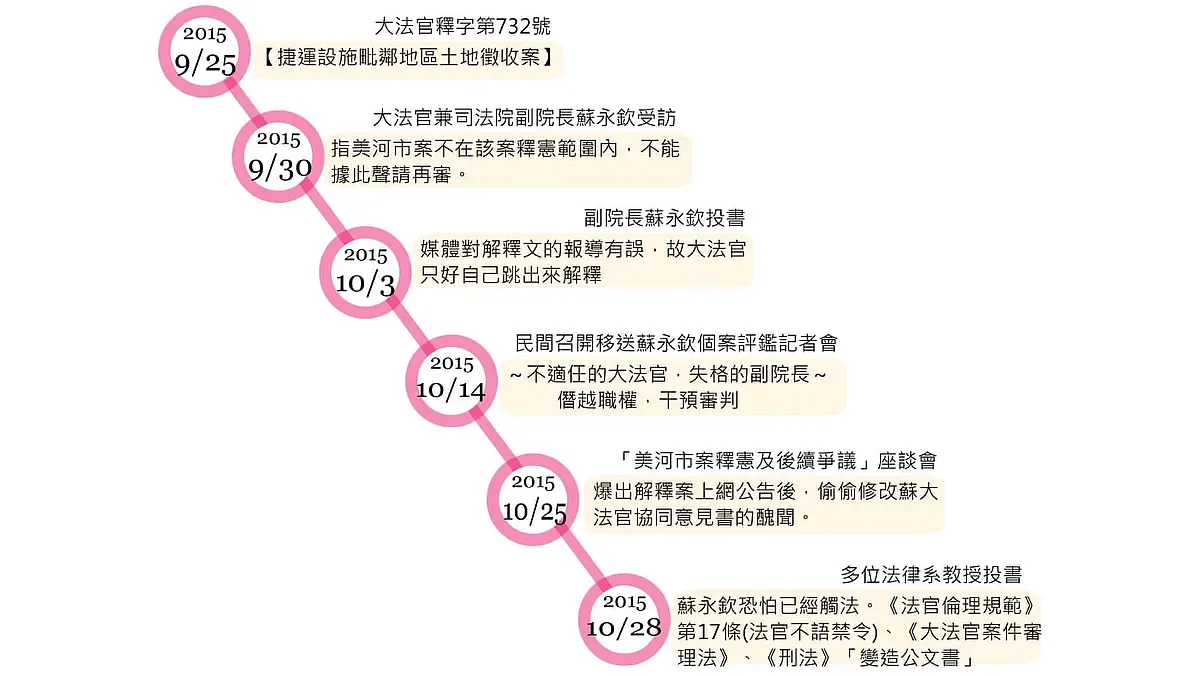
After the promulgation of Judicial Yuan Interpretation No. 732, Grand Justice Su Yung-chin took three actions: first, making public statements asserting that the Meilunshih case fell outside the scope of the constitutional interpretation and could not serve as the basis for a motion for retrial; second, publishing an op-ed; and third, subsequently having the Judicial Yuan replace his written "concurring opinion" to add the aforementioned text.
Grand Justice Su's extrajudicial remarks—including his statements and op-ed—clearly raise the issue of violating the "judge should not speak" prohibition, namely Article 17 of the Code of Judicial Ethics. Furthermore, by replacing the already promulgated "concurring opinion" to add text that was not originally there, he not only breached judicial ethics, but the new version and Grand Justice Su's act of replacing it likely also involve issues of legality.
The reason why "judges should not speak" has become a canon of judicial ethics is that when judges comment outside of judgments on cases adjudicated by themselves or others, first, it may manifest judicial bias and thereby shake public confidence in the judiciary; second, it may conflict with the interests of the parties involved, as a judge's commentary on other cases could influence the presiding judge's verdict, thereby undermining the credibility of the judiciary.
Issues Concerning the Violation of "Judges Should Not Speak"
Grand Justice Su's extrajudicial statements happened to involve another case: outside the scope of Interpretation No. 732, he made a prejudgment on whether a motion for retrial could be filed in the Meilunshih case based on that interpretation. If such an extrajudicial interpretation made by Grand Justice Su in his capacity as a Grand Justice were to be tolerated, it could realistically exert influence on the judges presiding over the retrial. This is precisely what Article 17 of the Code of Judicial Ethics aims to prevent.
Knowing that his actions raised concerns of conflicting with the "judges should not speak" prohibition, Grand Justice Su offered a self-defense in his op-ed. This defense appeared to invoke the proviso of Article 17 of the Code of Judicial Ethics: "However, this shall not apply where it is reasonably anticipated that the judgment or the fairness of the procedure will not be affected, or where such public explanation is necessary in the performance of official duties."
Yet, the question of "whether the land in the Meilunshih case falls within the scope of the constitutional interpretation text" was never a disputed issue during the proceedings of Interpretation No. 732 from the very beginning. Until Grand Justice Su replaced his opinion, none of the officially promulgated interpretation texts, reasoning, or opinions of that interpretation had ever debated this issue. Therefore, the opinion put forward by Su fundamentally did not belong to matters "within the scope of that case," and there could be no talk of an "explanation necessary in the performance of official duties."
Let us now examine the replacement of the "concurring opinion." The newly implanted text similarly raises the issue of violating the "judges should not speak" principle, because it constitutes commentary on another case outside the principal case. A more serious issue is whether Grand Justice Su and the Judicial Yuan had the authority to replace the version of the opinion after its promulgation, and what its "legality" might be.
The New Version of the Opinion Lacks Legality
The incorporation of the "concurring/dissenting opinion" system into Articles 18 and 20 of the Act Governing Adjudication by Grand Justices follows judicial practices in the United States. Although an "opinion" is neither the judgment itself nor the reasoning upon which the judgment is based, its emergence is endowed with a certain "legal status" and "legal authority" by the judiciary. It is not merely the expression of a judge's personal opinion.
Legalizing the "opinion" in the Act Governing Adjudication by Grand Justices means not only transplanting practices from other countries, but also explicitly acknowledging its "institutional function" (evidentiary function) and "legal authority." Moreover, Article 20 of the Act, which stipulates that opinions shall be "promulgated together with the interpretation text and reasoning," further defines the opinion as "part of the official document" of that constitutional interpretation case. Furthermore, pursuant to the same Article, those who "submit past the deadline" or "are unwilling to publish" shall not be published, leaving no room for separate publication subsequent to being "promulgated together." This is a very strong manifestation of the "institutional function" of the "opinion," which even the Grand Justice who authored the opinion must respect.
From this, it can be seen that Grand Justice Su and the Judicial Yuan had no authority whatsoever to "replace the opinion" after the fact. The new version of the opinion lacks legality, should be withdrawn, and reinstated to its original state. Furthermore, the "unauthorized" alteration of the contents of an already effective official document by Grand Justice Su and relevant personnel of the Judicial Yuan not only violates the Act Governing Adjudication by Grand Justices, but likely also constitutes the criminal offense of "falsifying official documents" under the Criminal Code. The gravity of this matter cannot be taken lightly.
※ This article was published in the Apple Daily on Oct. 28, 2015
This article is an AI-generated translation of the original Chinese text. In the event of any discrepancy, the Chinese version shall prevail.