
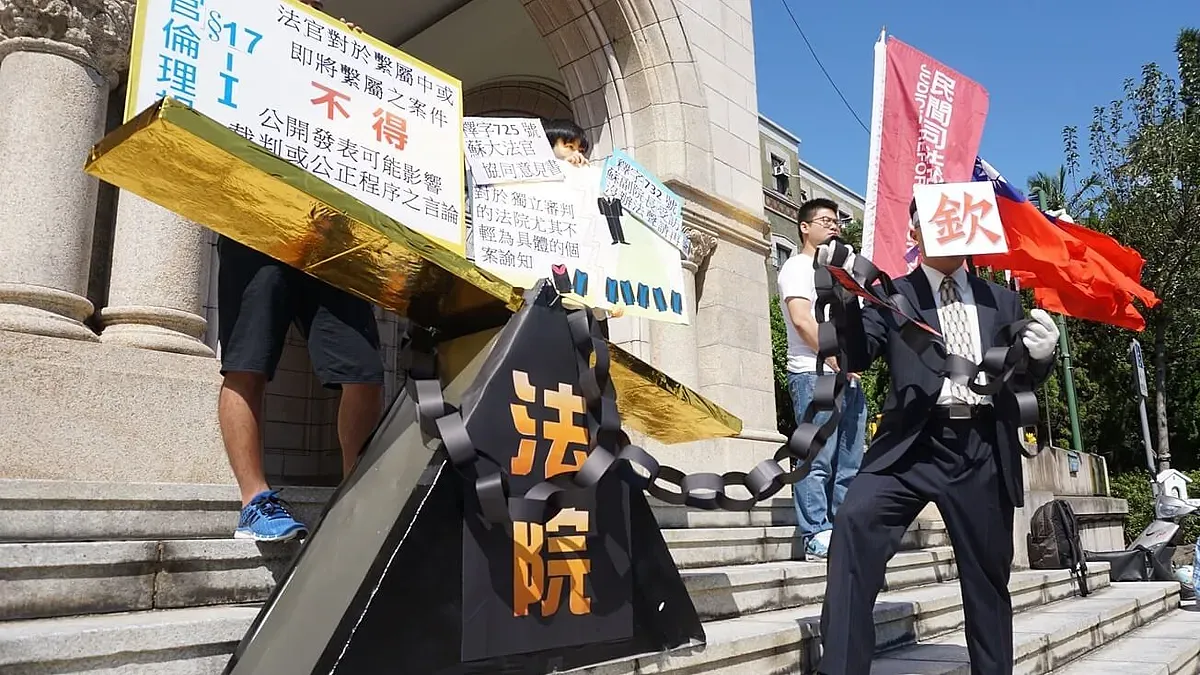
Aren't the Grand Justices Due for Self-Purification?
Last edited: 2026-08-30
Grand Justice and Judicial Yuan Vice President Su Yung-chin argued that a retrial could not be petitioned in the Meihoshi case, raising suspicions of judicial interference. He was recently referred for judicial evaluation and requested to undergo judicial self-regulation. Furthermore, a scandal erupted when he secretly modified his opinion after it was published online. The revised text added fifty-two words, the content of which was none other than to rebut that the Meihoshi case did not fall within the scope of Constitutional Interpretation No. 732 and therefore could not be retried.
In fact, this is consistent with his public statements. He said that because he was stuck at home watching TV during a typhoon holiday and found that media reports were "not a single one of them correct," he felt compelled to speak out. First, a fact must be clarified: when exactly was the modified opinion posted online? Was it before or after his public statements? Computers do not lie, and the Judicial Yuan must investigate this thoroughly.
If it was posted online before his statements, Su summoned reporters clearly to emphasize this passage. Since it had not been written previously, he rushed to add it in hopes that reporters would subsequently feature extensive coverage. When he was previously criticized for interfering in a specific case, he argued righteously that he was "interpreting Constitutional Interpretation No. 732" rather than discussing an individual case. In hindsight, this appears utterly hypocritical, evidently intended precisely for "this passage" he added, isn't it?
If it was added after his statements, aside from the impropriety of the content concerning a specific case, it also raises the question of whether an individual concurring opinion can be modified after its publication. Some argue that even the main text of a Grand Justice interpretation can be amended. While this is academically acceptable, our country has never done so. Grand Justices have held themselves to strict standards, traditionally taking a straightforward and open approach by amending opinions through "supplementary interpretations."
Of course, concurring opinions are not binding, and if individual Grand Justices wish to make revisions within a reasonable timeframe, a more lenient approach might seem permissible. Even so, it should at least be done openly and aboveboard, indicating the revised portions or even explaining the reasons for the changes, out of consideration for those of us who "truly take the words of the Grand Justices seriously."
However, Grand Justice Su's actions are a classic case of "protesting too much." His objective was precisely to shut down the Meihoshi case, leaving it with no possibility of being overturned, prompting him to unprecedentedly find reporters to discuss a specific case, put on a facade of interpreting Constitutional Interpretation No. 732, enlist other Grand Justices to endorse his stance, reach the conclusion that a retrial is impermissible, silence the ordinary courts, and undermine the environment for fair trial—all at any cost.
Grand Justices stand at the intersection of politics and law; their heavy responsibility is to recognize the potential infiltration of politics while still vowing to uphold the dignity of the Constitution. Given such a colleague, isn't it time for the Grand Justices to purge themselves?
※ This article was published in the Liberty Times on October 27, 2015
This article is an AI-generated translation of the original Chinese text. In the event of any discrepancy, the Chinese version shall prevail.