
Creating Optimal (Political) Benefits Between Ambiguous Theories/Logic?
Last edited: 2026-11-03
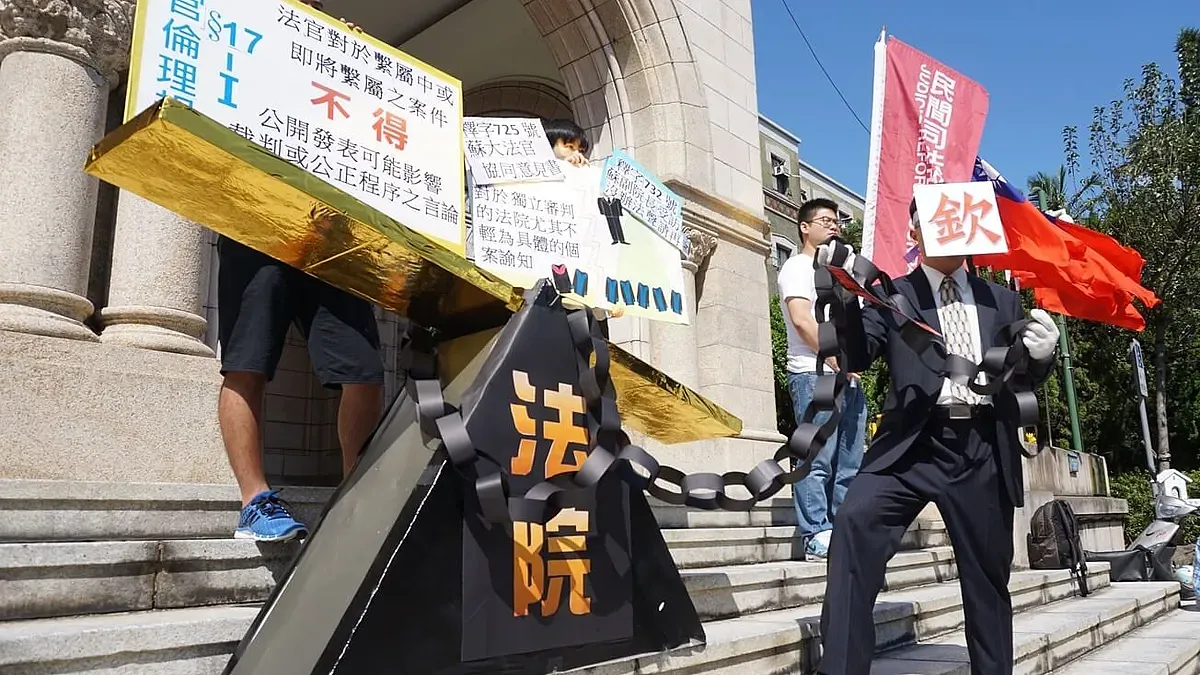
Grand Justice and Judicial Yuan Vice President Su Yung-ch'in commented on the "Meilongwan Case", arguing that the expropriated land was fundamentally for a depot rather than adjacent land, and thus fell outside the scope of unconstitutionality declared in J.Y. Interpretation No. 732. He also directly asserted that the case could not petition for a retrial and had no possibility of relief. After triggering criticism for "interfering with future trials", Vice President Su grew even "bolder after setbacks", publishing an article the next day to rebut. In a gentle and earnest tone, he reiterated his old arguments while becoming even more "clear and explicit": he "respected" the public's petition for a retrial, but suggested they might need to "carefully read" relevant retrial regulations, expressing belief that the court would "prudently review" whether a retrial was possible. At the end of the article, he specifically emphasized why he "had to step forward": because of the media's "obvious and comprehensive misguidance", and if a Grand Justice remained "silent" when questioned, it would be an "outdated legal mysticism".
Mr. Wang Chien-chuang subsequently wrote an article, noting that although U.S. Supreme Court Justices have gradually broken the tradition of "judicial silence", Vice President Su's expressing opinions on Interpretation No. 732 twice was extremely rare; he subsequently criticized that the Grand Justices' poor legal linguistics is the real reason why everyone cannot understand Grand Justice interpretations. Judge Tsai Chih-hung also wrote an article the next day to express agreement, believing that if the public misinterprets, "allowing the judiciary to make timely and early clarifications and interpretations by itself should be a better design for exerting the functions of the judicial power".
The author agrees with the words of Mr. Wang Chien-chuang and Judge Tsai Chih-hung. However, Vice President Su's words are exquisite and artful; what he thinks in his heart and says with his mouth is probably worlds apart from what the two well-meaning gentlemen are discussing.
Fundamentally Not Clarifying an "Interpretation"
Appropriately balancing "judicial silence" is worthy of affirmation. Judges' judgments should no longer be unfathomable and "pretentious", but should honestly communicate with the people to gradually gain trust. "Allowing the judiciary to make timely and early clarifications and interpretations by itself" is indeed a better method. However, is Vice President Su really talking about and wanting to talk about Interpretation No. 732? Actually, no.
Interpretation No. 732 did not discuss whether the "Meilongwan Case" could be retried, and Vice President Su completely overstepped his bounds. Except for President Lai Hao-min, all other Grand Justices submitted concurring or dissenting opinions. Aside from the dissenting opinion by Grand Justice Lin Hsi-yao arguing that this case should not be accepted, no one mentioned the "individual case".
Needless to say, not a single Grand Justice talked about what the "future fate of the individual case" would be or how it should be handled. Can Vice President Su's way of speaking be considered "clarifying Interpretation No. 732"? If other Grand Justices are able to exercise self-restraint and not touch individual cases, why can Vice President Su stand out independently and seemingly "surpass" the other Grand Justices?
Of course, some might say that individual cases and interpretations are tied together, and discussing Grand Justice interpretations inevitably drags in individual cases. This argument can be accepted because foreign countries have historically had a constitutional complaint system, and if our country introduced it, Grand Justices could naturally handle unconstitutionality issues of individual cases. If there were a constitutional complaint system, discussing law would mean discussing individual cases. However, Vice President Su has consistently been a leading opponent of this system, making it hard to imagine that he is unintentionally rather than intentionally discussing an "individual case".
For example, he stated in his concurring opinion to Interpretation No. 725: "The petition procedure by individuals stipulated in Article 5, Paragraph 1, Subparagraph 2 of the current Constitutional Interpretation Procedure Act is purely an objective normative review procedure. This is why the interpretation result only determines whether the laws in question are unconstitutional, and neither the interpretation text nor the reasoning text describes or responds to any of the petitioner's claims, nor do they provide any explanation for the underlying case that triggered the procedure."
Simply put, Vice President Su believes that citizens petitioning Grand Justices for an interpretation merely provides "legal material" of potential unconstitutionality for the Grand Justices to decide whether these materials are unconstitutional. When Grand Justices do not respond to what was said in a citizen's petition for constitutional interpretation, they also do not explain the individual case adopted by the citizen when petitioning. Taking the "Meilongwan Case" as the example, the Grand Justices are not bound by the reasons why citizens claim unconstitutionality, nor do they need to respond. As for the "individual case" of Meilongwan, they will certainly not make "any explanation".
From this, it is evident that Vice President Su has a special "infatuation" with the "Meilongwan Case", which is drastically different from his past attitude. He insisted on using the "individual case" of Meilongwan to make public statements. Even at the risk of being questioned as not "clarifying Interpretation No. 732" and being criticized for "stepping over" other Grand Justices, he still disregarded it and insisted on making public statements. The magnitude of this shift is simply astonishing!
Care More About the System Than Shielding
Many insinuate that Vice President Su has a deep relationship with President Ma, and the "Meilongwan Case" might cause President Ma to face lawsuits or even prison time after stepping down from office, which is why Vice President Su deliberately performed to set the tone and shield him. Perhaps out of excessive confidence, or perhaps mistakes made in haste, he ended up heavily criticized, as if he did more harm than help.
However, none of these are what we care about the most. Political power rises and falls, and there will inevitably come a day when the tea goes cold. What we care about is the preservation of the system and judicial independence. The status of Grand Justices is honorable and requires maintenance by everyone, including the Grand Justices themselves. Judicial independence is even more so, and Grand Justices bear an unshirkable duty, especially since Grand Justice Su also serves as Vice President.
Traditionally, Grand Justices have disciplined themselves and maintained personal integrity, and there has never been a constitutional convention of directly expressing opinions to the outside world. After an interpretation is promulgated, it is not impossible for Grand Justices to explain it publicly again, but there must at least be a set of clearer rules of the game. Can every Grand Justice act without discipline, saying whatever they want and each blowing their own horn? Furthermore, the content of Vice President Su's remarks "kidnapped" the entirety of the Grand Justices, vaguely implying that everyone shared the exact same view as him—even including the determination of the individual case being completely identical to his. Is this possible? Even if this were true, is it appropriate for a Grand Justice to state that "an individual case petition for a retrial will be dismissed"?
Finally, there is the issue of judicial independence. Holding the high position of Vice President, Grand Justice Su should be well aware of how his words and deeds attract public attention, as well as the potential impact and destructive power his actions may cause to the judiciary. During the authoritarian era in our country, judicial elites often controlled the promotions, disciplinary actions, and transfers of judicial personnel through judicial personnel powers to influence judicial independence. The general public still harbors deep doubts about the judiciary; judicial elites should already find it too late to protect a clean trial space for ordinary courts, and they certainly cannot and should not go in the opposite direction.
By publicly expressing such clear "personal opinions" on a specific individual case, Grand Justice Su has ensured that no matter how judges rule in the future, it is destined to be subject to criticism. The failure to be cautious in word and deed has preemptively caused damage to public trust in the judiciary. Perhaps some might say that judges may not necessarily feel pressure from Vice President Su. However, a reporter mentioned that the usually "boisterous" internal forum of judges seemed to have no one discussing whether Vice President Su's actions constituted interference with trials. Of course, we do not know what judges truly think in their hearts, but the total silence perhaps reveals a certain message.
The theory of "judicial silence" is a principle, and exceptions are certainly permissible. Clarifying constitutional interpretations is great, but please let the Grand Justices self-discipline a fixed mechanism so that not just anyone who wants to step forward can do so, and please self-discipline an objective scope so that not just anyone can say whatever they want. As for the "constitutional complaint" system, theories have their respective pros and cons which we can understand, but please do not ambiguously manipulate theory, nor betray your consistent principles for reasons unspeakable to outsiders—even disregarding the "potential harm" to judicial independence.
This article is an AI-generated translation of the original Chinese text. In the event of any discrepancy, the Chinese version shall prevail.