
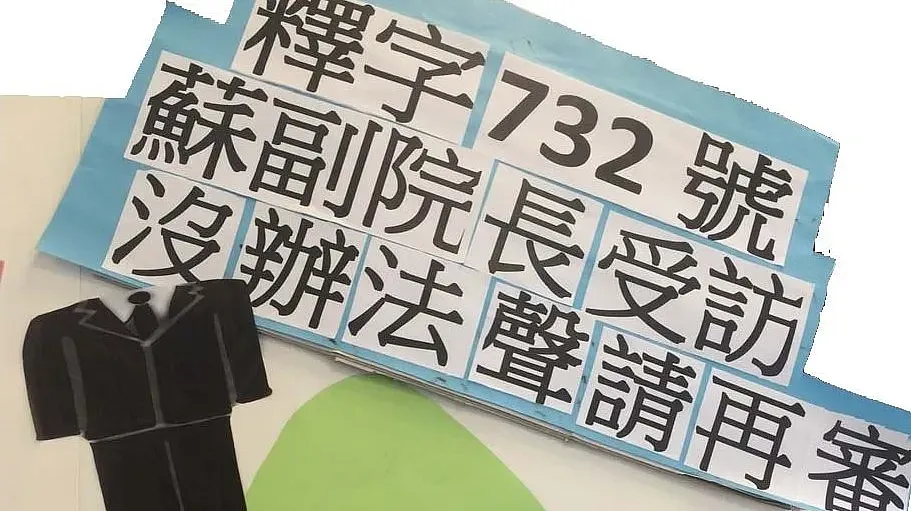
Su Yeong-chin is No Longer Fit to Serve as Grand Justice and Vice President of the Judicial Yuan
Last edited: 2026-08-30
Recently, the Grand Justices rendered Judicial Yuan Interpretation No. 732 regarding the Joint Development (Meilong) Project case, declaring the relevant statutory provisions unconstitutional. Media outlets widely reported that landowners involved in the project would likely be able to petition for a retrial, potentially subjecting the city government to tens of billions in damages. However, Su Yeong-chin—a Grand Justice and Vice President of the Judicial Yuan who participated in rendering this interpretation—stepped forward to further interpret the interpretation itself, stating that the Meilong Project did not involve the expropriation of "adjacent land" and therefore did not apply to this interpretation, nor could it serve as the basis for a retrial petition. Furthermore, Vice President Su recently submitted an op-ed to the media arguing that constitutional interpretations differ from court judgments, and remaining "silent" when media reports remain erroneous constitutes an outdated form of legal mysticism.
First, Vice President Su's explanation regarding the silence of judges is truly baffling.
Second, the Judicial Yuan holds the power of life and death over judges' promotions. Vice President Su's remarks will inevitably exert influence on the judges presiding over whether a retrial can be granted in this case, rendering him entirely unfit to serve as a Grand Justice and Vice President of the Judicial Yuan.
Furthermore, public media inherently possesses the right to independently comment on Grand Justices' interpretations—this is the most fundamental guarantee of the freedom of speech. On what grounds can a participating Grand Justice step forward to interpret their own ruling merely because the media's reporting of it is allegedly flawed? If such a rationale holds, should every single judge likewise step forward to interpret their judgments after the fact on the grounds that "the media reported it incorrectly"?
In fact, Su Yeong-chin's extremely ultra vires and inappropriate remarks have also opened Pandora's box for Taiwan's constitutional interpretation system, exposing its critical systemic flaws.
The issue breaks down into several layers.
First, why is it that even after a successful constitutional interpretation petition based on a specific case, one must still go through the procedure of petitioning for a retrial to obtain individual relief? This is because our country lacks a constitutional complaint system directed against judicial judgments. The Grand Justices can only review laws or administrative orders applied in a specific case, but cannot review whether the judgment rendered in that case is constitutional.
Moreover, whether the Meilong Project case can actually petition for a retrial and whether Su Yeong-chin's remarks make sense are beside the point. This is because the authority to initiate a retrial belongs to the judges of the fact-finding court, not the Grand Justices.
Looking back, the "Su Yeong-chin incident" once again highlights the absurdity of our constitutional interpretation system.
In Germany, whose legal system is similar to ours, the Federal Constitutional Court handles over 4,000 constitutional complaint cases directed against judgments each year. If a specific case is declared unconstitutional, the judgment is directly invalidated. Not only does our country lack this system, but the Grand Justices also issue only around ten interpretations a year.
We hope that those in charge will understand that every single case represents the tears of many ordinary people at the bottom of society, and the constitutional court's duty is to confront these profound conflicts over fundamental rights. We urgently need a constitutional complaint system directed against judicial judgments.
In the concurring opinion of Grand Justice Li Chen-shan, who participated in this case, he quoted a poem by Ku Cheng, mentioning the need to "let all eyes accustomed to darkness become accustomed to the light." We hope that this controversy will allow more people to see the tears of the people within individual cases, establish a constitutional complaint system, and launch the next wave of judicial reform.
This article is an AI-generated translation of the original Chinese text. In the event of any discrepancy, the Chinese version shall prevail.