
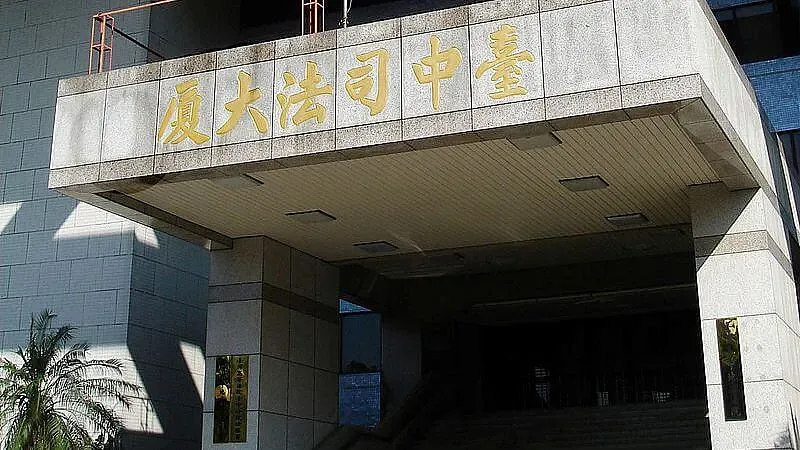
The Birthplace of Taiwan's Judicial Independence: Room 303 of the Taichung District Court
Last edited: 2026-08-30
Photo Credit / Wikipedia
Before the end of 1992, Room 303 of the Taichung District Court was merely an unassuming, eight-ping corner office. When Lu Tai-lang and Chen Han-chou transferred there from the Changhua District Court on December 8 of that year, none of them—not even the participants themselves—could have foreseen that nine days later, Room 303 would become the epicenter of Taiwan's judicial independence reform.
The first reform was the most fundamental aspect: case assignment. Although the law had stipulated for sixty years that case assignments should be decided by the judges' meeting, Taiwanese courts had practically never implemented this rule; instead, court presidents determined them based on personal preference. Consequently, this easily created a phenomenon: if specific types of cases were pre-assigned to specific judges for trial, maintaining judicial independence and fair trials would be impossible. How could a court that disobeys the law "independently adjudicate in accordance with the law"? Case assignment reform thus represented "small knowledge, big crucial point" within judicial independence. Case manipulation and personnel manipulation are the two major keys endangering judicial independence, and returning case assignments to the judges' meeting was the first step in breaking case manipulation. On December 16, 1993, these judges adopted a non-legal reform method: holding a press conference to voice their reform demands to the media and the general public. On December 29, after four rounds of voting, the Taichung District Court decided by a vote of 41 to 34 that case assignments should be determined by the judges' meeting.
Unlike several past judicial events, this was the first successful case of internal reform within the judicial system. Secondly, this movement emphasized collective action and institutional reform. Why was it possible to launch a successful movement within just a few days? Structurally speaking, public dissatisfaction with the judiciary in Taiwanese society at the time was already on the verge of collapse. "Why can a single match explode a room? Because it is full of gas," one participant remarked very modestly. Any movement that raises the banner of reform easily gains public support, and the media acted as the intermediary transmitting messages in this process. These judges neither received nor sought support from political parties, and the JRF had not yet been established at the time; therefore, the primary support came from the media. To a certain extent, the media translated these judicial reform ideals into easily understandable language, as ordinary people do not readily understand what case assignment is or why it matters. At the time, China Times reporter Chen Chih-cheng named this reform the "Judges' Autonomy Movement," making it easy for the general public to understand and accept.
Geographical and Structural Factors
The geographical location of the Taichung Court was also a crucial factor. If the event had occurred in a northern court that frequently tried major political cases, whether the reform could have succeeded would have been an unknown. The Judicial Yuan and the rulers did not seriously respond to or crack down on this wave of reforms, perhaps because they believed these reforms were insufficient to threaten their regime. Finally, these judges' demands had a legal basis; they were not demanding the enactment of new laws, but rather asking that the existing system return to the law. Coupled with the fact that the reform demands basically shifted the power of case assignment from a single court president to be shared by all judges, it was easier to gain the support of ordinary judges.
From the perspective of structural factors, one cannot fully explain why this reform occurred, and we must return to the individual level to explore it. First, before gathering at the Taichung District Court, these reform-minded judges already had experience working together or had exchanged ideals on judicial reform. For example, Chen Han-chou and Lu Tai-lang had been colleagues at the Changhua District Court, while Lu Tai-lang and Lin Hui-huang had engaged in all-night conversations about judicial reform ideals. Second, Room 303 was not merely a spatial term; it was a public space for discussing judicial reform theory and action strategies, and many opinions were jointly debated within this small room. Third, the participants had not spent a long time within the judicial system—about three to six years. The hierarchical nature of Taiwan's judicial system is a massive taming mechanism; how many young students, fresh out of school and harboring ideals, are gradually tamed by the system over the years step by step? (How many judges at the High Court level or above and prosecutors at the High Prosecutors Office level or above support reform?) These reform-minded judges had been in the system just long enough to understand it and engage in self-reflection, while not yet having been tamed by it. Fourth, the role played by the Taichung District Court President at the time, Huang Chin-jui. Had Huang Chin-jui not acted in such a controversial manner at the time, perhaps the voting would not have secured an absolute majority of support from the judges of the Taichung District Court.
Participants' "Non-Judge Experience"
However, these individual factors still cannot explain why judges pursuing judicial independence would adopt collective resistance methods. The primary key factor was the "non-judge experience" of these participants. Lin Hui-huang and Chang Sheng-hsing came from backgrounds as elementary school teachers; Lin Chih-chung had practicing experience as an attorney before entering the Judges and Prosecutors Training Institute and had led resistance actions during his time there; before becoming a judge, Lu Tai-lang was a prosecutor who had once searched a Kuomintang county branch office. The non-judge experience of these individuals helped them transcend traditional judges' mindset of thinking, and also helped them understand society's demand for judicial reform and adopt collective resistance strategies. Nevertheless, these judges maintained considerable self-reflection and vigilance regarding the adoption of collective resistance methods; if every reform required collective resistance, it would also inflict a considerable degree of damage on the judicial system. This was why, after about four years of the reform movement, some participants insisted that efforts should be fully focused on the practical pursuit of fair, accountable, and independent trial work.
The judges participating in the case assignment reform not only changed the system, but simultaneously changed themselves. One participant reflected afterward: at the time, they only wanted to participate a little bit, never expecting that once involved, they would discover so many problems within Taiwan's judicial system. The importance of Room 303 as a public space for discussing judicial reform ideals and action strategies was highlighted once again. The successful reform of case assignments made Room 303 of the Taichung District Court the locomotive for court system reforms in Taiwan over the following years, guiding the judicial reforms of subsequent years. Although these judges never "regarded reform as their vocation," over the ensuing years they participated in elections for representatives to the Judges Review Committee, petitioned for the inclusion of the judicial budget in the Constitution, abolished the system of submitting judgment drafts for review, and restored the power of detention to the courts.
In the history of Taiwan's judicial independence reform, these few grassroots judges made so many contributions yet received so little recognition. In the past, the Democratic Progressive Party or certain social figures demanding judicial reforms would be rebuffed by the Judicial Yuan or the ruling authorities under the guise of upholding judicial independence. The reforms initiated from within the judicial system by the judges of Room 303 left the Judicial Yuan and the ruling authorities with no excuses to evade them.
Combining Grassroots Forces to Deepen Reform
Perhaps, as one participant remarked, there was little more they could do in pursuit of judicial independence. However, judicial independence is merely a tool for pursuing fair and accountable trials; yet ironically, not all judges cherish judicial independence, and only those who have fought for judicial independence will cherish this hard-won achievement all the more. Taiwanese society also remains virtually ignorant of this chapter of history. The most important existing reform direction for Taiwan's judicial system is toward a judiciary that is accountable and capable of responding to societal needs. Judges capable of fulfilling this mission must not only uphold judicial independence but also deeply appreciate society's changes and needs. These judges of Taichung District Court Room 303, who previously possessed non-judge experience and deeply understood societal demands, seemed to have a more arduous mission awaiting them. And this mission could hardly be accomplished by the court system from within alone; it must be combined with the power of civil society to be achievable.
※ The author is a Ph.D. candidate in sociology at the University of North Carolina at Chapel Hill, with research interests in political sociology, social movement studies, and the politics of law
This article is an AI-generated translation of the original Chinese text. In the event of any discrepancy, the Chinese version shall prevail.