
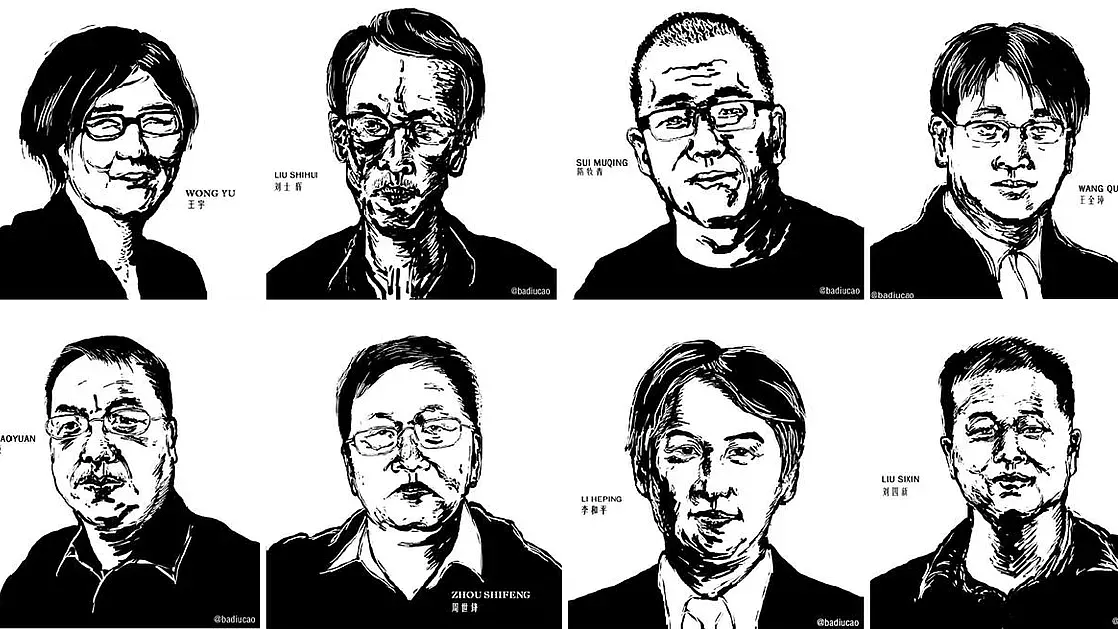
China Human Rights Lawyers Group Selects Top 10 Human Rights Cases of 2015
Last edited: 2026-08-30
Image source / Badiucao
I. The Chinese "709" Crackdown on Human Rights Lawyers and Citizens
- Author / Chung Chin-hua
- Reviewer / Tang Chi-tu
Case Introduction
 Image source / Badiucao
The "709" crackdown on human rights lawyers and citizens, which shocked the world, began in the early hours of July 9, 2015, when Chinese public security state security officers suddenly detained lawyer Wang Yu from Beijing Fengrui Law Firm, along with her husband Pao Lung-chun and son Pao Cho-hsuan (Pao Meng-meng). As of 6:00 PM on December 30, 2015, according to incomplete statistics released by the Hong Kong-based "China Human Rights Lawyers Concern Group," a total of 316 human rights lawyers, law firm staff, human rights defenders, and their family members in mainland China were summoned, forcibly interrogated, restricted from leaving the country, placed under residential surveillance, criminally detained, subjected to enforced disappearance, or arrested. Among them, 36 individuals remained in detention or under enforced disappearance.
For six consecutive months, the family members and defense counsel of the aforementioned 36 individuals were unable to obtain information from relevant Chinese public security and state security departments regarding their detention locations or the specific handling units. The lawyers they retained were also unable to meet with those detained or disappeared. On January 18, 2016, the relevant families and defense lawyers successively learned that lawyers Wang Yu, Chou Shih-feng, Li Ho-ping, Li Chun-fu, Wang Ch'üan-chang, Li Shu-yün, Dr. Liu Szu-hsin, Ms. Chao Wei, lawyer Pao Lung-chun, lawyer Hsieh Yang, lawyer Hsieh Yen-i, and Ms. Kao Yüeh had been approved for formal arrest by the authorities under absurd allegations of "subversion of state power," "incitement to subversion of state power," and "helping to destroy evidence" (additionally, Hu Shih-ken, Liu Yung-ping, Kou Hung-kuo, Lin Pin, Yin Hsü-an, etc. were also arrested for (inciting) subversion of state power; the coercive measures for citizens Chai Yen-min, Chang Wei-hung (Chang Wan-ho), Liu Hsing (Lao Tao), Li Yen-chun, Yao Chien-ching, Yen Hsiao-chieh, etc. remain unclear, while Ch'en Tai-ho, Sui Mu-ching, Huang Li-chun, Wang Fang, and Hsieh Yuan-tung have partially recovered their freedom). Furthermore, lawyer Wang Chiu-shih, Wu Kan, Hsing Ching-hsien, and Tang Chih-shun are currently in detention or under enforced disappearance.
Since the occurrence of the Chinese "709" crackdown on human rights lawyers and citizens, the legal community, media, human rights organizations, governments of various countries, the Office of the UN High Commissioner for Human Rights, and ordinary citizens both domestically and internationally have condemned and continuously protested against it.
Currently, the aforementioned cases are still in the investigative stage.
Case Commentary
The "709" crackdown on human rights lawyers and citizens in mainland China was a large-scale suppression campaign specifically directed against human rights lawyers, law firm staff, human rights defenders, and their families. It is an extremely ironic trampling of human rights and anti-rule-of-law event occurring against the backdrop of the so-called "governing the country according to law and the constitution."
Among the criminal cases triggered by this incident, unprecedented tactics were employed: large-scale, nationwide summons and harassment of lawyers to suppress dissent; residential surveillance in designated locations to isolate defendants and block all case information; refusal of lawyer meetings and correspondence on the grounds of "national security"; forcing defendants to make televised confessions on CCTV under illegal secret investigation principles while sensationalizing their moral and privacy matters; framing relevant NGO organizations as anti-China forces; and deploying national police resources to jointly handle cases while publicly claiming only the Hexi District Public Security Bureau in Tianjin was handling them. This was effectively a full-scale drill of malicious interpretation and execution of the National Security Law and the Foreign NGO Management Law by various powerful law enforcement departments under the guidance of authoritarian thinking. It was also a total explosion of ruling anxiety under stability-maintenance thinking, which mistakenly views lawyers—a force for social progress—as imaginary enemies.
The "709" crackdown has not only caused extremely severe physical and psychological harm to China's legal community, human rights defenders, and their families, but has also created the most horrifying atmosphere in the country since the Cultural Revolution, severely undermining the process of the rule of law, endangering human rights and freedom, and threatening normal social order. At the same time, it has caused extremely adverse international impacts, creating a major obstacle to China's better integration into the world.
II. The Ching-an Incident
- Author / Liu Shu-ching
- Lead Editor / Liang Hsiao-chun
Case Introduction
This article is an AI-generated translation of the original Chinese text. In the event of any discrepancy, the Chinese version shall prevail.