
The Lo Ming-tsun Case: Polygraph Reports Can Lie
Last edited: 2026-08-30
Lo Ming-tsun was once a police officer tasked with enforcing the law and maintaining public order. He never imagined that one day he would become the target of investigation and prosecution by other law enforcement agencies, and ultimately convicted by the court of accepting NT$50,000 in bribes from organized crime to cover up the real perpetrator of a shooting and frame a juvenile instead...
Background of the Incident
The events took place in the turbulent year of 1997. As Taiwan approached 1997, the Liu Pang-yu massacre and the murder of P'eng Wan-ju occurred, yet the police were unable to make any breakthroughs. In April 1997, the Pai Hsiao-yen murder case took place: the daughter of celebrity Pai Bing-bing was kidnapped and murdered, and the three kidnappers fled across the Greater Taipei area, committing several robberies, kidnappings, murders, and rapes during their flight. It was not until November 19 of that year that Ch'en Chin-hsing, the final suspect in the Pai Hsiao-yen case, surrendered. The police bore immense pressure from all sectors, and this period is widely regarded as the darkest era in Taiwan's policing history.
At that time, Lo Ming-tsun was serving as the head of the Criminal Investigation Division of the Taipei County Hsinchuang Precinct, a position that was both demanding and stressful.
r
To compound matters, at 1:00 AM on November 6, 1997, a shooting occurred at the Hsin-Shu-Lin Restaurant in Linkou, Taipei County. The restaurant's owner, Ch'en Pi-hsing, subsequently reported that three or four men had arrived at the entrance after the restaurant closed, and one of them fired a gun at the rolling metal shutter. This individual was identified as "Chang Chih-ping"1, a former shareholder of the restaurant. Chang Chih-ping was, in fact, an underworld figure in the Linkou area, frequently associating with his younger brother, Chang Chih-ch'eng, and a childhood friend, Huang Han-ch'i, among others. Upon learning of the incident, the Hsinchuang Precinct Criminal Investigation Division went to the "Golf KTV" where Huang Han-ch'i worked that very night, though Huang was not there at the time.
A few days after the shooting, Lo Ming-tsun received a tip-off that the actual perpetrator was Huang Kuo-wei, and that Huang Kuo-wei would be staying at the "Yali Motel" on November 10. That night, Lo Ming-tsun led a team to the Yali Motel and successfully apprehended Huang Kuo-wei, along with a firearm and bullets. Huang Kuo-wei confessed to committing the Hsin-Shu-Lin Restaurant shooting, stating his motive was to collect a debt for his aunt. Around 5:00 PM on November 11, the Hsinchuang Precinct invited restaurant owner Ch'en Pi-hsing to make an identification. At this point, however, Ch'en stated that she had not clearly seen who held the gun and could not be certain whether Huang Kuo-wei was present. Nevertheless, Ch'en insisted that she had indeed seen "Chang Chih-ping" at the scene. Consequently, at 18:00 on November 11, the Hsinchuang Precinct Criminal Investigation Division transferred Huang Kuo-wei (who was 17 years old at the time) to the Juvenile Court, and subsequently referred the matter concerning Chang Chih-ping to the Juvenile Court for joint processing on December 3.
The Outbreak of the Frame-Up Case
The matter thus appeared to have reached a conclusion, but on February 5, 1998, the case took a major twist: juvenile Huang Kuo-wei, who had remained detained since his transfer, recanted during a court hearing, stating that he was not the one who fired the shots at the Hsin-Shu-Lin Restaurant; rather, Huang Han-ch'i was the shooter!
Following juvenile Huang Kuo-wei's retraction, the Taipei Military Police Investigation Unit intervened in the case. Huang told the military police investigators that Huang Han-ch'i had instructed him to take the blame. Subsequently, the military police summoned Huang's mother to take her statement. Huang's mother stated that she also believed her son was taking the blame for someone else. To this end, Chang Chih-ping had prepared NT$80,000 in an attempt to secure bail for the detained Huang Kuo-wei, while Huang Han-ch'i had told her on November 30, 1997, "It's nothing to worry about now; we've arranged for someone to handle it."
Major Turning Point: From a Frame-Up to a Bribery and Cover-Up Case
r
Judging from the statements, although they initially discussed underworld figures in the Linkou area—such as Chang Chih-ping—running around to secure Huang Kuo-wei's early release, from this point onward, the military police investigation unit likely began to suspect that law enforcement personnel were involved in the frame-up. Consequently, the direction of the investigation shifted: to investigate whether any law enforcement personnel were involved in the framing scheme.
On March 20, 1998, Huang Kuo-wei was once again temporarily withdrawn from the juvenile detention center by the military police investigation unit.
Military Police asked Huang Kuo-wei: How did the police know which motel you were hiding in?
Huang Kuo-wei replied: "The people involved told me they had already contacted the police, and staying at the motel and getting caught was pre-arranged."
Military Police asked again: "Does your previous answer mean the police already knew you were not involved, and prior to your apprehension, they had reached an agreement with the involved parties to fabricate a case and solve it?"
Huang Kuo-wei replied: "I cannot be certain."
Judging from his responses in the statement, what Huang Kuo-wei understood was that the people actually involved had somehow notified the police regarding his surrender, but he was not sure whether the police were aware of the substitution. Interestingly (and regrettably), inferring from another statement given by Huang Kuo-wei, what he understood by "contacted" or "agreement" was not that the police knowingly abetted a substitute, but rather that the police promised "there would be no torture" (refer to the transcript of Huang Kuo-wei's prosecution interrogation on September 10, 1998. Prosecutor: "During police questioning, it was written that you reached an agreement with the police. Is this true?" Huang: "At the time, it seemed I heard Huang Han-ch'i and Chang Chih-ch'eng say they had already talked to the police. They told me not to be afraid and that I wouldn't be tortured.").
In any case, this statement shows that the military police investigation unit seemingly believed law enforcement personnel were involved in the frame-up, and not merely helping Huang Kuo-wei get released afterward, but abetting the frame-up from the very beginning.
On March 25, 1998, the military police investigation unit summoned a secret witness, C1, to take a statement. This C1 was later confirmed to be Liao Wen-hui, a close friend of Chang Chih-ping. On the evening of November 10, 1997, Liao brought Chang Chih-ping's girlfriend, Ts'ai Yü-wen, to inform Lo Ming-tsun that Huang Kuo-wei was suspected of shooting and of his whereabouts, which was why Lo hurriedly rushed to the "Yali Motel" that very night to arrest Huang Kuo-wei2. In the statement, C1 indicated that under pressure to solve the case, the perpetrators secretly reached an agreement with the police to have Huang Kuo-wei step forward to take the blame. He was not sure who specifically, but it seemed to be the head of the Criminal Investigation Division.
It was precisely in this statement that Lo Ming-tsun, head of the Hsinchuang Precinct Criminal Investigation Division, was targeted as being suspected of covering up the frame-up case. Unfortunately, when the secret witness gave this statement, the entire audio and video recording process was not carried out, making it impossible to know whether the statement matched the true questioning process or if discrepancies existed. However, from the perspective of C1 (Liao Wen-hui)—the very person who took Ts'ai Yü-wen to provide the tip to Lo Ming-tsun—his suspicion that Lo was involved in covering up the frame-up is understandable.
Ultimately, the military police investigation unit reported Lo Ming-tsun's suspected involvement in covering up the frame-up to the prosecutor at the Panchiao District Prosecutors Office. On September 5, 1998, the prosecutor issued a directive ordering the Taipei County Investigation Station of the Ministry of Justice's Investigation Bureau (MJIB) to investigate Lo Ming-tsun's suspected unlawful conduct. On September 10, 1998, the prosecutor personally interrogated Huang Kuo-wei regarding whether Lo Ming-tsun was involved in covering up the frame-up, though Huang was actually unclear about the matter. Huang stated that he had heard his mother mention giving money to Lo Ming-tsun, and that he heard getting him off the hook would cost NT$50,000. Notably, this was the first time the sum of NT$50,000 in bribe money associated with Lo Ming-tsun surfaced. Strangely enough, what Huang said was that it cost NT$50,000 to get him off the hook, not NT$50,000 to frame him. Yet Lo Ming-tsun was the head of the Criminal Investigation Division; he had no way to influence Huang Kuo-wei, who had already been transferred to the Juvenile Court.... Rumors circulated extensively in the underworld, and how the narrative morphed this way is truly difficult to verify. Because it made so little sense, the version of the story that was ultimately finalized in the guilty verdict became: these underworld figures pooled NT$50,000 in bribes for Lo Ming-tsun, in exchange for his promise to cover up the frame-up.
False Confessions of the Bribe-Givers
On September 23, 1998, a special task force composed of the First Investigation Corps of the Criminal Investigation Bureau (CIB), the Hsinchuang Precinct of the Taipei County Police Bureau, and the Taipei City Military Police Corps finally apprehended Chang Chih-ping, Chang Chih-ch'eng, and Huang Han-ch'i. These individuals were first questioned at the CIB and subsequently interrogated at the Panchiao District Prosecutors Office. They all admitted to the frame-up, but none stated that Lo Ming-tsun had accepted bribes and covered up the framing. However, when they were sent to the Taipei County Investigation Station of the MJIB for questioning, the situation completely changed: they successively "experienced a sudden epiphany" and confessed to the "truth."
The problem, however, is that the narrative constructed by the Taipei County Investigation Station after making them recant—while structured around the premise that Lo Ming-tsun had contacted them by phone, arranged a meeting at the "365 Tea House" to discuss the frame-up, accepted a total of NT$50,000 in bribes from them, and covered up the crime—contained details that continually shifted and contradicted one another across successive interrogations. The basic storyline came from Huang Han-ch'i, who was identified as the mastermind instigating the substitute, while supplementary details came from Chang Chih-ch'eng, who was believed to have accompanied Huang to meet Lo Ming-tsun. Examples of these contradictory details include:
| Version in the Final Guilty Verdict | Examples of Contradictions in Statement Contents | |
| Bribe Amount Contributed by Each Person |
|
|
| Timing of Contact with Lo Ming-tsun |
|
|
Furthermore, those who made these statements subsequently recanted during prosecutor interrogations or court trials, stating they had never given bribes to Lo Ming-tsun to cover up the frame-up.
This brings us back to the question: How did this version of the story come to be?
Examining the questioning process at the investigation station reveals that investigators extracted confessions from these individuals through prolonged fatigue questioning, leading questions, threats, inducements, and even by directly pre-drafting the statements:
Investigator: ...Damn it, do you want to serve a few extra years?
Investigator: Are you going to cooperate with me.... Under the Anti-Corruption Act... helping solve a case can mitigate or exempt punishment..... If sentence is halved, and the Organized Crime Prevention Ordinance can also be exempted... honestly speaking, you can leave this place after serving two or three months.
Investigator: You aren't telling me the truth; you need to tell me the truth so I can help you.... How many youths do you have? When your child grows up, will they still call you dad.... Today, your predicament happens to coincide with a commutation opportunity, otherwise how could I help you.... You only have this chance.
Investigator: If there's no reason, why would they accept? Would torture be required? I don't need torture.
Investigator: You went out to talk with him... but what did he say?
Chang Chih-ch'eng: ...I don't know the details...
Investigator: You were right there..... you have to chip in for this money...... how can you say...
Investigator: How much did you actually contribute?
Chang Chih-ch'eng: ...More than 100,000
Investigator: ...150,000.... Then do you know how much Chou Hsi-ch'üan contributed?
Chang Chih-ch'eng: (Shakes head)
Disc 15:19~15:36 shows investigators and Chang Chih-ch'eng not asking questions while the statement writing continued until 15:18, even turning pages to keep writing. An investigator stepped out briefly from 15:24 to 15:25, during which time the statement was shown to Chang Chih-ch'eng.
Investigator: I mean given once in the morning... once in the afternoon... given to you twice on the same day.... or given twice on separate days?
Another investigator: NT$80,000 given to you on the same day, or... given over two days, is that right?
Chang Chih-ch'eng: (Nods)
Investigator: Did you page him, or call his mobile phone? Do you know his mobile phone number?
Huang Han-ch'i: We don't contact each other often, not quite sure.
Huang Han-ch'i: If I came out back then, I would have been detained by him.
Huang Han-ch'i: ...Actually, it wasn't about mentioning 500,000... I told Chang Chih-ch'eng we needed to pool several hundred thousand for Huang Kuo-wei's lawsuit.
Investigator: ....You met and talked with Lo Ming-tsun... during the talk you asked Lo Ming-tsun to cut you some slack.... you would find someone to take the blame.... Lo Ming-tsun said he could help, but demanded money, and NT$50,000 was discussed at that time....
Investigator: The third time you talked was when you gave the money? Or the first time, giving money meaning the matter was settled, did you forget?
Huang Han-ch'i: That was just rumors outside, I wouldn't know.
Investigator: You said 130,000, he said 150,000.
Huang Han-ch'i: No, I.....
Investigator: His mother took.... Then what about your side?
Huang Han-ch'i: ....
Investigator: ....150,000..... 200,000...
Huang Han-ch'i: ....
Investigator: Borrowing money from people like this.... cannot be tracked out....
Investigator: ...I won't harm him....
Huang Han-ch'i: ...There will be matters later.....
Investigator: No there won't! As long as he doesn't know.... Just like Chang Chih-ch'eng said he took NT$80,000 from his mother, his mother won't get into trouble.....
Of course, investigators might argue these are merely investigative techniques, and that such methods are necessary to get these bad guys to obediently cooperate and speak the truth.
However, it must be specifically pointed out here that such questioning processes and contents actually bear the hallmarks of a false confession.
A "false confession" simply means making a false admission to a crime one did not commit. And why do we say the confessions in this case bear the hallmarks of a false confession?
First, looking at the interrogation methods, investigators targeted a single individual, Lo Ming-tsun, right from the start, concluding that he accepted bribes and covered up the frame-up. They proposed no alternative hypotheses; instead, they continuously exerted various pressures on the interrogatees to obtain the pre-conceived version of the truth they had in mind.
Second, looking at the content of the confessions, there is a complete lack of "secret revelation." That is, the confessions contain no crime details unknown to the interrogators beforehand that could be verified through objective evidence. The most typical example is a murder suspect revealing the location of a concealed corpse, allowing police to find it. The details in this case consist entirely of statements that constantly contradicted one another, with no objective evidence found to corroborate them: no communication logs, no surveillance footage, no monetary flow.
Furthermore, the content of the confessions actually exposes the confessors' ignorance of the truth. This is demonstrated by the fact that the interrogator had to resort to various means to inform the confessor of the actual details of the crime, as well as the absurdities within the confession itself. The most farcical example is how Chang Chih-ch'eng could not recognize Lo Ming-tsun and had to be continually guided by the investigator to make the identification:
Investigator: If you saw him now, would you still recognize him?
Chang Chih-ch'eng: Have to see the person, have to see him in person.
Investigator: What did he look like back then... height...
Chang Chih-ch'eng: About... old-looking...
Investigator: Fat or thin?
Chang Chih-ch'eng: (Thinking for a moment) Thin.
Investigator: What do you mean thin?
Chang Chih-ch'eng: Thin...
Investigator: How could Lo Ming-tsun be thin....
Another investigator: ....No way.... Lo Ming-tsun is about the same build as me.
Chang Chih-ch'eng: ...
Investigator: ...We are using a photo of him from a long time ago, not a recent photo.
Investigator: ...We'll show you all of them...
Chang Chih-ch'eng: (Nods)... More recognizable... (To imprint an impression of Lo Ming-tsun on Chang Chih-ch'eng, the investigator sets up a scenario by additionally providing video footage of the defendant Lo Ming-ts'n for Chang to view, in order to facilitate subsequent identification)
Investigator: ...Think about it... what was he like, being thin back then....
Chang Chih-ch'eng: ...My impression is not detailed... (Pointing to the bottom right corner of the paper)
11:36:49 Chang Chih-ch'eng identifies photos, shaking his head at the 1st through 9th photos to indicate none of them are him...
11:36:49 Chang Chih-ch'eng continues identifying photos. The investigator points a pen at the photo below (closer to Chang) and mutters to himself: No. 10 is thin, No. 8 will do, and then fabricates and records in the statement that No. 8 looks very much like Lo Ming-tsun (completing the illusion of Chang Chih-ch'eng's forged personal identification of Lo Ming-tsun).
Another investigator: ...Don't recognize any of them... too absurd... hanging out in Linkou for so long... don't even recognize these people?
As for the absurdities in the confessions, court records show that Lo Ming-tsun possessed an alibi for several contact or meeting times established in the guilty verdict. On the evenings of November 6 and 7, 1997, Lo Ming-tsun was required to attend and chair the "1106 Special Task Force Meeting" at the Hsinchuang Precinct of Taipei County, and he signed the meeting minutes. Furthermore, following the special task force meeting on November 7, Lo had a firearm-checkout record at 22:00, which further proves it was impossible for him to have gone out to meet Huang Han-ch'i and others. Additionally, on November 9, Lo went out to investigate a case with two other police officers at 16:00, and there was no record of him leaving again after returning, as proven by the entry-exit logbook.
The court that issued the guilty verdict refused to accept Lo Ming-tsun's alibi, reasoning that Lo could have slipped out stealthily during the special task force meeting, and that the entries in the logbook might not be entirely accurate. However, considering the relationship between Huang Han-ch'i and the others on one side and Lo Ming-tsun on the other—where the former were the petitioners and the latter was the person being petitioned—common sense dictates that the former should accommodate the schedule of the latter. Why would Huang Han-ch'i and his associates deliberately choose a time inconvenient for Lo (when he was in a meeting) to make an appointment?
Finally, looking at how these individuals subsequently recanted one after another, the court's view that their motive was to shield Lo Ming-tsun is counterintuitive. From the perspective of paying for and receiving services in bribery, Lo Ming-tsun did not deliver on the deal at all. Strictly speaking, according to underworld code, if Lo had indeed accepted bribes, they should have implicated him relentlessly. In Chou Hsi-ch'üan's words: "The Third Division of the Hsinchuang Precinct took the money and still made arrests; that is too devoid of loyalty and righteousness. If we ever get caught, we will surely tell the whole story of why we bribed the Third Division and blow the lid off the matter" (Chou Hsi-ch'üan's Taipei County Investigation Station statement, November 17, 1998).
Flawed Policing $\neq$ Cover-Up
After obtaining confessions from the bribe-givers, investigators proceeded to interview the police officers handling the shooting case-related duties. Suspecting that Lo Ming-tsun had released the real suspects in exchange for bribes, the investigators scrutinized every unreasonable and perfunctory aspect of the handling process during the questioning in order to construct a narrative that Lo was the mastermind directing it all.
- How did Lo Ming-tsun know Huang Kuo-wei was hiding in a motel?3
- Why did the police so easily believe the shooting was committed by Huang Kuo-wei without suspecting a substitute?
- Why didn't they diligently investigate the whereabouts of "Chang Chih-p'ing," the suspect named by the owner of the Hsin-Shu-Lin Restaurant, and instead handled the matter merely by forwarding Chang's case via official document?
- Why were the case files of the Hsin-Shu-Lin Restaurant shooting incomplete? Were certain parts removed to evade accountability?4
However, anyone with even a slight understanding of the police or bureaucratic system knows that none of these tasks could be unilaterally controlled by Lo Ming-tsun alone. Taking statements, tracking down suspects, compiling case files, and so forth were carried out through the division of labor among the members of the criminal investigation squad. One plausible explanation is collective bribery to cover up a frame-up, but unfortunately, evidence for this theory is lacking. Another plausible explanation is that the criminal investigation squad was under immense case pressure at the time, and officers felt that avoiding trouble was better than courting it, letting certain things slide. Consequently, it appeared as though the entire police system was riddled with operational negligence. The latter explanation is actually more probable, because the missing portions of the case files were actually the crime scene investigation record and notification form that the Linkou Police Station failed to submit, rather than something omitted or discarded by the Hsinchuang Precinct Criminal Investigation Division. Furthermore, a junior officer from the Hsinchuang Precinct Criminal Investigation Division admitted that he knew things were missing, but chose to ignore it, reasoning: "Major criminal cases must be officially registered and subject to strict supervision by superiors. Since the Linkou Police Station didn't submit them, I was happy to take it easy."
Flawed Polygraph Testing
After the Taipei County Investigation Station obtained confessions from the bribe-givers and statements from fellow police officers asserting that Lo Ming-tsun held command authority over the investigation, Lo agreed to undergo a polygraph test on December 18, 1998, to prove his innocence. Unfortunately, he failed the polygraph, which only deepened the investigators' belief in his involvement.
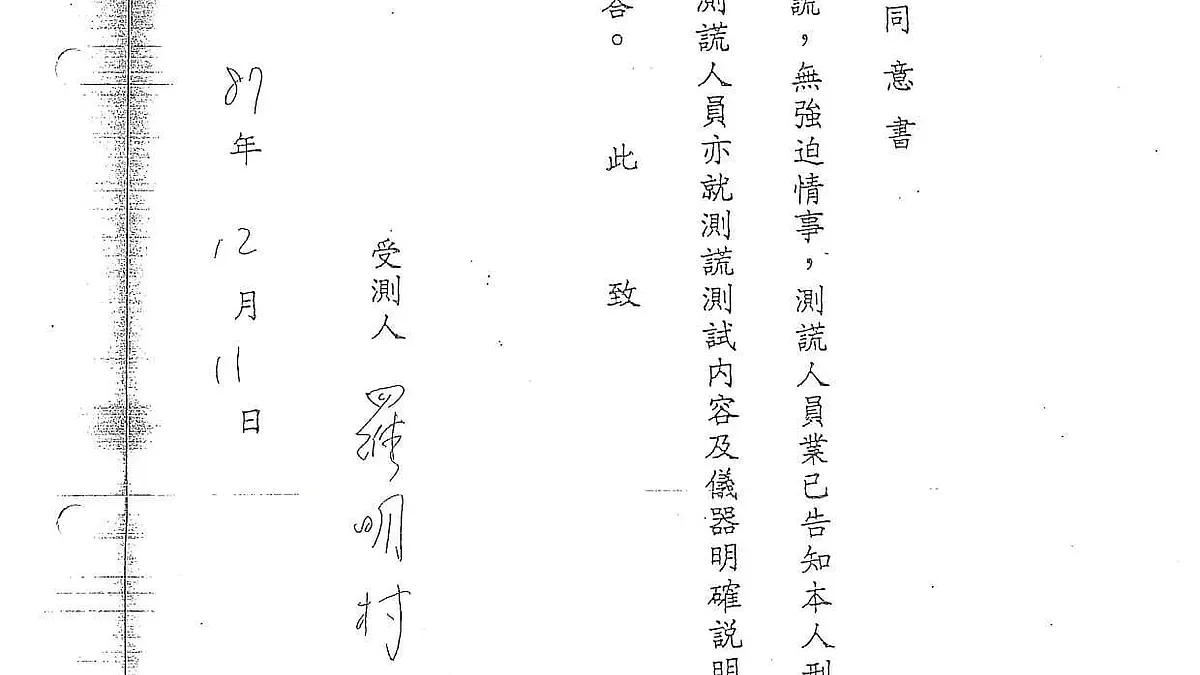
However, upon serious examination, Lo Ming-tsun's initial polygraph testing process was fraught with flaws5. The most obvious flaw was that because Lo had a heart condition, he was unable to complete the entire polygraph procedure, and the polygraph examiner actually signed on Lo's behalf afterward. This fact was confirmed during the retrial (first remand) when the court inspected the video recording of the polygraph process. However, during the second retrial, because the video recording of the polygraph process had exceeded its retention period and was destroyed, it could no longer be reinspected, and the fact was no longer recognized. Nevertheless, clues can still be found in the remaining polygraph charts.
The polygraph charts show that Lo Ming-tsun's heartbeat records were excessively violent, forcing the polygraph test to be aborted, and a "stop" mark appears on the chart.

The signature handwriting on Lo Ming-tsun's chart. Comparing it with Lo's signature on the statement to the right reveals that the handwriting is different. Regarding his signature, Lo stated that the polygraph process ended in less than two minutes.


The Cruel Guilty Verdict
The prosecutor ultimately prosecuted Lo Ming-tsun on charges of accepting bribes in breach of official duties. Lo was found guilty in the first and second instances, but the third instance (Supreme Court) revoked the verdict and remanded the case. During the first retrial, he successfully secured a reversal and was acquitted. Following his acquittal, the prosecutor appealed to the Supreme Court once again. This time, the Supreme Court issued a ruling unfavorable to Lo, revoking the acquittal and remanding the case. The second retrial once again changed the verdict, finding Lo Ming-tsun guilty of accepting bribes in breach of official duties and sentencing him to 13 years of imprisonment. The Supreme Court upheld the second retrial's verdict, and the case was thus finalized on April 13, 2009.
The main reasoning behind the crucial acquittal in the first retrial, contrasted with the main reasoning behind the guilty verdict in the second retrial, is outlined below:
| Acquittal in First Retrial Taiwan High Court Criminal Judgment, 89-Shao-Shang-Geng-(1)-29 |
Guilty Verdict in Second Retrial Taiwan High Court Criminal Judgment, 92-Shao-Shang-Geng-(2)-18 |
|
| Whether to Credit the Confessions of the Bribe-Givers | Not credited. The court inspected the interrogation video recordings from the investigation station and prosecutors office, concluding that the interrogation methods constituted improper interrogation and that the content of the confessions was contradictory. |
Credited. The court inspected the interrogation video recordings from the investigation station and prosecutors office, determining that many crucial parts were unclear and should not be interpreted to Lo Ming-tsun's advantage. Moreover, judging from the video content, the questioning methods were at most poorly toned or constituted necessary investigative techniques to help parties evoke memories, and did not constitute improper interrogation. The contents of the confessions differed only in details, while the general plot points remained consistent. |
| Whether to Credit Lo Ming-tsun's Alibi | Credited. The court credited Lo Ming-tsun's presence at special task force meetings on the evenings of November 6 and 7, 1997, during which he was unable to contact or meet with the bribe-givers. On November 9 at 16:00, he went out to investigate a case with two other officers, and upon returning to the police station had no further record of leaving, thereby not meeting with the bribe-givers. |
Not credited. The court held that even with special task force meetings, Lo Ming-tsun could have slipped out stealthily. As for his itinerary on November 9, because the entries in the logbook were not necessarily complete, they could not be used to prove Lo's whereabouts. Furthermore, because witnesses only testified in court during the first retrial regarding Lo's itinerary on that day, too much time had passed for them to possibly remember, rendering their testimony clearly an attempt to shield Lo. |
| Whether to Credit the Polygraph Report | Not credited. The court established that Lo Ming-tsun genuinely had a heart condition and ruled that the conclusions of the polygraph report could not be used to make findings disadvantageous to Lo. |
Credited. By the second retrial, the video recording of the polygraph process had exceeded its retention period and was destroyed, making re-inspection impossible. The court relied on the formal validity of the polygraph report and trusted the professional judgment of the examiner on-site to determine whether Lo was fit to undergo testing, thereby accepting the conclusion that he failed the polygraph. |
The Long, Arduous Road to Exoneration—When Will the Light Appear?
Unable to accept this outcome, Lo Ming-tsun fled overseas, separated from his family. He has continued to send petitions to the Prosecutor-General, hoping the Prosecutor-General would file an extraordinary appeal on his behalf, but his arguments have continually fallen on deaf ears. JRF also filed an extraordinary appeal for him once, but because Lo had filed too many petitions on his own, that extraordinary appeal petition was rejected within a week.
Additionally, JRF had already submitted a petition regarding the Lo Ming-tsun case to the Control Yuan in 2012. In April 2013, the Control Yuan issued an investigative opinion concluding that issues of illegal evidence acquisition indeed existed in this case, but it failed to issue a corrective or impeachment resolution, nor did it express an opinion on the flaws in the polygraph test. Consequently, JRF filed another petition in November 2014, hoping the Control Yuan would formally issue a corrective or impeachment resolution regarding the illegal extraction of confessions. In October 2015, another petition was filed regarding the flaws in the polygraph testing in Lo's case, urging the Control Yuan to investigate in accordance with the law.
It remains unknown whether there is an end in sight to these continuous efforts, but for his family, it is an endless torment...
Although the Lo Ming-tsun case may not command the same public attention as capital punishment wrongful conviction cases, we still hope more people are willing to understand this case, participate in rescue efforts, or lend their support. We also look forward to judges and prosecutors gradually recognizing the problems of false confessions and flawed polygraphs, and joining hands to assist in securing a retrial for this case.
Chronology
| Date | Content |
| 1997/11/06 01:00 AM |
The Hsin-Shu-Lin Restaurant shooting takes place. |
| 1997/11/06 20:00 PM |
Lo Ming-tsun convenes the "1106 Special Task Force Meeting" at the Hsinchuang Precinct of Taipei County and signs the meeting minutes, though no assignments are issued. (The court ultimately concluded that Huang Han-ch'i called Lo Ming-tsun's mobile phone that night to arrange a meeting.) |
| 1997/11/07 20:00 PM |
Lo Ming-tsun convenes the "1106 Special Task Force Meeting" at the Hsinchuang Precinct of Taipei County, signs the meeting minutes, and has a firearm checkout record following the meeting. (The court ultimately concluded that Lo Ming-tsun met with Huang Han-ch'i and Chang Chih-ch'eng at the "365 Tea House" that night to discuss the frame-up and bribery.) |
| 1997/11/09 16:00 PM |
The entry-exit logbook shows Lo Ming-tsun went out to investigate a case with two other officers, and had no records of leaving upon his return. (The court ultimately concluded that Lo Ming-tsun met with Huang Han-ch'i and Chang Chih-ch'eng that night at the "365 Tea House" to further discuss the framing method, bribe delivery, and acceptance.) |
| 1997/11/10 18:00 PM |
Ts'ai Yü-wen (wife of Chang Chih-ping) reports to the Hsinchuang Precinct, claiming the Hsin-Shu-Lin case was committed by Huang Kuo-wei, though no statement is taken (based on the testimonies of Ts'ai Yü-wen and Liao Wen-hui, which were ultimately not credited by the court). |
| 1997/11/10 22:00 PM |
Lo Ming-tsun leads a team to inspect the Liyah Motel. The first inspection around 11:00 PM turns up empty; the second inspection at midnight apprehends Huang Kuo-wei and the weapon used, and Huang confesses to the crime. |
| 1997/11/11 Morning |
The whistleblower letter written by Ts'ai Yü-wen is delivered to the Hsinchuang Precinct. |
| 1997/11/11 Evening |
The Hsinchuang Precinct transfers Huang Kuo-wei to the Juvenile Court of the Panchiao District Court. |
| 1997/12/03 | The Hsinchuang Precinct files an official request with the Juvenile Court for joint processing, stating: "Another suspect in this case, Chang Chih-ping, has been notified but refuses to appear for questioning, showing clear intent to evade criminal responsibility. Request joint handling." |
| 1998/02/05 | Huang Kuo-wei recants, stating that the Hsin-Shu-Lin Restaurant shooting was not actually carried out by him, but by Huang Han-ch'i. |
| 1998/09/23 | Defendants Chang Chih-ping, Chang Chih-ch'eng, Wang Chih-cheng, and Huang Han-ch'i are apprehended and brought in. |
| 1998/11/17 | Defendant Chou Hsi-ch'üan surrenders voluntarily. |
| 1998/12/11 | Lo Ming-tsun fails a polygraph test at the Investigation Bureau (Examiner: Li Fu-kuo). |
| 1999/01/12 | The prosecutor institutes a public prosecution at the Panchiao District Court. |
| 1999/07/29 | The court of first instance finds Lo Ming-tsun guilty of accepting bribes in breach of official duties, sentencing him to 13 years of imprisonment. (Taiwan Panchiao District Court Juvenile Court Criminal Judgment, 88-Shao-Lien-Su-14) |
| 2000/05/17 | The court of second instance finds Lo Ming-tsun guilty of accepting bribes in breach of official duties, sentencing him to 13 years of imprisonment. (Taiwan High Court Criminal Judgment, 88-Shao-Lien-Su-241) |
| 2000/08/03 | The first third-instance ruling revokes the portion concerning Lo Ming-tsun and remands the case, while dismissing other appeals. (Supreme Court Criminal Judgment, 89-T'ai-Shang-4675) |
| 2002/01/16 | The first retrial judgment acquits Lo Ming-tsun. (Taiwan High Court Juvenile Court Judgment, 89-Shao-Shang-Geng-(1)-29) |
| 2003/04/22 | The second third-instance ruling revokes all portions concerning Lo Ming-tsun and remands the case to the Taiwan High Court. (Supreme Court Criminal Judgment, 92-T'ai-Shang-2121) |
| 2008/10/29 | The second retrial judgment finds Lo Ming-tsun guilty of accepting bribes in breach of official duties, sentencing him to 13 years of imprisonment. (Taiwan High Court Criminal Judgment, 92-Shao-Shang-Geng-(2)-18) |
| 2009/04/13 | The final third-instance judgment dismisses the appeal, finalizing the conviction. (Supreme Court Criminal Judgment, 98-T'ai-Shang-1893) |
Notes
- The version of the Hsin-Shu-Lin Restaurant shooting story ultimately accepted by the court is that Huang Han-ch'i, Chang Chih-ch'eng, Chou Hsi-ch'üan, and Wang Chih-cheng approached Wang Wen-shan, a friend (presumably boyfriend) of restaurant owner Ch'en Pi-hsing, to negotiate over a dispute involving land-fill interests. When Wang Wen-shan avoided showing up, Wang Chih-cheng fired shots as a warning. As for Chang Chih-ping, he was not present at all. Restaurant owner Ch'en Pi-hsing mistakenly identified the present Chang Chih-ch'eng as his older brother Chang Chih-ping, because Chang Chih-ping had repeatedly called to harass her, and the two brothers looked alike. However, the truth of the shooting remains somewhat unclear as various individuals gave conflicting accounts, and it will not be discussed further here.
- This is supported by the testimonies of Ts'ai Yü-wen, Liao Wen-hui, and Lo Ming-tsun, but the guilty verdict deemed this matter to be fabricated.
- Lo Ming-tsun himself gave an incorrect account at the beginning regarding this part, bearing some responsibility. Lo originally claimed he learned of it upon receiving a whistleblower letter, but the whistleblower letter was not delivered to the police station until the morning of November 11, 1997, by which time Huang Kuo-wei had already been apprehended. Lo later corrected his statement, saying that on the evening of November 10, 1997, Liao Wen-hui brought Ts'ai Yü-wen (Chang Chih-ping's girlfriend) to provide the tip-off.
- The missing items were: the crime scene investigation record (produced by the police station), notification form (produced by the police station), special task force meeting minutes (produced by the Criminal Investigation Division), special task assignment control table (produced by the Criminal Investigation Division), and un-apprehended major criminal case investigation report (produced by the Criminal Investigation Division). The crime scene investigation record and notification form were not produced by the Linkou Police Station, while the special task force meeting minutes, task assignment control table, and un-apprehended major case report were placed inside the file of another connected case handled by the Criminal Investigation Division, though there indeed were omissions in failing to make copies for archival purposes.
- For detailed flaws, please refer to the Control Yuan Petition submitted jointly by JRF and Taiwan Association for Innocence regarding polygraph flaws in October 2015.
This article is an AI-generated translation of the original Chinese text. In the event of any discrepancy, the Chinese version shall prevail.