
JRF Newsletter
The Chiang Case Is Not Yet Over, and Our Steps Will Not Stop!
Last edited: 2026-08-30
Dear friends,
You may have heard of the Chiang Kuo-ching case, but did you know that since Chiang Kuo-ching was wrongfully executed by firing squad in 1997, the state has not held a single military officer criminally accountable for their illegal dereliction of duty? As for civil compensation, the court of first instance finally delivered its verdict on May 29. For this result, and for the wrongful convictions that continue to occur, we have no other choice but to fight!
This issue of the JRF E-Paper introduces recent updates on the accountability efforts in the Chiang Kuo-ching case, and we also hope more friends will come to understand the Chiou Ho-shun case, in the hope that one day, all wrongful convictions will be brought to an end.
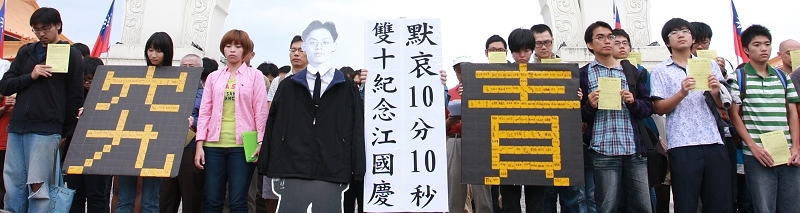
Yesterday (June 12), as usual, I went on the radio program, "Give Me an Explanation" with Chang Ta-ch'un on Thursday.
During our casual chat, he asked me: "What are we talking about today?"
I replied: "Yen Ching-piao and Chiang Kuo-ching."
He looked skeptical: "Chiang Kuo-ching? Isn't the case already over?"
I shook my head helplessly and said: "No, holding Chen Chao-min accountable for civil liability has taken two years of litigation, and the judgment was only handed down last week; as for the criminal case, it is currently still sitting at the Taipei District Prosecutor's Office, and with this dragging on, another year and a half has passed."
Just like this, holding the state and high-ranking officials accountable is no easy task, and as time passes, it easily fades from memory. When ordinary people are wrongfully killed and slaughtered, no one needs to take responsibility—from the February 28 Incident to the White Terror, whether political prisoners or innocent ordinary soldiers. Facing structural injustice, Taiwanese people can comfort themselves by thinking, "The dead are gone, but the living can be pursued," adopting an Ah Q-style attitude that makes life a bit easier to bear.
Another, more difficult path is to lock horns with the massive state apparatus to the very end.
Ever since Chiang Kuo-ching was executed by firing squad on August 13, 1997, the days of Chiang's father and mother "locking horns" with the Ministry of National Defense have stretched on for 17 years. Chiang's father exhausted his family's wealth and has passed away, while Chiang's mother continues to persevere. Looking back, although the JRF only began supporting the Chiang case around 2004, in the blink of an eye, ten years have also passed, and we are still persevering.
The civil judgment of the Taipei District Court's first instance has rekindled some hope in us. The judge directly established the responsibility of each officer and explicitly stated that Chiang Kuo-ching's death was caused by the actions of Chen Chao-min and others. This crisp and resounding slap across the face of the Taipei District Prosecutor's Office stood in stark contrast to the prosecutors' deliberate shielding, showcasing the judge's decisive and righteous perspective.
Of course, we do not know how long the civil accountability litigation will continue after appeal, nor on what grounds prosecutors will continue to obstruct or delay criminal accountability. But we know what seniors in the social movement sector often say: "A movement is a test of who has more breath." Whoever persists to the end will win. While individual capacity is limited, the combat capability of an organization is boundless.
Every NGO is an infinite organization, steadfastly guarding its post of concern. Just like the JRF, we will certainly persist in the Chiang case to the very end, and outlast them in endurance.
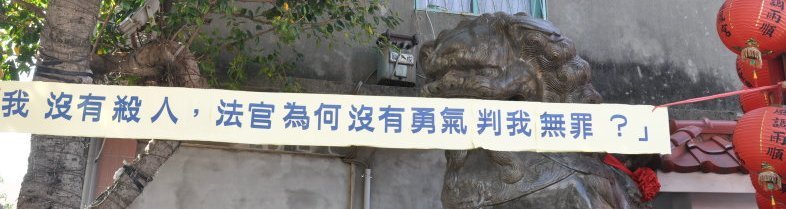
Understanding "Chiou Ho-shun": Never Let There Be Another "Chiang Kuo-ching"
What have we learned from the Chiang Kuo-ching case?
The making of a wrongful conviction, the confessions extracted through torture, the unfair trial—please put on the brakes before it is too late. Please get to know "Chiou Ho-shun" and ensure there is no next "Chiang Kuo-ching."
Chiou Ho-shun, from Chu-nan, Miao-li
He was considered the prime suspect in the kidnapping and murder case of schoolchild Lu Cheng. Because he and the other defendants confessed to the crime during the investigation stage, the court based its death sentence on these confessions.
However, an investigation by the Control Yuan revealed that his confession and those of the other defendants were obtained through improper methods of torture by investigating police officers, who repeatedly beat them and forced chili water down their throats. This is proven by interrogation audio and video recordings. Furthermore, after the Control Yuan investigated and issued a corrective measure, the police officers involved in the torture were also convicted by final court judgments. Nevertheless, the court still sentenced him to death based on these confessions.
Chiou Ho-shun Is Innocent
Among the evidentiary materials, there is a car rental agreement proving that at the time of the Lu Cheng case, Chiou Ho-shun was renting a car in Miao-li; the evidence includes the kidnappers' ransom note, which contains seven fingerprints left by the kidnappers, none of which match those of Chiou Ho-shun or any other defendant; the evidence shows that on the day of the incident, Lu Cheng took a public bus to school, whereas the confessions of Chiou Ho-shun and the other defendants stated that they targeted Lu Cheng for kidnapping because they saw him going to school in a luxury private car.
Despite so many problems, the court still sentenced him to death.
Chiou Ho-shun's Life Hangs in the Balance
He could be executed by firing squad at any moment. Priceless human life could be stripped away at any time due to the state's mistakes.
In 2010, Professor Lin Yü-hsiung of the National Taiwan University College of Law, Professor Yang Yün-hua of National Chengchi University College of Law, and Professor Li Chia-wen of National Cheng Kung University College of Law, among others, drafted a human rights report on the Chiou Ho-shun case. They pointed out major issues such as the confessions used in the judgment, the defendants' detention exceeding 22 years, and the 21-year delay in the case, which severely violated human rights. His plight has attracted the attention and support of countless domestic and foreign groups and the public.
In 2013, Control Yuan Member Li Fu-tien's investigative report on this case specifically pointed out: "There are truly countless dubious points in this case, and the aforementioned contradictions with the provisions of the Code of Criminal Procedure and the International Covenant on Civil and Political Rights are far from exhausted. If the accusatory evidence of the defendants is excluded, the remaining evidence in this case consists merely of voiceprint comparisons, the seized rope, and the ransom note—evidence that is extremely thin and whose connection to the facts of the case is highly questionable... However, 'how can one take a life when there are confessions but no evidence?' Moreover, the confessions of co-defendants contradict one another, shrouded in heavy doubt and filled with improper methods such as police and prosecutorial inducement, coercion, and enticement... We pray that the judicial authorities will carefully investigate the truth to prevent miscarriage of justice and wrongful suffering."
He was even listed by Amnesty International as one of the top five global urgent action cases. In 2013, international human rights experts visiting Taiwan to review our country's "National Human Rights Report" directly called out the Chiou Ho-shun case for its numerous problems.
However, despite the countless suspicions in this case and the unceasing social support, our state remains indifferent and unmoved. This is because the cries of the innocent are not loud enough, and the momentum for exoneration is not fierce enough.
Exoneration of Wrongful Convictions Needs You!
Chiou Ho-shun needs more people to cry out for him, more people to speak up for him. The exoneration of the Chiou Ho-shun case requires a voice powerful enough to awaken the state—and that is the support of you and me.
This article is an AI-generated translation of the original Chinese text. In the event of any discrepancy, the Chinese version shall prevail.