
Starting from Why People Dislike Military Police
Last edited: 2026-08-30
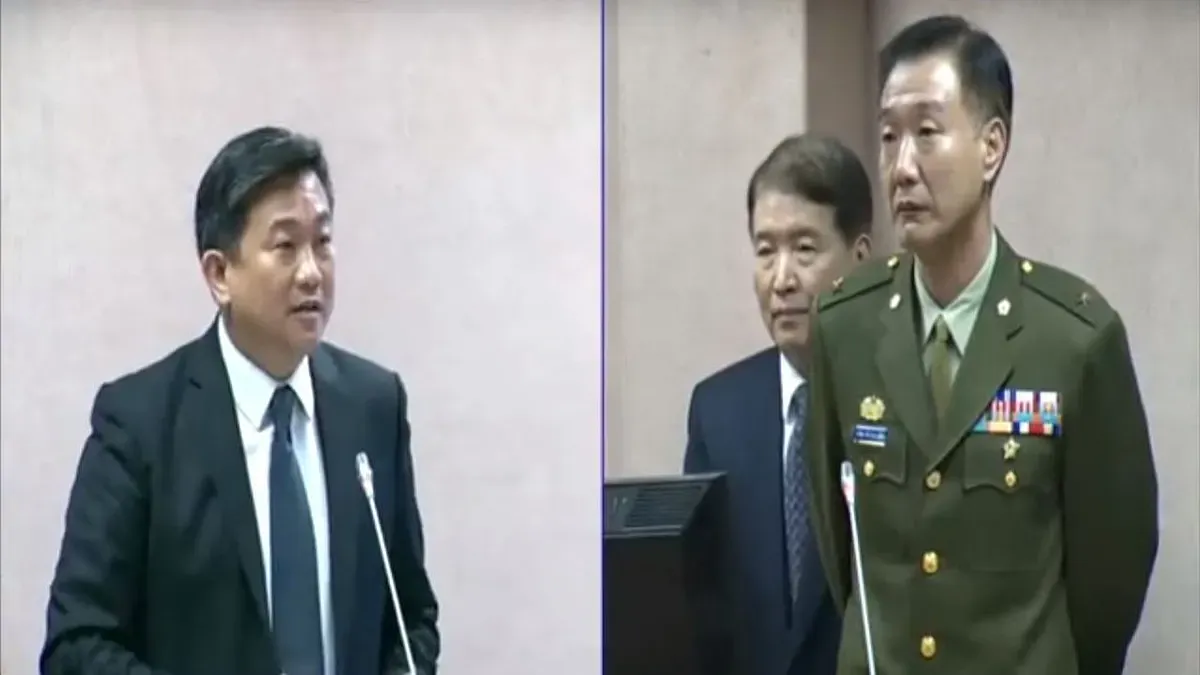
Photo/Legislative interpellation of the Minister of National Defense regarding the case of Military Police searching a civilian residence
When hearing about illegal searches conducted by the Military Police in the media, the initial reaction was not one of great surprise. After all, the military has often been involved in absurd misdeeds; the Hung Chung-chiu case remains fresh in people's memories, and the public dislikes the military. Later, many found it strange because in current practice, Military Police usually act only upon a prosecutor's order and rarely initiate criminal investigations on their own. As the truth finally came to light, the mastermind was the Military Security General Corps, making the Military Police mere scapegoats, and both units are now facing serious trouble.
The Ministry of National Defense is always evasive when facing problems, perfectly playing the role of the "black curtain" once again. Whether feigning stupidity or truly foolish, feigning stupidity is deeply malicious—knowing they caused a mess, yet acting totally clueless when questioned. Being truly foolish is even more terrifying, indicating that from the White Terror to the present, investigative methods and the mindset of evading oversight remain unchanged, while legal regulations are disregarded and they do not even know where they went wrong. Through this ordeal, the public has grown even more averse to soldiers and less trusting of military officers.
Wrong from the Very Beginning: Insisting That "Everything is Legal"
The Military Security General Corps is neither a judicial police officer nor a military police officer (Military Police). Even if a soldier commits the crime of divulging secrets, it is not their place to handle it, let alone when dealing with ordinary civilians. When the Military Police investigate a criminal case involving a civilian, they do not—and should not—take orders from the Military Security General Corps. The law stipulates that there is only one "investigative body," which is the prosecutor. When the initial move of an investigation fails to follow procedure, all subsequent actions become entirely illegal. Summonses are invalid, and detaining people or seizing items will lead to lawsuits. Debating whether a search warrant requires a prosecutor's approval and must then be applied for from a judge, or arguing whether "consent searches" require "prior" rather than "post-facto" consent, will not turn the actions of the Military Security General Corps and the Military Police from illegal to legal.
This is akin to a legislator bringing along law-abiding criminal investigators to "investigate a case." A legislator is not a judicial police officer and therefore lacks the qualifications to investigate cases, nor can they direct criminal investigators (although we know that, in reality, the police are sometimes quite happy to follow the orders of elected representatives). We would never be foolish enough to think that a legislator directing an investigation is legal simply because a criminal investigator is tagging along. Watching every press conference, high-ranking Ministry of National Defense officials down to the Minister firmly asserting that "everything is legal" sounds utterly absurd. This cannot be glossed over as a mere "procedural flaw"; rather, it is wrong across the board: "from start to finish, everything is illegal."
A Lack of Historical Awareness That Provokes Sensitive Social Nerves
This proves one thing: the military has always prioritized rank and unquestioning obedience to superiors, without questioning whether an order is legal or illegal. Of course, the military demands obedience, and superiors directing subordinates allows for smooth execution without obstruction. However, obedience is not blind compliance, especially since plots involving "soldiers dealing with commoners" are most likely to provoke the sensitive nerves of Taiwanese people. The high-ranking military officers who issued the orders seemed completely devoid of any "historical awareness," living in a parallel universe.
There are many reasons for this lack of historical awareness regarding the White Terror. For the younger generation, it may be because textbooks do not contain it and teachers do not teach it; for the older generation, they might have been the perpetrators, or they were influenced by being subordinates to perpetrators. This is because if perpetrators were to empathize with victims, it would equate to denying themselves; naturally, they lack the consciousness and empathy of victims. This is the consequence of incomplete transitional justice despite three changes of government. When Chen Shui-bian (Chen Shui-bian) came to power in 2000 and shouted about doing it, perhaps he lacked sufficient political strength, or perhaps changing his seat changed his mind, and he also wanted to use prosecutors, the military, police, and intelligence agencies to gather information and enjoy the thrill of striking political enemies. With the personnel and systems still in place, Ma Ying-jeou's accession to power led to the restoration of the party-state. While he may have had some ideals in the early stages, he was ultimately raised on the milk of the party-state; weaning himself off it would be self-destruction, and expecting him to implement transitional justice was beyond reasonable expectation.
How Chen Shui-bian and Ma Ying-jeou fell from high popularity should serve as a cautionary tale for any clever president. Implementing transitional justice is no easy task, and once a leader loses their aura, it becomes even harder to make any headway. Perhaps we should not have high expectations for Tsai Ing-wen (to spare her too much pressure?), or perhaps the people of Taiwan have long possessed the psychological fortitude of "having no expectations means suffering no harm." Yet, doing something versus not doing it is what distinguishes politicians from statesmen. It is simply a matter of whether ideal political will can be sustained and carried through. There is only one reason to do it, but a multitude of reasons not to. Of course, alongside hoping for the emergence of more statesmen, we look forward even more to the rise and deepening of civic awareness. As time passes, we hope to use wisdom and strength to untie and resolve the many problems left behind by our predecessors one by one.
※ This article was published in PNN PTS News Issues Center
This article is an AI-generated translation of the original Chinese text. In the event of any discrepancy, the Chinese version shall prevail.