
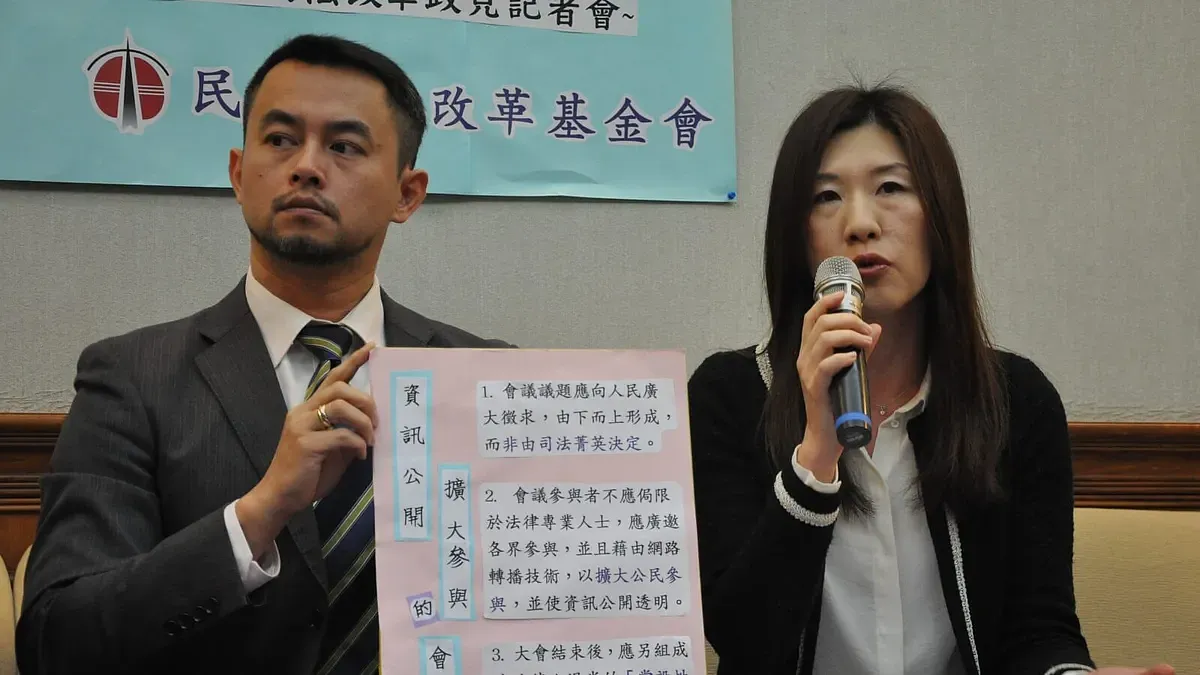
Press Conference Urging President Tsai Ing-wen to Fulfill Her Judicial Reform Platform: A New Vision for "Presidential Political Energy in Judicial Reform"
Last edited: 2026-07-27
Tsai Ing-wen promised to convene a "National Judicial Reform Conference" after being elected, explicitly stating in the televised debate on January 2nd this year: "Judicial reform is the president's responsibility. Only with the president's determination and political energy can judicial reform succeed." Therefore, the Judicial Reform Foundation demands that upon taking office, President Tsai Ing-wen should:
- Personally chair the "National Judicial Reform Conference."
- Nominate the President and Vice President of the Judicial Yuan and the Minister of Justice who are capable of realizing the president's judicial reform platform.
- Thoroughly carry out the entire judicial reform conference based on the principles of "information transparency" and "expanded participation."
I. Introduce Presidential Energy and Personally Chair the Conference
On August 25, 2015, Tsai Ing-wen announced her judicial reform policy press conference, detailing five major propositions. She mentioned that during her visits to grassroots communities across Taiwan in recent years, apart from complaints about economic stagnation and livelihood hardships, the most frequent grievance was undoubtedly "judicial injustice."
We affirm the determination of Tsai Ing-wen and Lin Chuan's cabinet to "boost the economy." However, compared to "economic reform policies" which sometimes still struggle against global shocks, judicial reform does not face the problem of an "external environment." The main problem lies in the difficulty of coordination "between courts," which falls squarely within the constitutional powers of the president. Therefore, we believe that as long as the president is determined, brings in presidential-level political energy, personally chairs the conference, and champions judicial reform, success will surely be achieved and allow the people to "immediately feel the change"!
II. Standards for the President of the Judicial Yuan and the Minister of Justice
Secondly, Taiwanese citizens have long distrusted the judiciary. Even as the qualifications of judges and prosecutors continue to improve, it remains unable to restore public confidence, culminating in a rule-of-law crisis that ultimately erodes democracy and freedom. To overturn public distrust in the judiciary, President Tsai's primary task is to nominate a President and Vice President of the Judicial Yuan and a Minister of Justice who command public trust. What kind of candidates can win the public's trust? The Judicial Reform Foundation proposes the following standards:
- Individuals who have made significant contributions to Taiwan's democratic movement and judicial reform, and have no record of subservience to those in power.
- Individuals who have a profound understanding and awareness of the hardships people encounter within the judiciary, and who are capable of implementing the president's judicial reform platform.
- Individuals who support the convening of the National Judicial Reform Conference, and possess the determination and capability to promote and implement major reforms (e.g., public participation in trials).
III. Conference Format of "Information Transparency" and "Expanded Participation"
Finally, regarding the upcoming National Judicial Reform Conference, the Judicial Reform Foundation advocates for the following format to avoid repeating the mistakes of 1999 and to open up a new vision for a new era:
- Conference topics should be extensively solicited from the public and formed from the bottom up rather than decided by judicial elites.
- Conference participants should not be limited to legal professionals; individuals from all walks of life should be broadly invited. Furthermore, live internet broadcasting technology should be utilized to expand civic participation and ensure transparent and open information.
- Following the conclusion of the plenary session, a "standing committee" with a majority of non-legal professionals should be established to continue deliberating on unresolved topics and to track and supervise the subsequent implementation of deliberation outcomes.
The people's judiciary must be forged collectively by the people. The Judicial Reform Foundation will launch the "National Judicial Reform Movement," inviting all citizens to think together and participate in the judicial reform movement kicking off in 2016. If you also believe that Taiwan's judiciary can be better and should be better, we invite you to take action, jointly reshape the future of Taiwan's judiciary, and strive to build a judiciary worthy of public trust!
The "National Judicial Reform Movement" is about to launch. Stay tuned, and we sincerely welcome your participation!
Press Conference Representatives
Lin Yung-sung, Attorney and Chairperson, Judicial Reform Foundation
Yu Po-hsiang, Attorney and Standing Executive Committee Member, Judicial Reform Foundation
Huang Chih-hao, Attorney and Standing Executive Committee Member, Judicial Reform Foundation
Lai Ying-chen, Attorney and Standing Executive Committee Member, Judicial Reform Foundation
Kao Jung-chih, Attorney and CEO, Judicial Reform Foundation
Press Contact
Attorney Kao Jung-chih 02-2523-1178
This article is an AI-generated translation of the original Chinese text. In the event of any discrepancy, the Chinese version shall prevail.