
The 323 That Has No Period
Last edited: 2026-08-30
Two years have passed, and I still want to know: who was the person that beat me? Without knowing this, it feels as though this matter has never reached a period.
Two years have passed since the police's violent eviction of citizens occupying the Executive Yuan on March 23, 2014. The government still owes an explanation regarding the "truth" of the March 23 Executive Yuan incident. Everything from the decision-making process, the conditions at the eviction scene, to the post-event reviews remains a complete blank, let alone relief and compensation for the injured.
For instance, what was the exact number of people injured during the March 23 action? Former National Police Agency Director-General Wang Cho-chun stated during an interpellation at the Legislative Yuan: "The number of injured citizens was 55, while the number of injured police officers was 119," whereas media reports put the number of injured citizens at over 100. However, according to interviews conducted by the nongovernmental "March 23 Executive Yuan Incident Truth Investigation Group," at least 400 to 500 citizens were injured as a result of the police eviction.
National Police Agency Report Downplays the Severity
Regarding the situation at the scene, the National Police Agency of the Ministry of the Interior reported that rioters had illegally intruded into the Executive Yuan compound for an illegal assembly that night, and that the police carried out the eviction only after prior soft persuasion and calls to disperse, without using excessive force. Nevertheless, the report by the "March 23 Executive Yuan Incident Truth Investigation Group" indicates that apart from the Executive Yuan compound, starting at 12:05 a.m. on March 24, citizens engaging in a peaceful sit-in on Peiping East Road and Tienchin Street were subjected to violent police eviction. Many suffered concussions, fractures, lacerations, or varying degrees of physical trauma and emotional distress, rendering the area a "hard-hit disaster zone."
Furthermore, between 5:00 a.m. and 7:00 a.m. on March 24, after all citizens within the compound had been completely evicted, the police actually continued to perpetrate violence against citizens who had already been driven out of the grounds. Deploying two water cannons, the police used high-pressure water jets in a fan-shaped pattern to "sweep" the crowds around the intersection of Chunghsiao East Road and Chungshan North Road. During this period, no citizens were carrying out any large-scale sit-ins on Chungshan North Road; many had just emerged from the compound, were merely bystanders at the periphery, or were simply passing by, only to be arbitrarily dragged into the police formation and beaten by police officers.
I kept telling myself that what I should hate is not an individual, but a system. But it is so difficult.
Over the past two years, although state organs have not been entirely inactive in investigating the truth of the March 23 Executive Yuan incident, whether due to deliberate leniency, insufficient momentum, or because the dark forces within the administrative system are truly too strong, it has yielded zero results.
Three days after the incident, the Internal Administration Committee of the Legislative Yuan immediately established the "Special Investigation Task Force on the Truth of the Executive Yuan's Suppression of the Anti-CSSTA Student Movement," demanding that the Executive Yuan provide relevant documents. In the face of parliamentary investigation, the Executive Yuan and the National Police Agency merely fobbed it off with a handful of sporadic documents that were of no help in clarifying the truth, prompting the Internal Administration Committee to freeze NT$20 million of the Executive Yuan's 2015 budget. After the Executive Yuan submitted supplementary reports that were virtually identical, the Internal Administration Committee still unfroze NT$14 million of the budget.
The Control Yuan accepted a petition from student groups in April 2014. After Member Ch'ien-Lin Hui-chun initiated an investigation, the relevant units refused to provide multiple documents, and the Control Yuan currently has the investigation suspended on the grounds that the case is undergoing judicial proceedings.
As for the pursuit of judicial criminal liability, the Taipei District Prosecutor's Office as early as June 2014 accepted a case referred by the police concerning three police officers suspected of causing injury, yet over the past two years no prosecution results have been seen. Instead, this has allowed the administrative agencies to use "non-disclosure of investigation" as an excuse to refuse document provision. The prosecutors' inept handling has hindered the exposure of the truth.
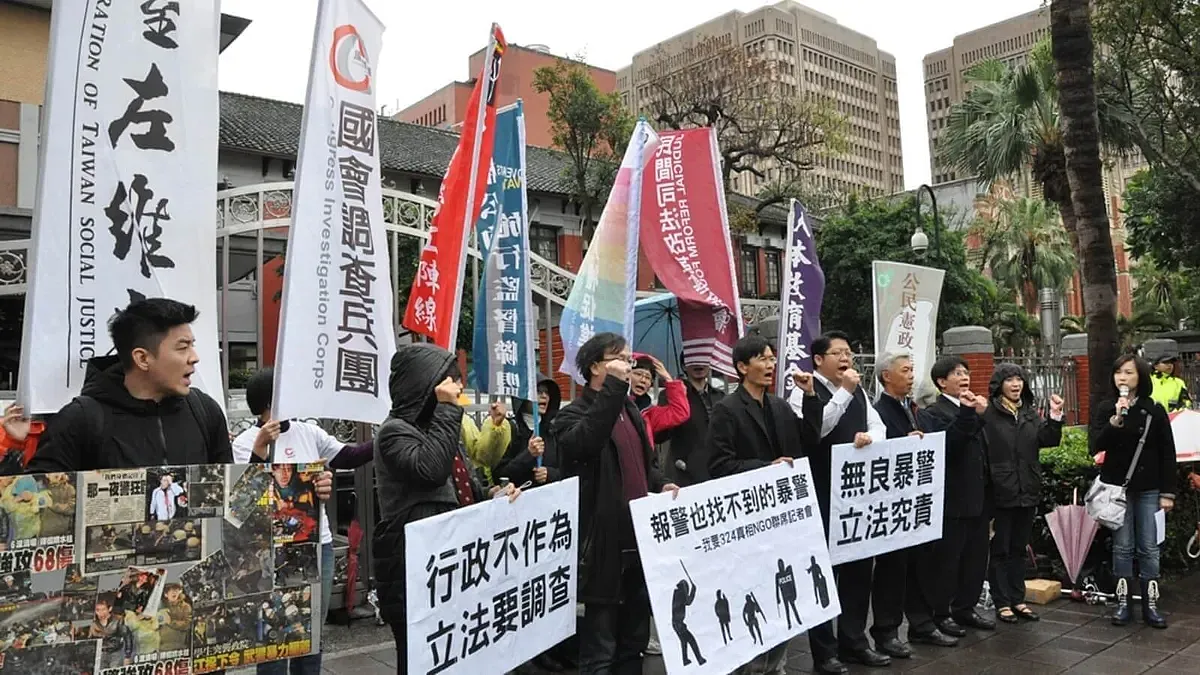
Meanwhile, in the private prosecution cases filed by over 40 injured citizens at the Taipei District Court, simply clarifying "the names of the police officers who struck the blows" met with obstacles at every turn. During the March 23 action, police officers used their equipment to obscure the insignia and identification on their uniforms. Even when clear video screenshots were submitted, the police units still responded that "after cross-referencing personnel data, no such person could be found." Compared with the result of Taipei District Prosecutor's Office prosecuting over 130 citizens involved in the March 23 incident, the M-Police real-time photo recognition system procured by the National Police Agency using taxpayers' funds appears to be useful only against ordinary people.
Regarding administrative penalties by administrative organs, currently only one police captain surnamed Hu from the Taipei City Police Department's Special Operations Corps has received a reprimand, because an officer in his squad beat a citizen named Lin Ming-hui until his head was bloodied. Unable to identify the specific officer who landed the blows, the Taipei City Police Department reprimanded the squadron commander 2 times for "negligence in the supervision of subordinates, with minor circumstances." This case was determined by a court judgment to have seen the Taipei City Police Department's eviction methods severely violate the principle of proportionality, and the Taipei City Government must compensate Lin Ming-hui NT$300,000; it remains the sole "successful" case of accountability.
The *2015/2016 Annual Report on the State of the World's Human Rights* published by Amnesty International stated: Regarding the excessive use of force by police to evict protesters from the Executive Yuan and its surrounding areas on March 23 and 24, 2014, or the government's overall actions during the "Sunflower Student Movement," no thorough, independent, and impartial investigation had been seen as of the end of 2015. Yet the National Human Rights Report completed by the Taiwan government at the end of last year did not even utter a single word about the March 23 Executive Yuan incident!
I hope that I do not hate, and do not feel anger. I hope that I can understand the police, and understand why they acted this way.
The obscurity of the truth surrounding the March 23 incident not only makes it impossible to hold those who issued the orders accountable, but also deepens the conflict and distrust between the police and the people, highlighting the issues of the police system and the unmonitored use of police force, while seriously infringing upon citizens' most fundamental freedom of assembly. Even when facing armed criminals, the police still have certain regulations for the use of force, yet when facing unarmed, peaceful sit-in crowds, the police employed eviction methods exceeding lawful and reasonable limits.
In February of this year, a report on the proper management of assemblies released by the United Nations Human Rights Council pointed out that "as part of the democratic process, assembly plays a fundamental role, identical to elections, in public participation, holding governments accountable, and expressing the will of the people." The report also recommended that governments establish independent, impartial, and additional non-judicial oversight mechanisms—including effective internal investigations and independent monitoring bodies—to promptly and effectively investigate crimes committed during assemblies. The report further asserted that acts of "failure to hold people accountable" may in themselves constitute a violation of rights.
Recently, civic groups held a press conference calling on the new parliament to form a special committee to investigate the truth of the March 23 Executive Yuan incident, and the Legislative Yuan's Internal Administration Committee is currently reviewing the draft amendments to the *Assembly and Parade Act*. The Democratic Progressive Party, which holds an overwhelming majority in the parliament, has no excuse to further delay the investigation into the truth of March 23, and should concurrently take more proactive action toward establishing systems such as monitoring mechanisms for assemblies and parades and impartial, independent investigative units. Lin Ch'ü, who is slated to assume office as Premier after May 20, should make it a top priority upon taking office to withdraw the prosecution against citizens who entered the Executive Yuan on March 23, using actions to prove his determination to safeguard the freedom of assembly.
※ Originally published in the PTS PNN News Issues Center
This article is an AI-generated translation of the original Chinese text. In the event of any discrepancy, the Chinese version shall prevail.