
The Truth of State Violence Cannot Be Evaded
Last edited: 2026-07-27
Photo Source / Tso Tsu Shin
That was a turbulent month. In March 2014, the Legislative Yuan took a mere 30 seconds to review the Cross-Strait Service Trade Agreement, shocking all sectors of society. A group of predominantly student citizens occupied the Legislative Yuan to protest the covert trade pact, sparking a movement that would later be known as the 'Sunflower Student Movement'.
The Sunflower Student Movement was full of dramatic twists and turns, but now that the wave has passed, judgments of right and wrong can be left to history. What demands our attention now is the dark and brutal early morning of March 24, which lies behind the brilliant sunshine.
The Government Continues to Turn a Deaf Ear
The current Executive Yuan central building was formerly the office building of the 'Taiwan Provincial Administrative Executive Office'. On February 28, 1947, right on the plaza in front of the gates of this building, people gathered to petition and demonstrate, only to be gunned down by the guards inside the office, resulting in numerous casualties. As if playing a cruel joke on history, 67 years later, from the night of March 23 to the early morning of March 24, 2014, the state once again confronted the people's roar with violence in the exact same place.
I believe many people spent a sleepless night on the evening of March 24 (though the protagonist of the incident, former Executive Yuan Premier Chiang Yi-huah, claimed he fell asleep a little past 1 a.m.). Regardless of political stance, and whether one supports the occupation of the Executive Yuan or not, the scenes in the news showing crowds being forcibly dispersed by armed police wielding shields and batons, beaten until their heads were bloodied, were utterly shocking. What exactly happened that night?
The people are the masters of the country. When the state turns around and confronts the people with violence, the people, as masters, have the right to investigate the truth of the incident. However, the truth of the February 28 Incident remains unclear to this day, and the truth of the March 24 Executive Yuan violent dispersal incident is no different. When facing the people's pursuit of the truth regarding state violence, the government's attitude has remained consistent from beginning to end: ignoring it entirely.
This dismissive attitude presents a paradoxical situation. Former Legislator Chou Ni-an questioned former National Police Agency Director-General Wang Cho-chun, asking why the police officer who injured her had still not been found. She asked, 'Are you unwilling to find him, or is your competence so poor that you cannot find him?' Wang Cho-chun unexpectedly replied, 'My competence is not very good!' A clear photograph of a police officer brandishing a baton on March 24, with his facial features clearly visible, has been widely circulated across the internet and media, yet to this day no such person has been found, turning it into a ghostly photograph.
'There Can Be No Reconciliation Without Truth'
Some citizens who faced violence that night believed that the police acted unlawfully in violently dispersing peacefully protesting crowds. Consequently, they filed criminal private prosecutions against the violent police officers as well as those in the chain of command—such as Fang Yang-ning, Huang Sheng-yung, Wang Cho-chun, and Chiang Yi-huah—hoping to hold the relevant individuals accountable through judicial procedures. However, two years have passed, and the private prosecution cases continue to bounce back and forth among courts at all levels over procedural issues, becoming a 'ping-pong ball', without conducting substantive reviews on whether the police's use of violent dispersal that night was lawful. Meanwhile, some of the 'defendants' have been appointed as Presidential Office Senior Advisors while also serving as visiting scholars in America, and others have retired or been promoted. The judicial authorities are clearly powerless, or even unwilling, to touch the truth of and accountability for state violence.
So what have the administrative authorities done? According to the results of Legislator Ku Li-hsiung questioning Minister of the Interior Chen Wei-jen in the Legislative Yuan, there is currently no official investigation report—only the words 'no illegality found'. However, without an investigation report, and under circumstances where it remains unclear who ordered the 'time-limited' dispersal that day, who commanded and deployed the police forces, who used violent means, what violent means were used, why they were used, who was injured, and the severity of the injuries, the phrase 'no illegality found' is merely an incantation of self-deception.
An important principle of transitional justice is that 'there can be no reconciliation without truth.' The reason is that without truth, there can be no accountability, and naturally no reconciliation. President-elect Tsai Ing-wen has repeatedly emphasized the importance of transitional justice. The author hopes that the new government can begin by investigating the truth of the March 24 Executive Yuan violent dispersal incident. At the same time, it is hoped that the courts can exercise the moral courage expected of judicial personnel, and impartially hold unlawful civil servants accountable according to law. The truth of state violence must not be evaded by the government!
※ This article was published in Apple Daily
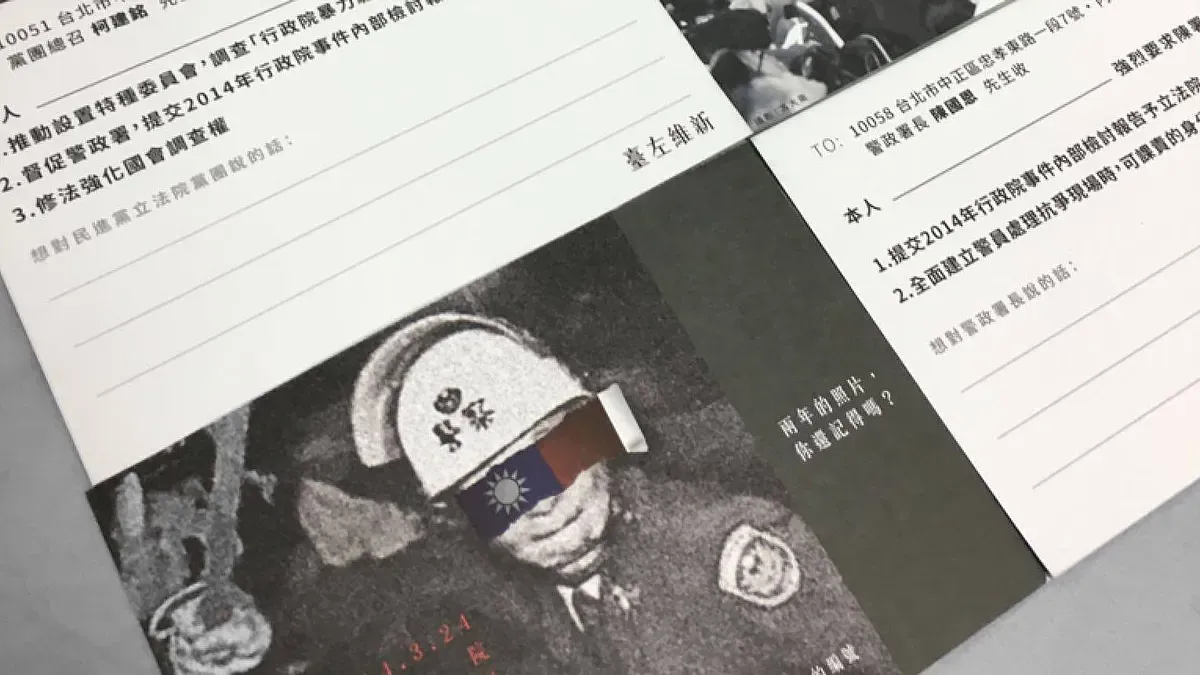
Tso Tsu Shin has designed three postcards, presenting appeals to the Democratic Progressive Party Legislative Caucus, Taipei Mayor Ko Wen-je, and National Police Agency Director-General Chen Kuo-en respectively: 'Two years have passed, we want the truth, we want accountability, we want checks and balances; those in power should take action.' We invite everyone to write what you want to say to them on the postcards, gathering the strength of all of Taiwan to let the government know we have not forgotten.
- Regional distribution points: http://bit.ly/1MnylV4
- Printing sponsorship and collection: http://bit.ly/1o8zofW
This article is an AI-generated translation of the original Chinese text. In the event of any discrepancy, the Chinese version shall prevail.