
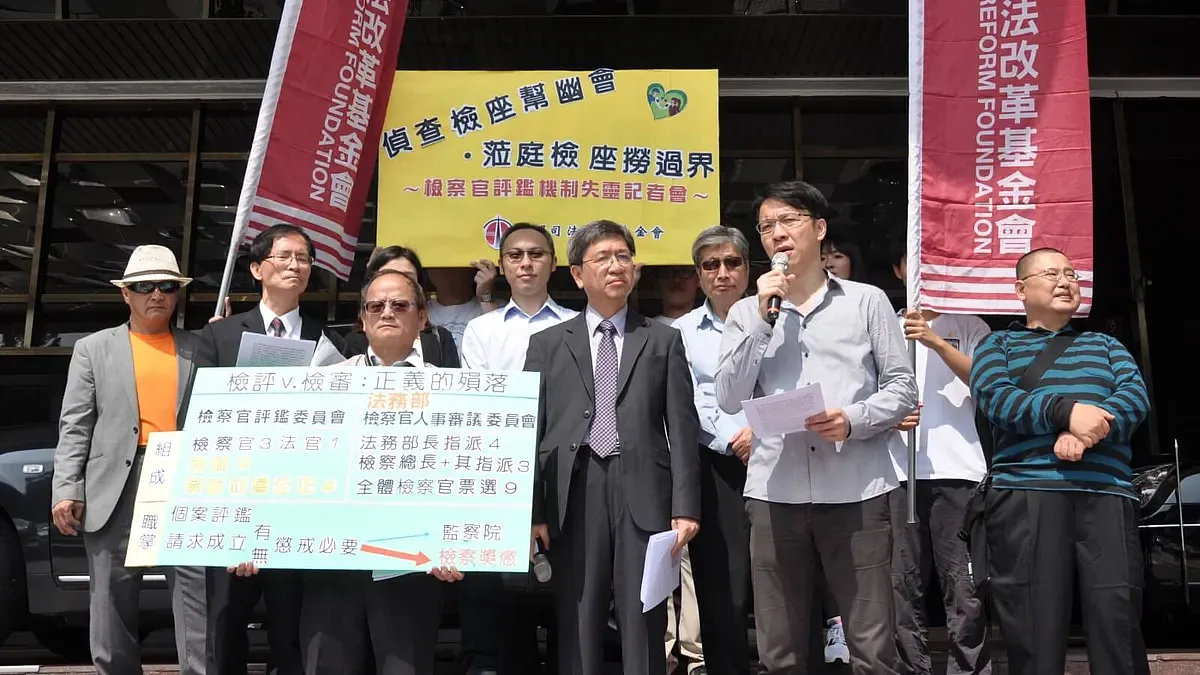
Prosecutor in Charge of Investigation Arranges Secret Meeting, Trial Prosecutor Oversteps Boundaries: Press Conference on the Malfunction of the Prosecutor Evaluation Mechanism
Last edited: 2026-08-30
The individual case evaluation system has been in effect for four years since the Judges Act came into force on January 6, 2012. Out of 30 resolutions made by the recently concluded Second Prosecutor Evaluation Commission (PEC), only 3 found disciplinary action necessary and were referred to the Control Yuan. Among the remaining 27 cases not referred, one case had established grounds for request but no necessity for discipline.
This either reflects a quantum leap in the quality of the prosecutorial system, ineffective reporting by requesting evaluation agencies, or simply the malfunction of the prosecutor evaluation mechanism altogether. Regardless, we arrive at a conclusion: referring a prosecutor for disciplinary action is exceedingly difficult, and evaluating prosecutors faces insurmountable hurdles!
The two cases presented today illustrate the passive handling attitude of the second Prosecutor Evaluation Commission (PEC) and the lack of determination by the Ministry of Justice's internal Prosecutor Review Committee (PRC) to initiate disciplinary proceedings. These are the critical factors behind the malfunction of prosecutor evaluation system.
Case 1: The Phantom Family Reunion, Invisible to the PEC
The JRF reported Prosecutor Wang Ming-yu (王銘裕) for arranging an unauthorized meeting between Mr. A—a married suspect whose detention and communication ban had already been ruled by the court—and his girlfriend while interrogating him regarding a suspected bribery case involving an arbitrator. The prosecutor also ordered Mr. A's defense counsel to leave the interrogation room, allowing Mr. A and his girlfriend to meet privately. However, the girlfriend's actions on that day—including her arrival, statements, and conversations—left no record whatsoever in the prosecutor's progress sheet, the attendance log of the prosecutors' office for that interrogation, or the interrogation transcript. She came and went like a phantom, leaving no trace behind. Prosecutor Wang Ming-yu clearly violated the court's ruling on the detention and communication ban, and obstructed the exercise of defense counsel's right to be present.
Nevertheless, the PEC failed to thoroughly investigate the details of the conversation between Mr. A and his girlfriend, or the communication process before and after the prosecutor arranged the meeting, in order to clarify whether there was any inducement of a confession from Mr. A. Instead, it glossed over the matter by stating that whether the scope of the detention and communication ban "falls under matters reserved for judges or discretionary powers of prosecutors remains legally inconclusive." It concluded that when Prosecutor Wang Ming-yu arranged the "family reunion" for Mr. A and his girlfriend, he was uncertain whether he needed to apply for a judge's permission or could decide on his own, lacking the awareness of illegality, and thus resolved that the request for evaluation was unfounded (Appendix 1). We believe that such an absurd reasoning by the PEC is nothing short of shielding the prosecutor.
Case 2: Prosecutor Oversteps Boundaries, Smacked Down by the PRC
Ms. B was a caregiver for an elderly woman, living with her and attending to her daily life. One day, Ms. B was discovered to have withdrawn NT$2.72 million from the elderly woman's post office savings account within a span of just four months, despite the original agreement stipulating that Ms. B could only withdraw NT$50,000 per month. The prosecutors' office indicted Ms. B for fraud.
During the preparatory proceedings, Prosecutor Kuo Ch'ien-hsüan (郭千瑄) acted as the trial prosecutor. The assigned judge asked Ms. B whether she pleaded guilty, and repeatedly refuted Ms. B's defense with sarcastic and mocking harsh words. Subsequently, turning to ask the prosecutor for their opinion, Prosecutor Kuo Ch'ien-hsüan directly petitioned for detention (prosecutors have no power to petition for detention during trial proceedings), and the assigned judge promptly issued a detention order.
During the trial proceedings, while the shadow of Ms. B's detention still lingered, she was frequently interrupted from speaking by the presiding judge, abruptly ordered to stand and sit down, and subjected to harsh, mocking roars. When making her final statement, she became emotionally agitated and attempted to headbutt. Prosecutor Kuo Ch'ien-hsüan actually demanded that the bailiffs handcuff Ms. B on the spot (she had no authority to demand handcuffing).
In fact, when a criminal case enters the court trial stage, pursuant to Article 60 of the Court Organization Act, the prosecutor's authority is limited to public prosecution and does not include the right to petition for detention or direct bailiffs to use restraining devices. Prosecutor Kuo Ch'ien-hsüan's aforementioned words and actions clearly constituted an abuse of authority.
Regarding Prosecutor Kuo Ch'ien-hsüan's petition for detention during the preparatory proceedings, the PEC deemed it merely an "expression of opinion," which was not in violation of the law. However, according to the evaluation resolution rendered by the Judges Evaluation Commission (JEC) concerning the assigned judge in that trial, and the cited trial recording transcripts, the court decided to detain Ms. B on the spot precisely because Prosecutor Kuo stated, "Please Your Honor detain in accordance with the law." The PEC clearly distorted the actual situation of the trial (Appendix 2).
Secondly, regarding Prosecutor Kuo's order for the bailiffs to handcuff the defendant during the trial proceedings, video footage of the trial clearly showed that Ms. B had already been pinned to her seat by multiple bailiffs upon her first headbutt, posing no threat to the personal safety of herself or others present in court. Yet, because Ms. B continued to cry out and tearfully accuse the prosecutor of being a "dinosaur" after being pinned down, Prosecutor Kuo "directly spoke out and gestured to order the bailiffs to handcuff the defendant on the spot without waiting for the presiding judge's order" (Appendix 3). This clearly encroached upon the presiding judge's statutory authority to direct litigation. The PEC resolved that the grounds for the request were established, but merely considering that the evaluated prosecutor was junior in seniority and had encountered an emotionally out-of-control defendant, chose not to refer her to the Control Yuan, instead transferring the matter to the internal Prosecutor Review Committee for deliberation.
To our dismay, the Ministry of Justice's PRC not only distorted the PEC's factual determinations regarding the misconduct, but also openly violated the requirements of the Judges Act and the Court Organization Act to officially publicize resolutions. It withheld publication of the results overturning the PEC's findings, and further manipulated news media to "whitewash" the prosecutor, allowing Prosecutor Kuo to escape unscathed. At this point, the Ministry of Justice severely undermined the credibility of the individual case evaluation system.
Article 59-1, Paragraph 2 of the Court Organization Act and Article 90, Paragraph 2 of the Judges Act both explicitly stipulate that resolutions of the Prosecutor Review Committee shall be made public. However, regarding the resolution outcome concerning Prosecutor Kuo Ch'ien-hsüan's disciplinary action, the PRC on one hand failed to make a formal public announcement, while on the other hand released through the media that the resolution was "no disciplinary action to be taken," on the grounds that "amidst shouting to be handcuffed, Prosecutor Kuo had requested the judge to stop it" (Appendix 4).
However, according to the transcript of the recording and the findings determined by the PEC, Prosecutor Kuo Ch'ien-hsüan "directly spoke out and gestured to order the bailiffs to handcuff the defendant on the spot without waiting for the presiding judge's order." The PRC distorted the facts of the case and directly overturned the facts established by the PEC—this is simply unbelievable!
Compared to the Ministry of Justice's PRC, the PEC at least includes external members such as judges, scholars, and lawyers. If the Ministry of Justice and the internal PRC composed of prosecutors are left entirely free to arbitrarily re-determine facts, it will further weaken the functions of the PEC—already constrained by budget and personnel staffing—and obliterate the sincere intention of the evaluation system to introduce external oversight into individual case evaluations.
We therefore maintain that when deliberating on disciplinary matters concerning prosecutors, the Ministry of Justice's PRC should, in principle, be bound by the facts determined in the PEC's resolutions. To take a step back, even if it is argued that the Judges Act does not explicitly provide that the facts determined by the PEC have full binding force over the PRC, if the PRC wishes to re-determine facts, it should attach reasons and publicly explain the deliberation process and the reasons for not adopting the original facts, so as to avoid accusations of protecting one's own.
In response to the current situation where the individual case evaluation mechanism for prosecutors under the second PEC has nearly malfunctioned, this Foundation will continue to analyze institutional factors and draft legislative amendments, while hereby putting forward the following demands:
- This Foundation sternly condemns the PRC for distorting and overturning the factual determinations of the PEC, and demands that the Minister of Justice remand the case to the PRC for re-deliberation pursuant to Article 17, Paragraph 2 of the Regulations for Deliberation of the Prosecutor Review Committee.
- This Foundation calls upon the Third Prosecutor Evaluation Commission to actively operate the individual case evaluation system and enhance its oversight intensity, in order to win public trust in the judiciary.
Appendices
- Appendix 1: Resolution No. 7 [104-Jian-Ping-Zi], 2015, of the Prosecutor Evaluation Commission
- Appendix 2: Resolution No. 2 [104-Ping-Zi], 2015, of the Judges Evaluation Commission
- Appendix 3: Resolution No. 5 [104-Jian-Ping-Zi], 2015, of the Prosecutor Evaluation Commission
- Appendix 4: Apple Daily Report, March 19, 2016
Attendees
TW-JRF Chairperson, Attorney Lin Yung-sung (林永頌)
TW-JRF CEO, Attorney Kao Jung-chih (高榮志)
Press Contacts
TW-JRF CEO Kao Jung-chih 02-25231178
TW-JRF Executive Secretary Huang Ling-hsuan (黃齡萱)
This article is an AI-generated translation of the original Chinese text. In the event of any discrepancy, the Chinese version shall prevail.