
2015 Annual Work Focus and Financial Report
Last edited: 2026-07-27
Thank you for your continued support of the Judicial Reform Foundation. Thanks to your support, we are able to devote ourselves to judicial reform without worry. You are not alone on the path of judicial reform!
In addition to donations, we also welcome you to participate in our events or invite us to give lectures. JRF welcomes you to invite your friends and family to join our ranks, and to learn about and support JRF together!
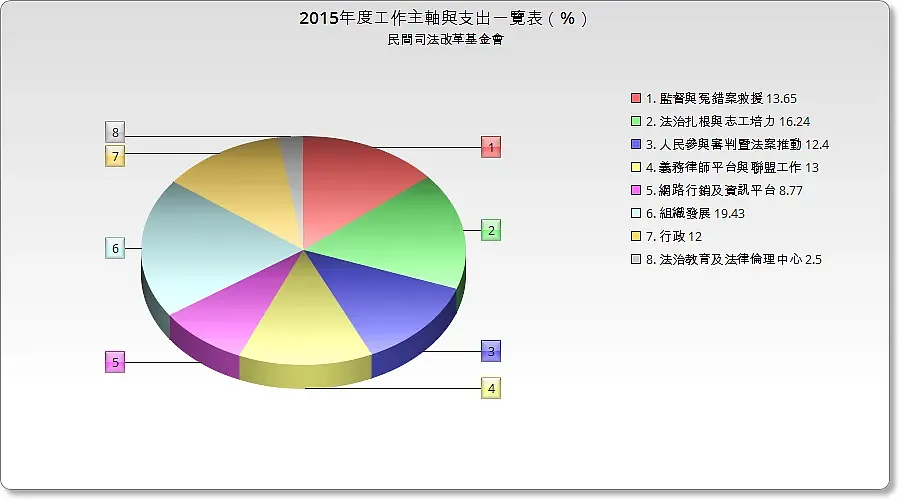
2015 Annual Work Focus Outcomes and Expenditure Status
| Category | Key Work Items | Expenditure (NTD) |
| Supervision and Wrongful Conviction Relief | Individual evaluation of judges and prosecutors, courtroom observation, wrongful conviction relief team | 3,071,111 |
| Legal Rooting and Volunteer Empowerment | Human resource training, volunteer team, student camp, central-southern branch expansion, lawyer online platform | 3,676,140 |
| Public Participation in Trials and Legislative Promotion | Public participation in trials, mock trials, prosecutor, correctional institution, police and attorney system reforms, forensic science system reform | 2,790,421 |
| Pro Bono Lawyer Platform and Coalition Work | Social movement lawyer platform, 318 pro bono lawyer team, coalition work | 3,364,118 |
| Online Marketing and Information Platform | Digital archives, publishing and editing, legal issue symposia | 1,972,060 |
| Organizational Development | Online fundraising platform, annual fundraising banquet, supporter cultivation | 4,370,808 |
| Administration | General administrative matters | 2,707,079 |
| Legal Education and Legal Ethics Center | Translation and publishing work | 561,276 |
| Total Annual Expenditure | 22,513,012 | |
Wrongful Conviction Relief
Hsu Tzu-chiang said, "In prison for sixteen years, I gained more than I lost. After losing my freedom, I came to understand better what is important in life. Now being able to speak and walk freely, and embrace my family, I feel extremely blessed." Hsu Tzu-chiang, his family, the pro bono lawyer team, and volunteers persevered for 16 years. After being wrongfully accused for 20 years, the collegial panel of the Taiwan High Court finally delivered a not-guilty verdict for Hsu Tzu-chiang on September 1, 2015! Unfortunately, the prosecutor appealed the decision, and Hsu Tzu-chiang is still waiting for ultimate justice to arrive.
In addition, for Chiou Ho-shun, who has been behind bars for 28 years, we secured medical treatment last year for his frail and painful condition. To this day, he continues to hold on while awaiting relief. We also assisted teacher Hsu Pei-ming in securing help from psychological counseling experts and filing a relief lawsuit. For 6 years, the southern pro bono lawyer team has never given up hope, and students from National University of Kaohsiung have even initiated spontaneous support actions. On one hand, we strive to dedicate ourselves to individual case relief; on the other hand, we seek to bring about change from a systemic perspective, hoping that one day no one else will suffer from wrongful grievances.
Appeal Center
In the past, payment orders were derided as "legal scams." Even if a debt did not exist, if an objection was not promptly filed, the court would treat the debt as valid, causing many innocent citizens to "make a single slip that becomes a lifelong regret" and plunge into an abyss of debt for life. Taking a chicken restaurant owner surnamed Chu in Kaohsiung as an example: "Five years ago, he received a payment order issued by the court ordering him to repay NT$300,000 to a man surnamed Wu and others whom he did not know. Chu thought it was a scam and ignored it, never expecting that someone with ulterior motives would exploit loopholes in court review to obtain a genuine payment order using a fake promissory note. As a result, his chicken restaurant was auctioned off by the court to repay the debt. Chu was so angry he suffered a heart attack and survived only after undergoing surgery." What is even more chilling is that even after a subsequent investigation confirms that the promissory note was forged, because the law stipulates that "the forger must be definitively convicted before a case can be overturned," it effectively blocks all avenues of relief for victims!
JRF formed a lawyer team to speak up for long-neglected disadvantaged citizens and promote legal amendments. Following three readings in the Legislative Yuan, the amendments to the Code of Civil Procedure were promulgated and took effect on July 3, 2015. In addition to lowering the legal effects of payment orders, for innocent citizens harmed during the period of the old law, the law also opened up a two-year window to file for retrial relief, restoring a hopeful tomorrow to victimized citizens.
Legal Rooting
"Legal popularization" has always been one of JRF's primary missions. In 2015, we planned a series of campus tours, including lectures and campus mock trials, interacting face-to-face with nearly 3,700 students. Through lecturers speaking on different topics, paired with the firsthand testimony of wrongful conviction defendant Hsu Tzu-chiang, we led students to examine whether the judiciary is moving closer to or further away from the presumption of innocence, to understand the flaws in the judicial system, the causes of wrongful convictions, and how we can bring about change to truly put an end to wrongful convictions.
At the same time, we have brought the courtroom into the classroom! We did not want to merely stand on the podium and talk unilaterally about how important judicial neutrality and objectivity are, or what the structural factors of judicial problems are. Case scripts written by pro bono lawyers allowed students to play assigned roles. In the classroom courtroom, witnesses were subjected to sharp cross-examination by prosecutors and defense attorneys, judges presided over litigation proceedings, and ultimately the jury deliberated. In the process where student jurors discussed and persuaded each other based on their respective arguments, alongside critical thinking with one another, it also opened up a pathway to thinking about Taiwan's judiciary.
Pro Bono Lawyer Platform
The 318 Movement has ended, but the state's intensive prosecution of citizens has not stopped. The pro bono lawyer team pledged to fight side-by-side with everyone in the courtroom and ensure no one is left behind. We continue to assist with all litigation matters, and also help injured parties who were driven away by "violent police officers who cannot be found even when you call the police" to file private prosecutions pursuing state violence or state compensation lawsuits. Currently, the pro bono lawyer platform has a total of 200 lawyers assisting 269 cases. Among them, in August 2015, the state compensation lawsuit filed by teacher Lin Ming-hui for injuries sustained during the March 23 Executive Yuan violent dispersal won a favorable court judgment, ordering the Taipei City Government to pay NT$300,000 in consolation money for mental distress—making it currently the only winning case. Additionally, 30 injured individuals (including the late elderly Mr. Chou Jung-tsung) filed state compensation settlement claims against the Taipei City Government, but currently the Taipei City Government and the Taipei City Police Department refuse to accept them. The pro bono lawyer team has filed state compensation lawsuits with the court. These arduous processes continually prove how difficult it is to compel the state apparatus to admit its own mistakes!
Legislative Promotion
On October 25, 2013, the Judicial Yuan unilaterally promulgated the "Regulations on Court Audio Recording and Its Utilization and Preservation." Ostensibly hoping to protect personal data, it erected numerous obstacles to obtaining audio recording discs, resulting in a less transparent judiciary. Claiming to protect litigants' privacy, it actually infringed upon the people's right of access to court. In response, JRF and the Taiwan Bar Association jointly proposed counter-proposals regarding court audio recordings. After much effort, related provisions were added to the Court Act on July 1. 2015, ensuring the Judicial Yuan can no longer restrict the public's right to obtain court audio recordings, and making the judiciary more sunny and transparent.
For a long time, public trust in the judiciary has failed to improve. To address these issues, JRF has dedicated itself to promoting legislation for public participation in judicial trials, and "honest simulation, sincere responsibility, and policy promotion" remains our original intention. In May 2015, we hosted the fourth mock jury trial and invited Judge Craig Iscoe from the United States to Taiwan for a series of symposiums, with the results published in the "2015 Annual Special Issue on Citizen Mock Jury Trials."
2015 Statement of Income and Expenditure Final Accounts
| Item | Final Settlement Amount | Description | |
| Subtotal | Total | ||
| Income | 21,802,319 | ||
| Donation Income | 21,073,092 | ||
| Interest Income | 635,114 | ||
| Other Income | 94,113 | ||
| Expenditure | 22,513,012 | ||
| Personnel Expenses | Subtotal 11,855,670 | ||
| Salaries and Wages | 9,945,382 | ||
| Overtime Pay | 179,182 | ||
| Retirement Pensions | 492,952 | ||
| Insurance Benefits | 952,365 | ||
| Other Personnel Expenses | 285,789 | ||
| Office (Administrative) Expenses | Subtotal 3,345,060 | ||
| Stationery, Books, Newspapers, and Magazines | 194,336 | ||
| Printing and Binding Expenses | 328,513 | ||
| Utilities and Fuel Expenses | 132,741 | ||
| Travel and Transportation Expenses | 886,459 | ||
| Postal and Telecommunication Expenses | 180,559 | ||
| Taxes, Dues, and Fees | 7,500 | ||
| Rental Expenses | 943,130 | ||
| Repair and Maintenance Expenses | 32,445 | ||
| Property Insurance Expenses | 11,909 | ||
| Public Relations Expenses | 21,482 | ||
| Other Office (Administrative) Expenses | 605,986 | ||
| Meeting and Activity Expenses | Subtotal 5,757,128 | ||
| Venue Expenses | 31,900 | ||
| Business Promotion Expenses | 2,957,733 | ||
| Lecture Fees, Writing Fees, or Attendance and Review Fees | 2,284,020 | ||
| Publishing and Distribution Expenses | 4,732 | ||
| Other Business Expenses | 478,743 | ||
| Acquisition Expenses | 618,093 | ||
| Donations | 651,189 | ||
| Depreciation | 285,872 | ||
| Pre-tax Surplus (Deficit) for the Period | -710,693 | ||
| Income Tax Expense | |||
| Post-tax Surplus (Deficit) for the Period | -710,693 | ||
This article is an AI-generated translation of the original Chinese text. In the event of any discrepancy, the Chinese version shall prevail.