
Prosecutorial Self-Regulation: Protecting One's Own?
Last edited: 2026-07-27
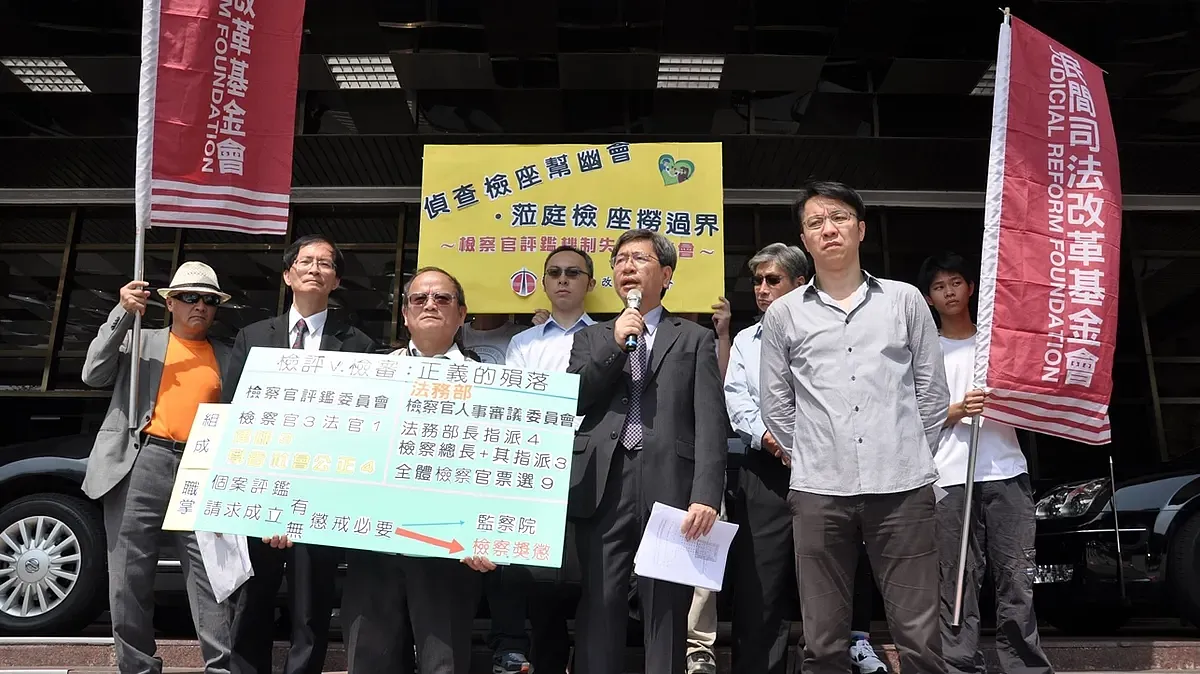
On the morning of the 7th, the Judicial Reform Foundation (JRF) went to the Ministry of Justice to protest the failure of the prosecutor evaluation system. The JRF specifically pointed out that the Prosecutor Evaluation Commission (PEC) had confirmed that Prosecutor Kuo of the T'aoyuan District Prosecutors' Office had indeed exceeded his authority, and resolved to submit the matter to the Prosecutor Review Board (PRB) of the Ministry of Justice for disciplinary review. Unexpectedly, the PRB overturned the PEC's factual determination and resolved not to issue any punishment. This is not merely a jurisdictional conflict between the PEC and the PRB; rather, it is a fundamental issue concerning the raison d'être of the prosecutor evaluation system, which must be confronted with utmost seriousness!
Historically, although prosecutorial agencies maintained internal self-regulatory and supervisory mechanisms, the public has long been unable to trust them. Consequently, the Judges Act, promulgated and enacted on July 6, 2011, established a new prosecutor evaluation system. Through fair and objective evaluation procedures, unfit prosecutors are weeded out to ensure the public's right to a fair trial. The Act stipulates that the PEC shall be composed of three prosecutors alongside a diverse group of external members, including one judge, three attorneys, and four scholars and impartial members of society. Before making an individual case evaluation resolution, the PEC must provide the evaluated person with an opportunity to state their opinions, conduct necessary investigations, and notify relevant parties to appear and explain. Accordingly, prosecutor evaluation is a mechanism that incorporates external oversight, and the evaluated prosecutors are also guaranteed due process.
The PEC is an administrative agency that independently conducts prosecutor evaluations. An individual case evaluation resolution it renders is an administrative disposition that directly produces external legal effects. It has the effect of confirming that a prosecutor has engaged in conduct unsuited for office (such as dereliction of duty, exceeding authority, misconduct, or serious violations of prosecutorial ethics norms) and triggers disciplinary proceedings against the prosecutor. Once an individual case evaluation resolution is served on the evaluated person and others, it may not be arbitrarily revoked; the determination of facts and constitutive elements within the reasoning of the resolution binds other state organs and constitutes the foundation or prerequisite for a prosecutor's disciplinary disposition.
In contrast, the PRB is composed of four representatives appointed by the Minister of Justice, the Prosecutor-General and three representatives appointed by them, and nine representatives elected by all prosecutors. It is merely a unit internal to the Ministry of Justice and the prosecutorial system, and is not an administrative agency with an independent statutory status. The resolutions of the PRB must still be submitted to the Minister of Justice for approval and announcement before taking legal effect externally. The PRB legally possesses the discretionary authority to determine the type of disciplinary action for prosecutors. If it is further allowed to reinvestigate facts and make new factual determinations, the legal effect of the individual case evaluation resolution—which possesses an external oversight nature—will be effectively hollowed out by the personnel review procedure of an internally closed organization. This will further weaken the status and function of the PEC. Such a procedural design not only borders on redundancy, but also invites the criticism that "prosecutorial self-regulation simply means officials shielding one another"!
In conclusion: individual case evaluation → personnel review → approval of discipline, constitute a sequence of continuous, multi-stage administrative procedures. The confirmation of specific facts made by the PEC in its individual case evaluation resolution should bind the Ministry of Justice and the PRB in subsequent procedures. Therefore, the Kuo case warrants reconsideration, and the Minister of Justice should remand the case to the PRB for reconsideration. As the organization that requested the individual case evaluation of the prosecutor, the Judicial Reform Foundation naturally has the right to initiate administrative litigation to uphold the rule of law in the event of dissatisfaction with the PRB's resolution or the Ministry of Justice's approval and announcement.
This article is an AI-generated translation of the original Chinese text. In the event of any discrepancy, the Chinese version shall prevail.