
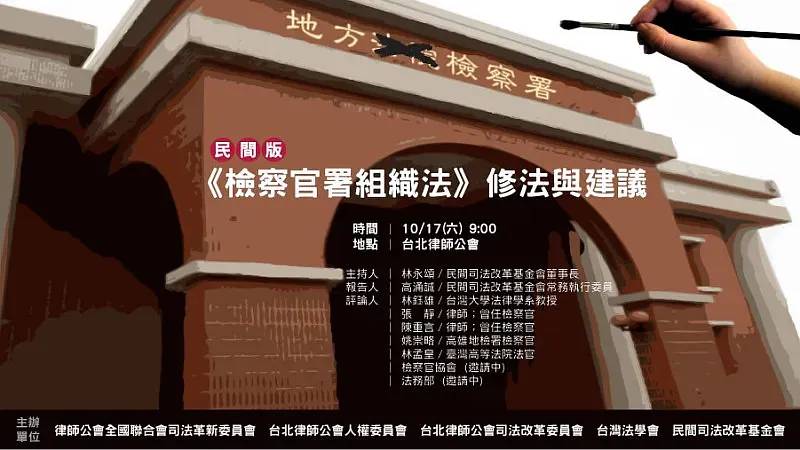
Seminar | Draft Organization Act of the Prosecutors Offices (Private Version) and Recommendations Seminar
Last edited: 2026-11-03
Criminal justice activities are composed of three roles: the judiciary (judges), prosecutors, and the defense (attorneys). Prosecutors represent the public interest of the state, investigate and prosecute crimes, and act as public prosecutors; attorneys defend criminal suspects, urge the criminal justice system to conform to procedural and substantive justice, and protect human rights; judges weigh evidence, determine facts, and render independent trials in accordance with the law. These three roles stand as a tripod, and none can be dispensed with. Among them, prosecutors hold the gateway to criminal proceedings and are the directors who initiate criminal actions, while simultaneously shouldering the roles of guardians of the rule of law and representatives of the public interest. The success or failure of the prosecutorial system in its operations is truly the critical factor in whether criminal justice can achieve social justice.
Examining the evolution of Taiwan's judicial organization in detail, early on, both prosecutorial organizations and courts at all levels below the high courts were under the jurisdiction of the Ministry of Justice, and both were governed by the Court Organization Act. However, since the implementation of the "separation of the judiciary and prosecution" in 1980, no exclusive organization act has been enacted for prosecutorial agencies, resulting in two agencies belonging to the executive and judicial branches respectively being governed by the same Court Organization Act.
Although the regulations concerning prosecutorial agencies were amended in 2006, the current prosecutorial system still suffers from problems such as uneven workloads, mismatch between power and responsibility, and unclear directives, failing to shake off external long-standing speculations about political intervention, which leaves prosecutorial independence subject to grave doubt. The reform of the prosecutorial organization is clearly becoming imminent. Therefore, enacting an organization act exclusively for prosecutorial agencies to define prosecutors' powers and duties, implement prosecutorial independence, and protect defendants' human rights is indeed the foremost and urgent priority of current judicial reform.
NGOs have always insisted that in order to ensure the high independence of the prosecutorial system, an independent Organization Act of the Prosecutors Offices should be established separately. Therefore, regardless of our limitations, we have put forward relevant legislative amendment proposals. As the draft is initially formulated, there are bound to be omissions and errors, and we urgently need advice from all sectors. For this reason, the Judicial Reform Foundation, together with the Judicial Reform Committee of the Taiwan Bar Association, the Human Rights Committee of the Taipei Bar Association, the Judicial Reform Committee of the Taipei Bar Association, and the Taiwan Law Society, have jointly organized this seminar, inviting the bench, prosecution, defense, and academia, and we sincerely hope you will not hesitate to offer your criticism and guidance.
Time
October 17, 2015 (Sat) 09:00-12:30
Venue
Taipei Bar Association (9F, No. 7, Sec. 1, Roosevelt Rd., Taipei City)
Agenda
| Time | Agenda | Moderator / Speaker / Discussant |
| 08:30-09:00 | Registration | — |
| 09:00-09:10 | Opening Remarks by Moderator | Lin Yung-sung / Attorney |
| 09:10-09:30 | Report on the JRF Draft Proposal | Kao Yung-ch'eng / Attorney |
| 09:30-09:45 | Discussant Commentary I | Yao Ch'ung-lüeh / Prosecutor |
| 09:45-10:00 | Ch'en Chung-yen / Attorney | |
| 10:00-10:15 | Chang Ching / Attorney | |
| 10:15-10:25 | Intermission | — |
| 10:25-10:40 | Discussant Commentary II | Fan Chia-yen / Chief Prosecutor |
| 10:40-10:55 | Lin Meng-huang / Judge | |
| 10:55-11:10 | Lin Yü-hsiung / Professor | |
| 11:10-11:55 | Response to Comments and Re-commentary | Speaker, Discussants |
| 11:55-12:25 | Q&A | Attendees |
| 12:25-12:30 | Closing Remarks by Moderator | Lin Yung-sung / Attorney |
Attachment Materials
- Draft Organization Act of the Prosecutors Offices
- Handbook for the Seminar on the Amendment and Recommendations for the Organization Act of the Prosecutors Offices
- Prosecutorial Efficiency and Guarantee of Judicial Independence / Ch'en Chung-yen
- Explanation of the Draft Organization Act of the Prosecutors Offices / Kao Yung-ch'eng
Meeting Verbatim Record
Report on the JRF Draft Proposal—Kao Yung-ch'eng / Attorney
Good morning, Moderator, Discussants, and all advanced attendees present. I will now present the "Organization Act of the Prosecutors" drafted by the Judicial Reform Foundation through approximately two and a half years and hundreds of person-times of intensive discussions.
Three years ago, when I was assigned this task at the JRF's annual planning meeting, I actually felt rather panicked. Because as everyone knows, the reform of prosecutors and prosecutors offices is extremely important, but it is also a very arduous project, and practically speaking, I truly did not know where to start. Later, the subcommittee decided to dust off and re-examine the draft "Prosecutors Offices Act" previously drafted by the JRF more than a decade ago—a draft in which the Association for Prosecutorial Reform had also participated in discussing—to see how, based on recent situations and an increasing number of mature discourses, supplementary additions and revisions could be made to that year's draft. Therefore, we used that version as our foundation. During the discussion process, we naturally had many practicing attorneys and judges participate, as well as attorneys who had recently stepped down from the prosecutorial circles. Our only regret was that we could not find incumbent prosecutors to participate in our discussions. Without the participation of incumbent prosecutors, we were essentially in the dark regarding how they might view our draft across different dimensions, including perhaps administrative prosecutors on temporary assignment or prosecutors performing other prosecutorial duties. Therefore, the JRF thought we had done our best. Although during the discussion process, opinions from some incumbent prosecutors were indeed informally consulted, it was clearly insufficient. Thus, we believed we should hold a meeting like today's to throw this version out for everyone to discuss, criticize, and offer opinions on. As a result, many people are laughing and saying I am the target today; I have simply set up the target first and welcome everyone to criticize and offer opinions.
First, let me briefly explain this draft—what kind of problems we aim to solve. Lawyer Lin has already mentioned some of the problems regarding prosecutors seen from the perspective of the public and the legal profession. Of course, this might be somewhat one-sided, but from the perspective of the people, or from the perspective of some judges, problems that we wish to resolve are still visible. The first and biggest problem is the mismatch between power and responsibility. This mismatch, seen from the perspective of attorneys or the public, manifests as certain prosecutors casually indicting people. While we can understand that the standard for indictment differs from the standard for conviction, some cases appear to be indiscriminate indictments, ultimately resulting in acquittals or even directly being returned by judges facing stronger reactions, yet prosecutors do not face any disciplinary action. We do not see a situation where power corresponds with responsibility; this is the mismatch of power and responsibility for individual prosecutors. There is also the problem of hierarchical centralization, or put differently, prosecutors-in-chief causing frontline prosecutors to take the fall under unclear directives, mirroring the second problem encountered. In reality, it is the will of the prosecutor-in-chief, but the responsibility is borne by the frontline prosecutor—a clear mismatch of power and responsibility. Even within the system of the Code of Criminal Procedure, such situations occur, just as the High Prosecutors Office repeatedly rescinds and remands cases with a multitude of opinions, yet the frontline district prosecutors are ultimately forced to indict. Therefore, the mismatch of power and responsibility is the earliest discovered and most serious problem recognized by all.
The second problem is opaque directives. As just mentioned, although the Judges Act and the Court Organization Act both prescribe "hierarchical unity of the prosecution" (prosecutorial monism) and even stipulate that directives must be put in writing, has this been implemented? The clearest and most explicit example we saw was that of Ch'en Shou-huang. Was the communication and assigned matters between Chief Prosecutor Ch'en Shou-huang and Prosecutor Lin Hsiu-t'ao put in writing? No! The problem lies in opaque directives.
The third problem is the career advancement ladder and uneven workloads. As Lawyer Lin just mentioned, frontline prosecutors in our prosecutorial system suffer from uneven workloads, an extremely heavy volume of cases, and a myriad of evaluations, with everyone setting their sights on promotion to prosecutor-in-chief, and after becoming a prosecutor-in-chief, wanting to be promoted to the High Prosecutors Office—because the High Prosecutors Office is simple: high pay, fewer duties, not necessarily close to home, but clearly an uneven workload. Everyone wants to seek ease and avoid hardship; this is human nature, and everyone wants to climb upward. Once people want to climb upward, the career advancement ladder appears. After the career advancement ladder appears, personnel control becomes a space where other forces that ought not to intervene can meddle. Therefore, we believe that this career advancement ladder and uneven workload phenomenon must be improved.
After all, the career advancement ladder is human nature; the most serious issue lies in the problem of overall human resource allocation. Experienced prosecutors are promoted to prosecutors-in-chief and the High Prosecutors Office, where they no longer handle cases and only talk; the rich investigative practical experience accumulated over a dozen years of practice is completely wasted. Prosecutors are different from judges; although judges also go to high courts and the supreme court, they handle cases personally, and their practical experience is carried with them. Our prosecutors are not like that; the higher a prosecutor is promoted, the more their actual case-handling experience is passed down and disappears. I think this is a huge problem. Every time, it is young, rookie, and inexperienced prosecutors facing the cases of ordinary citizens, and we can imagine how public grievances will arise among the people.
The fourth problem is political interference. Political interference is mainly carried out through personnel and the career advancement ladder. Sometimes it is not necessarily a naked, top-down directive; rather, it is bottom-up, with frontline prosecutors spontaneously courting favor and handling matters in a way that conforms to the will of their superiors above. Such situations are commonplace.
The fifth problem is the lack of external oversight power. Many people say that after the passage of the Judges Act, we have the Evaluation Committee for Prosecutors. However, having served as a member of the Prosecutors Evaluation Committee myself, I know very well how effective the Prosecutors Evaluation Committee is, especially since it is an ex-post external oversight power. We believe: should there be an ex-ante external oversight power introduced in terms of personnel, specifically within the Prosecutorial Personnel Review Committee? What we aim to resolve are essentially these few problems.
This draft mainly extracts the Chapter on Prosecutorial Agencies from the Court Organization Act to legislate it independently. There is also a Chapter on Prosecutors in the Judges Act, but the draft does not attempt to address the issue of the prosecutor's legal status—that is, the question of whether to sever ties with judges. We believe in starting with the organizational part first. Therefore, the draft is divided into: General Principles, Supreme Prosecutors Office and Branch Offices, Chapter 3 Regional Prosecutors Offices, Chapter 4 Principle of Prosecutorial Monism and Direction and Supervision of Prosecutors, Chapter 5 Allocation of Prosecutorial Affairs, Chapter 6 Prosecutors Meetings, Chapter 7 Prosecutorial Mutual Aid, and Chapter 8 Supplementary Provisions, totaling 8 chapters and 58 articles.
Below is a brief introduction to some of the key points of the draft. Of course, some parts of the draft are organizational regulations, such as the personnel allocation of various offices and divisions within the prosecutors office and their official ranks; this part is actually not the focus of discussion for this meeting and will be skipped over directly during the upcoming introduction.
The first key point is naturally to implement organizational streamlining, changing prosecutors offices from three tiers to two tiers, and merging investigation and public prosecution to achieve a match between power and responsibility. From the official standpoint, the biggest change is naturally that we have turned three tiers into two tiers. But if everyone thinks about it, before the 2006 amendment to the Court Organization Act which legislated the Special Investigation Division specially and gave the Prosecutor-General a personal guard, the Prosecutor-General's function was either extraordinary appeals or unifying legal interpretations across the prosecutorial community; he held no major substantive power and was actually a symbolic position consistent with the Code of Criminal Procedure. As everyone is well aware, the person who truly wielded supreme prosecutorial power was actually the Chief Prosecutor of the High Prosecutors Office, while the personnel power over prosecutors-in-chief was controlled in the hands of the Minister of Justice. This is also why, when the Court Organization Act was amended back then, both the Association for Prosecutorial Reform and the JRF supported it, believing that political control over personnel by the Minister of Justice was far too strong and should be specially pulled out, and that the Prosecutor-General's independence should be specially elevated by having him nominated by the President and confirmed by Parliament. However, over the past few years, everyone clearly witnessed the struggle between Prosecutor-General Huang Shih-ming and Minister Tseng Yung-fu. Therefore, we believe we must rethink and consider what the function of this highest-level prosecutorial agency should be.
Of course, we also understand that during the reform process, vested interests should be minimized as much as possible. Therefore, our thinking is—people say your flattening is pulling the bottom up to the top, but actually we should consider that we are elevating all district offices into two tiers: the high level and the supreme level. Changing from three tiers to two tiers also has a very important purpose, which is the first problem mentioned earlier: to make power and responsibility match as much as possible. We hope to merge investigation and public prosecution, hoping that cases "travel with the prosecutor," because the investigating prosecutor is the most familiar with the case and can fully act as a public prosecutor attending court through the final court instance. This is our thinking, and we also hope to enhance efficiency through organizational streamlining.
Secondly, we hope to increase external oversight power, especially by moving it forward to the composition of the Prosecutorial Personnel Review Committee. We hope to include external members. The main provisions for this part are in Article 10 of the draft, which regulates the establishment of the Prosecutorial Personnel Review Committee. As you can see, the selection of members is somewhat complex. We propose changing the current 17 members to 2 judges, 2 attorneys, 5 prosecutors, 2 academics, and 5 socially impartial individuals, with the Prosecutor-General serving as an ex officio member, handling it in a 2-2-2-5-5 ratio. As everyone can see, this is vastly different from the current composition of the Prosecutorial Personnel Review Committee; external individuals constitute the majority, while true legal professionals—even including the Prosecutor-General—only hold 7 seats. We hope to exercise oversight power through external members.
Here I must specifically mention that the design of the Personnel Review Committee is naturally related to the direction of reform. As I just mentioned, how to divide power between the Minister and the Prosecutor-General? Especially to prevent political intervention. But how to also protect the Minister's own policies? After all, he is a political appointee. How to ensure that his policy concepts can be implemented, which requires people to execute them—especially regarding criminal policy? Balancing the powers and responsibilities between the Minister and the Prosecutor-General is truly a profound learning experience. At least in terms of personnel power, we hope to balance the powers of the Prosecutor-General and the Minister through the Prosecutorial Personnel Review Committee, moved forward into the personnel power. In fact, we use a triangular approach, a separation-of-powers approach, to check and balance each other. One can see from the nomination of regional prosecutors-in-chief that regional prosecutors-in-chief are nominated by the Prosecutor-General for an appropriate number of candidates, submitted to the Personnel Review Committee for review, and then selected by the Minister of Justice. In the middle, there is a tripartite balancing mechanism. Based on this balancing mechanism, we also hope that the Personnel Review Committee includes external individuals who can represent certain civic opinions. Of course, Professor Wang Chin-shou actually has some criticisms: your Personnel Review Committee is not thoroughly democratic and does not consist of external members truly elected with a democratic mandate. This is indeed a dilemma. As the JRF has always worried about in past reforms, if the power of consent were truly delegated to legislators, would it be influenced by populism? Would it truly lead to the collapse of the prosecutorial system? This is what we fear.
Additionally, regarding the communication mechanism between the Minister of Justice and the Prosecutor-General, this is actually Article 38 of the draft and a focal point of our draft—namely, the communication mechanism between the Minister of Justice and the Prosecutor-General concerning criminal policy. As a political appointee, how does the Minister of Justice balance the implementation of criminal policy concepts with the independence of the Prosecutor-General (who must not have too much external interference)? In principle, the Minister cannot issue individual case directives and can only exchange views with the Prosecutor-General regarding general directives and legal opinions. People often mention a recent example in Germany (where the German Minister of Justice dismissed the Prosecutor-General because the prosecution restricted freedom of the press). Ultimately, whose directives—the Minister's or the Prosecutor-General's—should prevail? In fact, we have also made a design for this in the latter part of Article 38: if the Minister believes that general directives and opinions issued by the Prosecutor-General violate the Minister's directives and legal opinions, the Minister may request the Prosecutor-General to withdraw the directive; if the Prosecutor-General refuses to modify it and submits it again for reporting, the Minister must accept it, or have the Executive Yuan submit the Prosecutor-General to the legislature for consent to dismiss. This establishes where ultimate political responsibility lies. Therefore, I think we have considered this part and handled it. We hope to establish the boundary between legal policy and investigative positions, avoid political intervention, and implement responsible politics.
In resolving the problems of the career advancement ladder and uneven workloads, the first reform is the abolition of prosecutors-in-chief. Currently, the primary wish, hard work, and toil of frontline prosecutors is the hope of being promoted to prosecutor-in-chief. In the prosecutorial circle, there is an unwritten convention regarding promotion to prosecutor-in-chief: "once you miss your cohort, you can no longer climb up." We believe that clinging to that career advancement ladder provides a space where interested parties can manipulate human resources and allow improper forces to meddle. Therefore, we hope to abolish prosecutors-in-chief and adopt a system of senior prosecutors. Senior prosecutors adopt negative qualifications; that is, within five years, as long as there are no negative evaluation records, one is naturally a senior prosecutor. Once naturally a senior prosecutor, under the power and responsibility matching the prosecutor-in-chief corresponding to the Personnel Review Committee, they lead teams to handle cases, acting as team leaders with senior prosecutors dividing into groups for team case-handling. We believe this model is better able to pass down case-handling experience and eliminate the current bad habit of "the higher the rank, the lighter the responsibility." Because the current transfer of experience actually suffers from a generational gap, we hope to make this correct allocation of human resources.
Furthermore, we hope to implement a written directive system. The current directive power already includes a written directive system, but we hope to endow directive power with a special characteristic: it must be attached to the case file and be inspectable from the outside. Thus, it must be sunshine-oriented and subject to official supervision, preventing the current situation where a prosecutor-in-chief can allocate all cases and affairs, exercising sole control while remaining opaque to the outside world, from happening again. Therefore, we hope that in the future all written directives can be retained—not necessarily made public, but at least allowing judges to see in the case file how this case was handled and whose will it was. We hope to let the outside world see who should truly bear responsibility through the sunshine-oriented written directive system.
In addition, we also hope this draft will gain the support of frontline prosecutors. Currently, the power of prosecutors-in-chief is immense. As seen previously when Prosecutor Tsai Ch'i-wen challenged the Personnel Review Committee and the Minister's personnel power, it was indeed discovered that frontline prosecutors truly need someone to represent their voices. How to find a balance point in vertical power between prosecutors-in-chief and prosecutors, we hope to achieve through prosecutors meetings. Of course, prosecutors meetings are also an existing system under the Judges Act, but as far as we know, they have not been truly solidly implemented. We hope for decision-making to be democratized and transparent. Of course, in our ultimate power-processing design, we still place this final power with the prosecutor-in-chief, who bears this responsibility and takes ultimate accountability. The above few points are the main essentials of this draft. As for the official ranks and grades of other offices and divisions, they are relatively less important.
Due to limited time, I have tried to keep my report as brief as possible, mainly to hear everyone's opinions so we can take them back and revise accordingly. We hope everyone can help out together. Our prosecutorial system has only been amended once in several decades, back in 2006, and this amendment does not seem to have been very successful. Of course, there are criticisms; for example, Prosecutor Ch'en Jui-jen also said he believes the 2006 amendment was not problematic, but rather that it encountered the wrong people. He has actually always hoped to have the right person—a truly right person. But my question is this: previously, whether it was Ch'en Ch'ung-ming or Huang Shih-ming, both were actually among the top five in the poll of prosecutors. Where is the right person? My question lies right here. In a democratic and constitutional country, rather than hoping for the right person, shouldn't we start by addressing the system? Of course, this is a consideration of the JRF. Thank you.
Discussant Commentary I—Yao Ch'ung-lüeh / Prosecutor
Hello everyone attending the meeting. Thank you, Lawyer Kao, for your report, and I am very glad to have the opportunity to participate in the discussion of this draft today. Actually, when I first saw this draft, the first question I kept pondering was: do we necessarily have to—even if we really want to reform this prosecutorial system—do we necessarily have to enact a separate Organization Act of the Prosecutors Offices outside of the Court Organization Act? I consulted some materials; for example, in German law, their Court Organization Act also contains regulations concerning prosecutors. Again, for example, the Organization Act of the Canton of Bern in Switzerland also regulates prosecutors offices and courts in the same piece of legislation. So I am wondering about the necessity of enacting a separate law. Of course, some people might feel that if we legislate them together and write names like "such-and-such District Court Prosecutors Office," it seems the district court and the prosecutors office get merged together, which might cause some problems. But regarding the German Court Organization Act I just mentioned, (courts and prosecutors offices) are also regulated together, yet the names of their prosecutors offices do not have the word "court" prefixed to them. So if we have such comparable legal systems as a reference, is there still such a necessity? In fact, everyone can ponder this.
Furthermore, since this law is a regulation concerning organizational law, as this report also mentioned, in order to implement the prosecutor's burden of proof, it is even stipulated in this law that investigation and public prosecution must be merged. The first thing that came to my mind is: is it appropriate to prescribe provisions of litigation law regarding the burden of proof within an organizational law? Another more practical question is—of course, I personally also feel that sometimes having the same person for both investigation and public prosecution might really help more with the fulfillment of the burden of proof, but is it practically feasible? Can practice achieve such a system? I think there may still be some problems currently. The most important issue is human resources. Taking the prosecutors office where I work as an example, a prosecutor's average monthly intake of cases is about seventy or eighty. Then, besides internal and external duty shifts, you are also asked to go to court to act as a public prosecutor. People might also say: just split the public prosecution group and merge them all with the investigative group, and after case allocation, an individual might receive at most around sixty cases. Is it possible to go to court to perform public prosecution work on top of your regular duties? I think it might pose a certain degree of difficulty.
Moreover, according to this new Organization Act of the Prosecutors, it is equivalent to eliminating the High Prosecutors Office. If cases are tried in the High Court, how can prosecutors from the regional prosecutors offices support such public prosecution duties at the High Court? Practically speaking, I think if we look at the manpower of the Kaohsiung District Prosecutors Office, even if the number of prosecutors were increased to 200 now, manpower probably still wouldn't be enough. So this part perhaps needs to be reconsidered. And actually, I feel that because not every case is that major, saying that investigating prosecutors and public prosecutors must be different—unless it's in relatively major cases, for example, major cases in Kaohsiung like ASE Group or Cheng-I Food oils—in principle, within our office, investigative prosecutors will always go to court together with the public prosecutor to act as public prosecutors. Therefore, for such major cases, as far as our office is concerned, it is never just the public prosecutor fighting single-handedly in court; investigating prosecutors always accompany them. In these instances, regarding the mastery of case files or arguments, we are already able to relatively fulfill these things we need to prove. So this part is perhaps something everyone can ponder further.
Of course, these are relatively technical and detailed issues, and perhaps when we truly legislate in the future, we can adjust them. But I think there are two major issues. The first issue is: although the reporter stated that we are not going to address the issue of the prosecutor's legal status, from my perspective, it somewhat tries to transform the prosecutor's nature into something closer to an administrative official. Another point is what the reporter just mentioned: in order to avoid political intervention, from my perspective, why does it somehow seem to reinforce political interference?
First, let's talk about this regulation pointing toward administrative officialization. If everyone has read these articles—for example, Article 4: when a prosecutor exercises duties in accordance with the law, outwardly it shall be done in the name of the prosecutor-in-chief. If viewed from the perspective of a prosecutor's indictment, does that mean all indictments must be made in the name of the prosecutor-in-chief? If so, will this conflict somewhat with the provisions of the Code of Criminal Procedure? Furthermore, the reporter also emphasized that this is intended to resolve the mismatch between power and responsibility. Under such circumstances, if indictments are made in the name of the prosecutor-in-chief, then ultimately if there is any problem with the case—for example, an acquittal, or being accused of indiscriminate indictment—when responsibility is truly pursued, are we going to pursue the prosecutor-in-chief, or the co-signing prosecutor? Usually, in my view, exercising duties outwardly in the name of a head is generally what administrative agencies do.
Next, regarding the issue of obedience to directives. I think everyone can see Article 39 of the draft; I feel paragraphs 2 and 3 are relatively problematic concerning the compliance with illegal or improper orders. The final provision of the draft is that prosecutors cannot refuse such illegal or improper orders. Therefore, it is very hard for me to imagine where the so-called, grandly stated role of the prosecutor as the guardian of the rule of law goes when a prosecutor cannot refuse an illegal order. Moreover, all these orders that cannot be refused are written down on paper. When problems arise later, does this amount to entrapping prosecutors themselves? You wrote it down on paper yourself; whether you indicted or did not indict this case, will it involve issues of abusive indictment or non-indictment? It amounts to a prosecutor doing something illegal and yet writing down on paper themselves: "I indeed did such an illegal thing." So I feel there seems to be a problem. Following this issue of directives, I don't seem to see in the draft whether a prosecutor, if they believe an order is illegal or improper, or if their legal conviction conflicts with the legal opinion, can directly make a written request to the prosecutor-in-chief asking for a transfer of duties or asking someone else to handle these cases. This is my first question.
My second question is the so-called issue of political interference. The reporter just mentioned that the institutional design aims to strike a tripartite balance mechanism—namely, a tripartite balancing mechanism among the Minister, the Prosecutor-General, and the Personnel Review Committee. But however I look at these provisions, it seems that whether it is the Prosecutor-General, the prosecutors-in-chief, or the personnel review committee members—respectively stipulated in Articles 5, 6, and 10 of the draft—their final appointments must all go through the consent of the Minister. If these people are all selected by the Minister, then the so-called tripartite balancing mechanism actually concentrates entirely on the Minister's side and fails to play a balancing role. Moreover, since the Minister is a political appointee, doesn't such institutional design in the draft allow political control to penetrate even deeper? Actually, I am somewhat puzzled. Furthermore, although the draft claims to pursue internal democracy among prosecutors and mentions prosecutors meetings, regarding personnel systems, it doesn't seem to give frontline prosecutors any opportunity to express their opinions. As everyone knows, Prosecutor Tsai Ch'i-wen challenged the personnel system this year. In fact, this year, whether regarding the promotion of prosecutors-in-chief or second-instance prosecutors, some district prosecutors offices have already held voting systems to allow frontline prosecutors an opportunity to reflect their opinions. Of course, our office also implements a similar system; although imperfect, it at least takes this step to allow frontline prosecutors to express their opinions on promotions to prosecutor-in-chief or second-instance prosecutors. This part doesn't seem to appear at all in the draft.
Of course, I think this draft also has parts worth adopting. For example, as the reporter just mentioned, abolishing the system of prosecutors-in-chief and adopting the senior prosecutor system is a design I personally think is not bad. Solely based on my own observation, I believe the operational design of the prosecutors-in-chief system up to now indeed has some problems. It feels as if for ordinary frontline prosecutors who want to get promoted, being a prosecutor-in-chief is equivalent to unlocking a key to promotion—meaning you must first serve as a prosecutor-in-chief before you have a chance to go to the second instance and continue to become a prosecutor-in-chief/prosecutor-general. This also leads people to be more willing to serve in the position of prosecutor-in-chief, compounded by undemocratic internal factors that may cause operational problems. Perhaps its original design intent was good, but in practice, it encounters issues, so I think changing to senior prosecutors is a good direction. However, in this draft, although it mentions that senior prosecutors should lead prosecutors in handling cases, it does not subsequently discuss how to pick two or three senior prosecutors from among so many senior prosecutors to lead frontline prosecutors in handling cases. This is perhaps something that can be considered further afterward.
Due to limited time, I have merely raised some doubts and opinions after reading this draft, for everyone's reference. Thank you.
Discussant Commentary I—Ch'en Chung-yen / Attorney
Hello everyone. I am very glad to have the opportunity here today to express some opinions on the JRF's "Draft Organization Act of the Prosecutors Offices."
Actually, forcing someone to finish explaining such a huge subject within fifteen minutes is quite asking the impossible, so frankly speaking, I can only address a few critical main issues. First of all, what I want to affirm is that the JRF initially put forward a major main axis—namely, prosecutorial independence and their democratization, etc.—as a principal principle. Of course, whether the actual regulatory outcomes can achieve such goals, Prosecutor Yao also mentioned that the practical results of certain individual regulations might contradict the initial goals pursued. In fact, when we look at this matter, I think we should look at prosecutorial efficiency. Because if we only look at improper interventions and undue interferences, they are all quite negative, but actually, the primary goal they want to pursue is better prosecutorial efficiency.
Of course, efficiency is a broad concept that includes compliance with the entire legal procedure. Therefore, I believe you must first point out a positive goal before you can see the full picture and avoid undesirable effects during the pursuit process, including the issue of undue interference. I think that way, things will become relatively clearer. Therefore, prosecutors—especially based on my personal observation—occupy a very important position in Taiwan's entire judicial system, not just at the legal level, but within Taiwanese society as a whole. We can see from many food safety cases that administrative agencies' penalties all have to wait until prosecutors institute indictments. This is not merely the tip of the iceberg; we all know that food is unsafe, we all know that our land is continuously polluted, but ultimately, the ones who truly initiate the overall reform mechanism must be prosecutors.
So right at the beginning, I also want to emphasize that when we look at things, especially during reforms, I want to remind everyone that there are many very serious prosecutors among them, including prosecutors-in-chief. For example, the cases handled by the Changhua District Prosecutors Office—I have seen some of their experience sharing and meetings, which were all led by prosecutors-in-chief. Therefore, I believe that during reforms, perhaps we should not forget or omit that under the existing mechanism, certain serious people should not be lumped together and written off. I want to clarify this point first, and I feel it is necessary to emphasize it.
Therefore, besides looking at negative, improper interference, I think what is more important is prosecutorial efficiency, and there is an interactive relationship between them. That is to say, it is precisely because of improper allocation of affairs and a lack of operation under good efficiency that half of the prosecutors want to escape the chronic quagmire of frontline investigation. That is why they want to say: oh, a better allocation of affairs and an ideal environment, including prosecutors-in-chief or other positions. Put differently, if this prosecutorial mechanism has a relatively reasonable allocation of affairs and fully exercises its efficiency, many incentives will actually cease to exist. This point is particularly highlighted in this draft version, which mentions abolishing the prosecutors-in-chief system, and specifically manifests the spirit of team case-handling through the merger of investigation and public prosecution. I strongly agree with this point, and I believe this is precisely the main axis of the entire reform. That is to say, when we want to reform, we emphasize that prosecutors should not be interfered with, that things should be in writing, etc. But in fact, Professor Lin Yü-hsiung has called for this for a very, very long time. When I took the oral examination for the judicial officers, I saw his treatise on prosecutors already written right there, and it still hasn't been implemented to this day. To find a truly useful method, I believe collaborative case-handling and group case-handling may be the main prescription, and I will talk more about this later.
In addition, I also want to see that when we examine prosecutors—since prosecutors are mainly in the criminal mechanism, spanning the entire stages from investigation, trial to execution—when we look at the tasks and legal status of prosecutors, we must absolutely not forget the purpose for which the prosecutorial mechanism is established, as well as where its tasks lie. At the same time, when examining issues like improper interference, we must not ignore the oversight mechanisms already existing in the Code of Criminal Procedure, including those of the court. That is to say, when there is an improper indictment, no matter how bad things get, there is still a judge from the court. For instance, taking the Wei Yang case, that was a case subject to heavy criticism. But viewed as a whole, because there was an investigative judge who had to review the application for detention, and after the court rejected it, the case was stopped. From the perspective of procedural law, this is a good design because it prevents improper situations from occurring during the investigative stage. Of course, the quality of an indictment is another issue, and I will talk about my other issue elsewhere.
As for another issue, regarding indictments, we have the court. Our current problem lies in non-indictments. Except for extreme cries of grievance that do not join the trial, almost nothing else happens, and the problem lies right here. In fact, regarding prosecutorial issues, and respecting prosecutors as independent judicial officers—the core of judicial independence, in my view, is not acting according to administrative law or acting in accordance with the law, because every civil servant must do that. Its core lies in acting in accordance with one's legal convictions. Because of acting in accordance with legal convictions, you cannot force someone to do something that conflicts with their legal conviction. Therefore, Prosecutor Yao also mentioned that the JRF provisions indeed have a major problem. But apart from that, there is still a certain scope. So I think concepts must be defined first: when exercising directive power, in which areas does such directive power exist?
In fact, when non-indictments occur, we see that they are mainly suspended prosecutions or non-prosecution dispositions. Of course, deferred prosecution mainly—because non-prosecution is a relatively minor situation, so non-prosecution dispositions—overall, these non-prosecutions based on the principle of expediency have relatively fewer normative densities.
Let's talk about these articles. If we compare them with Germany—from Section 153 and below 153 to 154, I remember there are dozens of sections where prosecutors can, during the investigative stage, based on considerations of the principle of expediency and more importantly the balancing of superior interests, non-prosecute many cases based on the principle of expediency. But their main requirement is that it must be approved by the court. In fact, regarding statistical figures of courts refusing approval, frankly speaking, in Germany it is not high either. But what is more important is that such an approval mechanism serves as a review mechanism. Sometimes, when a prosecutor wants to do something and knows it has to be submitted for someone else to look at, the mere existence of the mechanism holds very high value, rather than its approval rate. This, in fact, is also something that can solve problems to a certain extent within our Code of Criminal Procedure. Because our current accusations against prosecutors for being politically interfered with target not only situations of prosecution, but also situations of non-prosecution. To some extent, the Code of Criminal Procedure can handle this.
To let prosecutors do their jobs properly—especially viewed from the perspective of the purpose of the Code of Criminal Procedure—if you want to pursue the truth, it means you must investigate the evidence that ought to be investigated, even if it involves a person of high status, someone with great influence, or even prosecutorial superiors. All of these are premised on the guarantee of the prosecutor's judicial independence. Without this independence, in fact, when we look at food safety cases as an example, what we see is the inaction of administrative agencies; this is a fact. But sometimes, viewed from the perspective of administrative agencies, if you do not give them sufficient independence, and various interferences can be imposed on them when they make a decision, asking a frontline civil servant to directly challenge a food company with complex political and business connections behind it is, frankly speaking, an almost impossible mission. This is also why prosecutors—at least under our current premise affirming their judicial independence—can develop those cases. Therefore, I think the most important value—and the JRF has also pointed out this value—is that the first most important thing is the rule of law. The rule of law is the reason why prosecutors exist. If it were just handling cases, we wouldn't need prosecutors; we would have police officers and civil servants. It is because we primarily want to ensure that the spirit of law can be practiced, which is the rule of law. The implementation of the principle of the rule of law is primary. To avoid the existence of dark, abusive, and improper interventions, transparency is the best antiseptic, so transparency is very important.
Of course, democratic mechanisms—some details inside, I think especially regarding superiors and the Personnel Review Committee—were not handled very well in my view. In fact, the crux lies in professional efficiency, and regarding efficiency, I believe in group case-handling. This is one of the main perspectives of my observation.
rWhy against interfering with case handling? As you just mentioned, first, personnel promotions, as well as poor working environments, and frankly speaking, a somewhat unclear evaluation benchmark. Personnel promotion is certainly one. In fact, when we look at avoiding interference and avoiding negative evaluations, what mainly encourages people to pursue and act is a sense of achievement and the recognition of that sense of achievement. Measured by current group evaluations, going out makes people feel you are a prosecutor-in-chief, you are a prosecutor, you are a successful person in society. You cannot tell all prosecutors, "Oh, forget it, other people's evaluations don't matter." But in fact, this touches upon human beings' most fundamental source of motivation: you want to be recognized and affirmed. Measured by current group standards, it is because being promoted implies general recognition by others. You might not necessarily agree with this view, and in fact you shouldn't have such a view, but situated within this group atmosphere, this is a reality. Besides this evaluation standard, another very realistic issue is your working environment. Not only your case allocation volume and office issues, but when you need to do various specific things regarding personnel, differences in your title will have a huge impact. Of course, a prosecutor shouldn't only care about this, but conversely, a fatal impact is the case allocation part. When a case—for example, under the current mechanism, when a prosecutor submits a case for review, it must go through the prosecutor-in-chief, and the prosecutor-in-chief expresses different opinions here, and these opinions don't seem to be entirely rational communications—for a frontline prosecutor handling investigations in the district prosecutors office, whose case burden is already extremely heavy, frankly speaking, these are situations they try desperately to avoid. This is a working environment.
Evaluation benchmarks are the same; everyone also knows that evaluation benchmarks are currently digitized. That is why Prosecutor Ch'en Jui-jen said that case-handling prosecutors have become extinct, because that is not smart. For a prosecutor, receiving a case and closing a case means I take, for example, the facts of the referral as the basis, and then look at whether the evidence is sufficient, almost like a judge acting only when brought a case. If you don't investigate, there is no evidence, so I can dispose of this case and close it. If I want to investigate, closing a case means it's closed; cases increase by one, and unclosed cases decrease by one. Yes, as Prosecutor Yao just mentioned, a monthly case intake of 80 cases—please do not ignore that a prosecutor may have 200 unclosed cases sitting there. Two hundred cases plus another 80 cases a month—not to mention special projects, court sessions, document reviewing, and writing documents, all crammed together. However, current performance evaluation figures do not reflect this. Evaluation figures will not show that for this case, even though three pieces of evidence seemed sufficient to make a decision, you chose to investigate ten pieces of evidence. That cannot be seen, and this evaluation benchmark will naturally affect the whole unintelligent and unreasonable situation, leading to improper situations happening to relatively clever prosecutors. Of course, I don't want to completely negate this, meaning there are also very serious people who can manage everything well at the same time, but sometimes improper situations will occur right here.
Next, the problem is not merely undue interference. Active improper interference is a fact, but frankly speaking, in my impression, the proportion at most accounts for perhaps 10%. But many more problems actually stem from a lack of interaction at all. Superiors—whether prosecutors-in-chief or prosecutors-general—have no interaction. What kind of interaction is this? In fact, from the perspective of a team, when a prosecutor-in-chief can give instructions, when a prosecutor-in-chief can tell you how to handle a case, yet lacks understanding of the entire case situation and understanding of your needs to give you support, that is an even bigger problem. When a prosecutor-in-chief—a higher-ranking superior—completely fails to understand the problems faced by frontline prosecutors and suddenly issues a directive, whether that directive truly hits the mark is naturally questionable. This is a very obvious problem.
As for the necessity of a special act, Prosecutor Yao has already spoken more about it. Should it be constitutionalized? Because Professor Lin is here, I won't dare to show off; he will have very wonderful discourses. From my perspective, where does the value of a special act lie? Frankly speaking, I am relatively reserved about it because nearly 20 articles inside are organizational regulations, regulations on personnel offices, etc. Those few core articles could actually be placed within organizational law, the Court Organization Act, or the Judges Act. If people feel the Court Organization Act is not enough, then an Court Organization Act and Prosecutors Offices, etc., I think through such means it could also be resolved. Looking at the current draft, I cannot see the absolute necessity of independent legislation. Moreover, I see a concern: the nature of a prosecutor's job is inherently to play the
This article is an AI-generated translation of the original Chinese text. In the event of any discrepancy, the Chinese version shall prevail.