
Regarding this Foundation being invited to co-host the "Attorney Regulation Act Amendment Opinion Collection" event with the Executive Yuan and vTaiwan, details are as set forth in this official letter
Last edited: 2026-11-03
Subject
Regarding this Foundation being invited to co-host the "Attorney Regulation Act Amendment Opinion Collection" event with the Executive Yuan and vTaiwan, we cordially invite the Taiwan Bar Association and all local bar associations to assist in inviting members to complete the online questionnaire; actively leave any pro or con opinions on the discussion threads; and delegate representatives to attend the opinion collection discussion meeting at the Executive Yuan at 19:00 in the evening on May 4, 2016. Details are as explained, and your favorable reply is requested.
Explanation
1. As the provisions of the Attorney Regulation Act involve critical matters such as whether lawyers can truly implement lawyer self-governance and self-discipline, lawyer training, the organization of bar associations, and lawyer disciplinary actions, this matter is of utmost importance and affects all lawyers. It is entirely normal that various parties hold and eagerly wish to express differing opinions. To this end, representatives of bar association organizations and the Ministry of Justice's drafting meetings have undergone years of discussions, demonstrating immense dedication.
2. However, judging from the "Draft Resolution Version of the Attorney Regulation Act Amendment from the Drafting Meeting" concluded at the 83rd meeting of the Ministry of Justice's Attorney Regulation Act Drafting Committee on May 29, 2014, the draft amendment to the Attorney Regulation Act submitted by the Ministry of Justice to the Executive Yuan in early 2015, and the draft amendment to the Attorney Regulation Act proposed by Legislator Yu Mei-chu in early 2015 (specifically during the 6th session of the 8th Legislative Yuan), the contents of the various versions differ, demonstrating that the lawyer system still contains numerous aspects worthy of thorough discussion and exchange of opinions.
3. In particular, in recent years, the demographic structure of lawyers has undergone drastic changes, with a sudden surge in the number of newly practicing lawyers who are increasingly active in participating in issues. Discussions on major controversial issues are moving toward democratic deliberation—allowing stakeholders to participate in discussions without being constrained by venue and time, ensuring prior disclosure of information, real-time and transparent discussion processes, and the complete exchange and mutual persuasion of diverse opinions, which is more conducive to the formation of consensus. Even if a consensus ultimately cannot be reached, the pros, cons, and difficulties of different opinions are presented during the process, enabling decision-makers to meticulously plan complementary measures when making decisions and mitigate adverse impacts.
4. Building upon the above explanation, this also represents the original intent of this Foundation being invited to cooperate with the Executive Yuan and vTaiwan to co-host the "Attorney Regulation Act Amendment Opinion Collection" event. The event details are elaborated as follows:
Phase I: Collection of Opinions via Online Platform (Questionnaire and Forum Discussion Threads)
- From April 12 to April 27, an online platform was used to consult the opinions of lawyers and the general public. The topics include: 1. "Single Bar Admission and Nationwide Practice"; 2. "Whether Lawyers Should Provide Pro Bono Service Hours"; and 3. "How to Maintain Lawyer Quality" (regarding the disclosure of lawyer information).
- Among these, parts 1 and 2 are restricted to individuals with lawyer status. Only part 3 collects thoughts from the general public as well.
- There are two ways opinions are collected on the online platform. In addition to the questionnaire, a discussion thread has been established on the vTaiwan platform for each question, complete with moderators to assist in organizing questions and gathering opinions for more concrete discussions.
Phase II: Convening a Discussion Meeting at the Executive Yuan at 19:00 on the Evening of May 4.
- Following the conclusion of Phase I, stakeholders—namely representatives of the Taiwan Bar Association, representatives of various bar associations, representatives of the Ministry of Justice, and lawyers or citizens who have continuously published quality remarks on the online forum—will be invited to participate in an in-person discussion meeting.
- Prior to this meeting, the opinions collected during Phase I and meeting materials will be publicly released online in advance. Furthermore, the entire meeting will be livestreamed with live text broadcasting to enable those unable to attend to participate via the internet. After the meeting, supplementary materials from all parties and the meeting minutes will also be compiled and published online.
5. Furthermore, after the commencement of this event, the Taiwan Bar Association also issued Official Document No. 105092 (105) on April 13, expressing its concerns and doubts regarding the online questionnaire activity of Phase I, and requested the Executive Yuan to immediately suspend the event and widely solicit opinions from representatives of the Taiwan Bar Association and local bar associations.
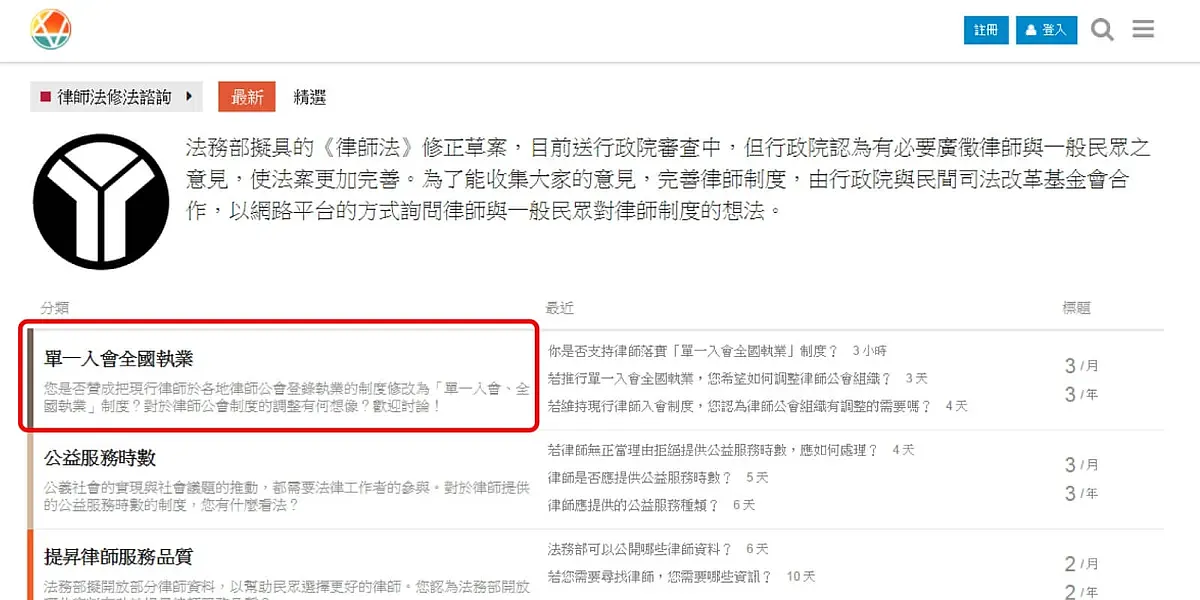
6. However, as explained in paragraphs 3 and 4 of this official letter, the purpose of this event is not to overturn any resolution results using a single questionnaire outcome, but rather to seek a starting point for expanding participatory discussions. Taking the topic of "Single Bar Admission, Nationwide Practice" as an example, the questionnaire reserves open-ended options for filling in responses, and an online forum has been established for posting comments and discussions (refer to the two charts below). Moreover, the initial planning of this event already scheduled the invitation of representatives from the Taiwan Bar Association and local bar associations to participate in discussions and express their opinions.
1. Single bar admission, nationwide practice (Single choice)
- Favor (Skip to question 2)
- Oppose (Skip to question 3)
- Other (Open-ended field for input)
(Regardless of whether you are in favor or opposed, you can go to vTaiwan to discuss)
2. If single bar admission and nationwide practice are implemented, how would you like to adjust the organization of bar associations? (Multiple choice)
- Maintain the status quo.
- Retain only the national bar association, establishing branch offices as needed by each locality.
- Abolish the national bar association, retain local bar associations, or merge them into regional bar associations.
- Other (Open-ended field for input)
3. If the current lawyer admission system is maintained, do you think the bar association system needs adjustment? (Multiple choice)
- Maintain the status quo.
- Adjust into principal districts and concurrent districts (concurrent districts bear at most 1/3 of the membership dues, but rights are restricted).
- Other (Open-ended field for input)

7. In summary, it is hoped that doubts and misunderstandings can be resolved, and that the lawyer system can expand participation through an unprecedented approach, allowing all sectors to fully exchange opinions. This constitutes the most important significance of this event. Accordingly, your esteemed association is cordially invited to assist in inviting members to complete the online questionnaire; actively leave any pro or con opinions on the discussion threads; and delegate representatives to attend the opinion collection discussion meeting at the Executive Yuan at 19:00 in the evening on May 4, 2016. Should you have any suggestions, please feel free to provide them to this Foundation (Contact Person: Attorney Ch'en Yü-fan, Telephone: 02-2523-1178, Email: contact@jrf.org.tw). Please examine and favorably reply.
Original Recipient
Taiwan Bar Association, Keelung Bar Association, Taipei Bar Association, Taoyuan Bar Association, Hsinchu Bar Association, Miaoli Bar Association, Taichung Bar Association, Nantou Bar Association, Changhua Bar Association, Yunlin Bar Association, Chiayi Bar Association, Tainan Bar Association, Kaohsiung Bar Association, Pingtung Bar Association, Taitung Bar Association, Hualien Bar Association, Yilan Bar Association
This article is an AI-generated translation of the original Chinese text. In the event of any discrepancy, the Chinese version shall prevail.
