
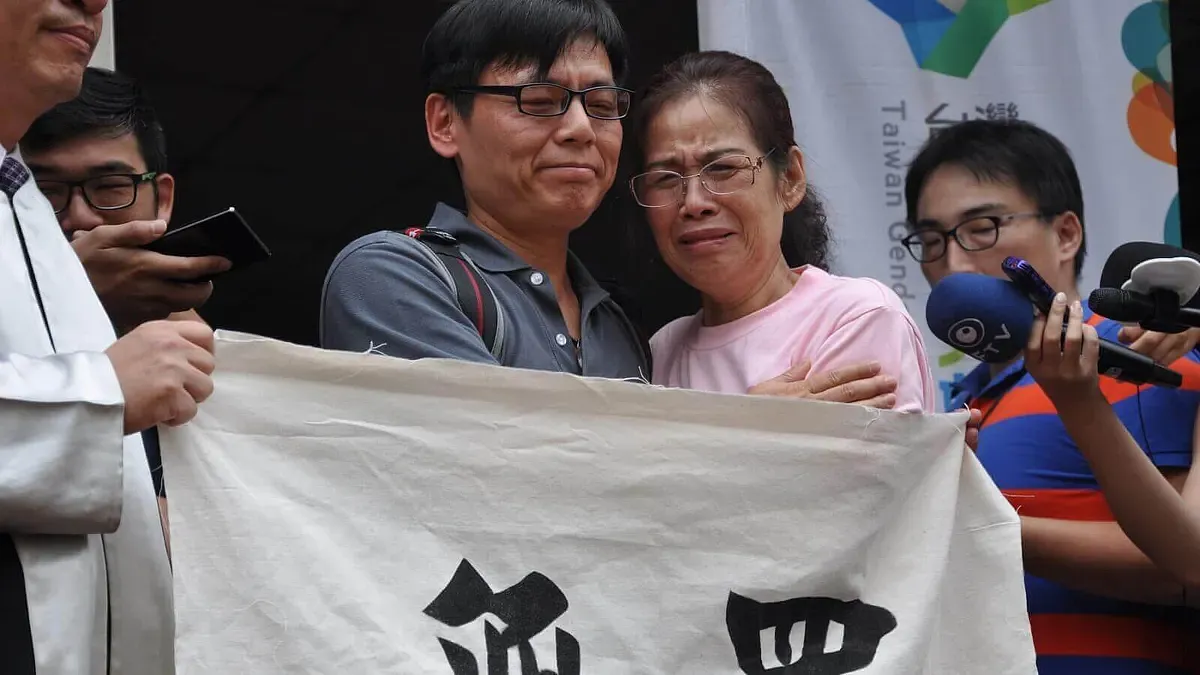
Hsu Tzi-chiang is a Philosopher
Last edited: 2026-07-27
Psychologists say that facing devastating disasters brings extreme trauma. The emotional force of trauma is too powerful to be ignored. While some people find it difficult to walk away from trauma, those who do, according to scholarly research, possess the traits of optimism, social support, and the ability to assign new meaning to the disaster. Finding meaning after a disaster refers to how survivors explain their survival in a certain way and give an existential meaning to their subsequent lives. Just as Frankl described in Man's Search for Meaning, finding meaning was the primary reason he survived his suffering in a Nazi concentration camp.
These assertions are similar to my own experiences. People who have suffered major judicial hardships are often able to comprehend different meanings in life. Su Chien-ho and the other two defendants, whose acquittals were finalized a few years ago, and Hsu Tzi-chiang, who was just acquitted, sometimes speak and approach life like philosophers. They are survivors of judicial injustices who were detained in detention centers for 11 and 16 years, respectively. Both had been sentenced to death and had experienced a period of "waiting to die every day."
Finding Meaning in Adversity
This is much like a patient who lives a law-abiding, smoke-free, alcohol-free, disciplined, and healthy life, only to be diagnosed by a doctor with terminal lung cancer. The moment is excruciatingly painful, prompting one to ask the heavens, "Why me?" Instantly, direction is confused and time is disoriented; the compass and the clock, like paper pinwheels, spin wildly in the wind.
Many people who describe the experience of accompanying a terminally ill loved one note that they seize the present moment and focus more intensely on exchanging relationship connections. Afterward, re-examining this experience from a broader context can sometimes reveal with surprise that adversity actually possesses a "valuable" side. Perhaps it rebuilds relationships with loved ones, perhaps we cherish our lives more, or perhaps we discover higher potentials in one another.
Of course, this is not in praise of disaster. Given a choice, we certainly would not want our loved ones to contract cancer, nor would we want anyone to suffer judicial injustice, let alone praise Nazi concentration camps. Pain is unpleasant, and denying this is overly hypocritical and pretentious. Moreover, people who have experienced disaster, even if they can find meaning afterward, may still struggle emotionally, experience real psychological or physical pain, and even find it difficult to make long-term life plans.
Adversity is like an unprovoked blow to the head, forcing us to temporarily pause our lives and contemplate existence. The process may be cruel, but it can also allow people to step outside Earth's coordinates and redefine their lives on the scale of the solar system or the galaxy.
Living in the Present and Focusing on Life
Su Chien-ho is optimistic and talkative. What I admire most about him is that he seemingly no longer harbors any resentment or hatred toward the police officers who tortured him or the judges who sentenced him to death. Unburdened and untethered, it has all drifted away with the wind. Just as he most likes to begin his speeches: "My name is Su Chien-ho, I have been engaged in 'practical work' in judicial reform for twenty years, and my 'profession' is being a defendant." It seems like a playful tone used to mock his own life. Yet viewed from a broader context, the three of them truly used the golden years of their youth to whet and hone the progress of judicial reform. This is a higher scale and meaning of life.
Hsu Tzi-chiang often says that the day his death sentence was finalized was a form of relief for him—he was finally freed from judicial torment. He had chosen to trust the judiciary and turn himself in, yet ironically, the judiciary seemed to continuously validate that his choice was wrong. Before his death sentence was finalized, he had long since given up on his life, and it was only because his family refused to leave regrets that they persisted without giving up.
Yet, he had merely agreed to let his family seek various channels to rescue him, while he himself began to live a life of "taking it one day at a time." Even now, over three years since his release, he still has the habit of not thinking about "what to do tomorrow," living each day well one day at a time.
When I first heard him speak this way, I felt it was perhaps too passive, thinking maybe it was because his trial had still not concluded. Later, I gradually realized that he is actually very earnestly focused on the present moment, much like the lyrics of the band 信樂團 (Shin): "Treat every day like doomsday to love each other." His mood is even calmer and more steadfast, making it difficult for trivial matters in life to cause massive emotional fluctuations. Volunteers often joke that Hsu Tzi-chiang is likely the person with the healthiest psychological state within the JRF.
Therefore, I often feel that Su Chien-ho, the other two, and Hsu Tzi-chiang are very much like philosophers. It is as if they have already lived once and died once, returning to interact with us anew bearing the wisdom of a past life. From their simple language, a radiance of wisdom frequently emanates.
I think this kind of life that finds meaning after adversity is perhaps a galaxy-scale life! Yet we people who bustle and toil busily within the judiciary often care only about the patch of sky directly above our heads, completely oblivious to the fact that the positions of the redeemer and the one waiting for redemption have been inverted.
This article is an AI-generated translation of the original Chinese text. In the event of any discrepancy, the Chinese version shall prevail.