
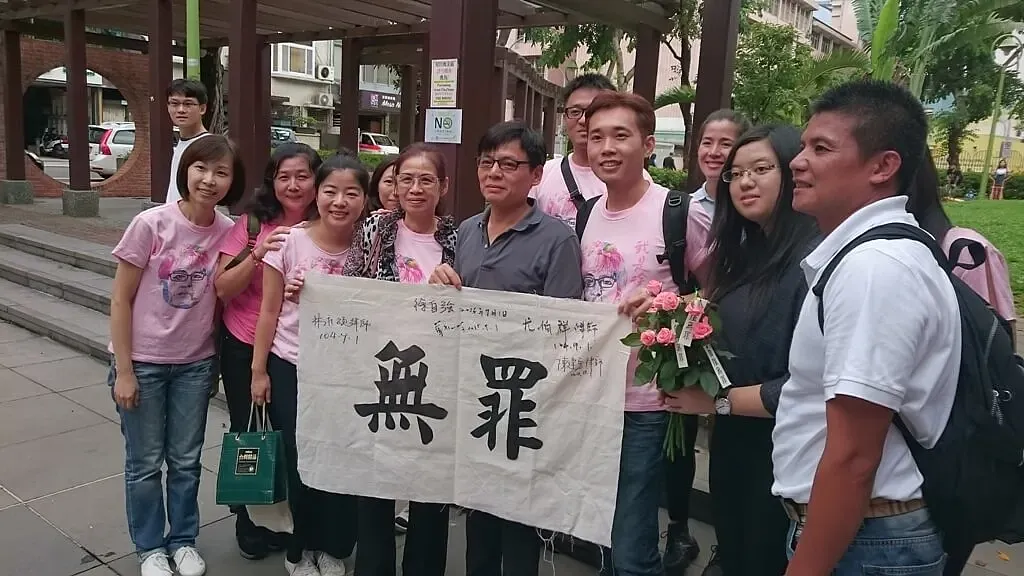
Justice Blooms, Saluting Three Brave Judges
Last edited: 2026-08-30
After a 20-year legal battle, the Hsu Tzu-chiang case—which went through 7 death sentences, 2 life sentences, 1 Judicial Yuan Interpretation, and 5 extraordinary appeals—finally saw the Taiwan High Court render a not-guilty verdict on the retrial's ninth remand yesterday (Sept. 1), overturning the original conviction and acquitting Hsu Tzu-chiang.
The case occurred in 1985 (Republic of China year 84), when real estate developer Huang Chun-shu was kidnapped and murdered. Suspects Huang Chun-ch'i and Ch'en I-lung were successively captured and confessed that Hsu Tzu-chiang was also an accomplice. However, aside from the confessions of Huang and Ch'en, the case lacked any direct evidence linking Hsu Tzu-chiang to the crime. Hsu even provided an alibi for the day in question, but because the two co-defendants stubbornly insisted on his participation, Hsu was sentenced to death.
Under circumstances where the case had no physical evidence and only human testimony, Hsu Tzu-chiang's pro bono defense team petitioned the Grand Justices for a constitutional interpretation in 2003. The Grand Justices accepted the case and issued Interpretation No. 582, which generally held that cross-examination of Huang and Ch'en must be conducted to ensure the credibility of their testimony, thereby meeting the prudent and strict standards for the admissibility of evidence under the Code of Criminal Procedure.
However, after Interpretation No. 582 was issued, Huang Chun-ch'i was unwilling to submit to cross-examination by Hsu's lawyers in court. Although Ch'en I-lung once underwent cross-examination during the eighth remand retrial, he frequently responded to critical case details with "I don't remember." Given the lack of physical evidence and insufficient testimony in this case, logically Hsu Tzu-chiang should have been acquitted long ago after the Grand Justices issued Interpretation No. 582. Yet, regrettably, the judiciary still convicted Hsu based on insufficient testimony, and it took another decade plus before he finally obtained his first acquittal yesterday.
Realizing the Presumption of Innocence and Preventing Miscarriages of Justice
The famous Su Chien-ho case was exonerated after 21 years. The Hsu Tzu-chiang case has also taken 20 years thus far, and how many 20-year spans does a person have in a lifetime? A similar issue in both cases is whether the principle of the presumption of innocence is truly implemented in our judicial system. Frankly speaking, requiring every adjudicator to firmly uphold the presumption of innocence in their heart is not easy; precisely for this reason, the three judges yesterday are all the more exceptional. Facing squarely the issue of insufficient evidence in this case, these three judges courageously wrote an acquittal verdict in the spirit of the "presumption of innocence." We believe the bravery of these three judges will leave a profound impression in the hearts of the people. We also look forward to the spirit of the presumption of innocence being more thoroughly implemented in judicial practice to reduce the occurrence of future miscarriages of justice.
This article is an AI-generated translation of the original Chinese text. In the event of any discrepancy, the Chinese version shall prevail.