
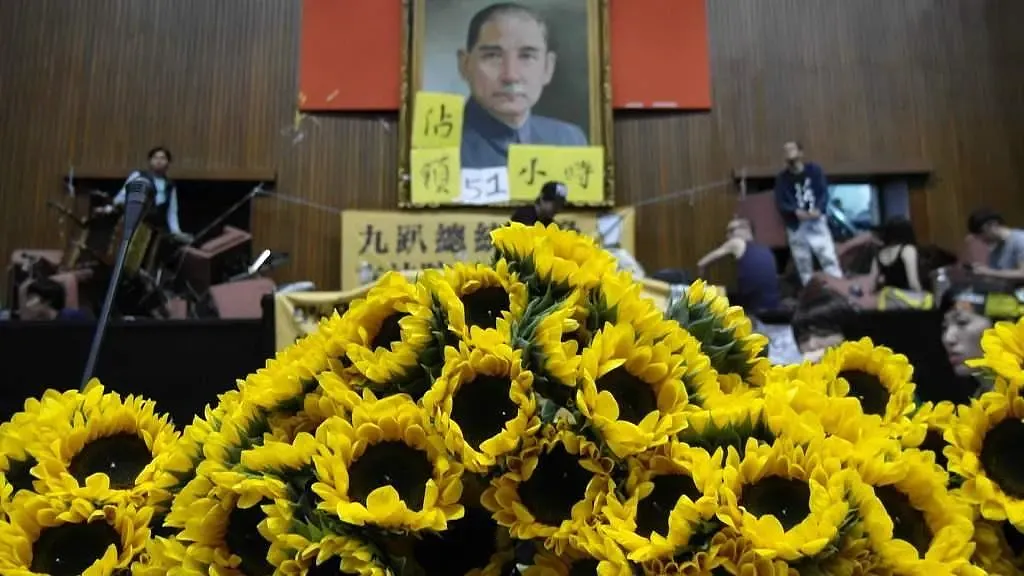
Prosecutors Who Indicted Sunflower Movement Participants Receive Promotions
Last edited: 2026-08-30
Almost all prosecutors who indicted participants of the Sunflower Movement have received promotions. Prosecutor Chen Yu-ping, who handled the case regarding the March 18 occupation of the Legislative Yuan, was promoted to Chief Prosecutor of the Tainan District Prosecutors Office. Prosecutor Chang Chih-yao, who handled the case regarding the March 24 occupation of the Executive Yuan, was promoted to Chief Prosecutor of the Nantou District Prosecutors Office. Another prosecutor, Teng Ting-chiang, was promoted to Chief Prosecutor of the Taitung District Prosecutors Office. Prosecutor Hsieh Chi-meng, who handled the April 11 'passing by' protest at the Zhongzheng First Police Station, was promoted to Chief Prosecutor of the Yilan District Prosecutors Office. Whether this constitutes 'normal' or 'abnormal' phenomena warrants deeper examination.
Of course, such a headline might be somewhat unfair in implying a strong correlation between receiving a promotion and indicting the Sunflower Movement. Perhaps these prosecutors are simply outstanding and consistently excel at handling cases. However, the Sunflower Movement as a whole had a massive impact on Taiwan and was widely affirmed by the general public. For prosecutors to indict participants on a large scale was to side with those in power and act against the majority of public opinion; it is impossible that they did not have some thoughts in their minds about this (if they lacked even this awareness, the legal knowledge, common sense, and self-consciousness of these prosecutors would be utterly disappointing). Vigorous prosecution may have been a demand from superiors or the result of independent judgment, which leads to different evaluations of the prosecutors. Naturally, this is also tied to our 'imagination' of the 'role of prosecutors.' Prosecutors always hope to have greater and more independent room for handling cases, yet most seek only to protect themselves, and those who dare to stand up and fight are few and far between.
If they simply comply with demands from superiors, lacking the courage or willingness to raise objections or engage in dialectical debate, then the unity of the prosecutorial system becomes merely an excuse. Serving as hired muscle and sharing the blame uniformly with superiors is only to be expected. Treating the Sunflower Movement like any ordinary case and attempting to maintain a 'business-as-usual' attitude is nothing more than an unrealistic evasion. Unifying investigative standards, clearly defining the scope of indictments, and establishing legal interpretations are all necessary and important tasks when dealing with cases involving major social controversies. To be frank, even within the prosecutorial ranks, there are likely differing voices regarding the threshold standards and scope of indictments. If these investigative or indicting standards are not properly and fully discussed and determined beforehand through panel meetings, prosecutor meetings, or even chief prosecutor meetings, and if the political responsibility and pressure are not clearly borne by superiors, the outcome goes beyond mere discord (though the indictment of the Sunflower actors seemed strangely unanimous). Furthermore, if malicious litigation risks are discovered later, having frontline handling prosecutors bear full responsibility while the chief prosecutor and other instigating high-ranking prosecutors slip away unscathed is a severe mismatch between power and responsibility.
Chief Prosecutors Must Exercise Accountability
The Taipei District Prosecutors Office has been accused of acting as muscle and accomplices, and former Chief Prosecutor Yang Chih-yu bears the greatest responsibility. He made a clear value choice: to safeguard those in power and warn the protesters, while simultaneously shielding law enforcement officers who used excessive force. Whether yielding to higher-level intentions or acting out of conventional cowardice, this was his choice. Perhaps current legal systems remain flawed, and abuses of power cannot necessarily be investigated to hold him accountable, but history has long since established a certain evaluation and positioning for such actions.
Certainly, the Chief Prosecutor of the Taipei District Prosecutors Office is bound to face criticism regardless of what he does, and I am certain he has plenty of grievances. But let us not forget that this position holds immense power. Since he desired this position and dared to accept it, he must possess commensurate determination. No amount of grievances can be understood, yet they hardly deserve sympathy. With great power comes great responsibility—this is not merely a line from a Spider-Man movie.
An exceptional chief prosecutor must externally possess the courage and executive resolve to bear pressure, rather than fobbing people off with boilerplate phrases like 'We respect the independent investigation of prosecutors, thank you for your feedback.' Internally, he must empower and fully communicate with prosecutors, rather than remaining elusive and concealed behind the scenes, leaving subordinates to second-guess higher-level intentions or guiding the direction of investigations through obscure means.
Take the indictment of Sunflower Movement participants as an example: applying increasingly severe legal provisions, relying on increasingly hollow factual determinations, and employing increasingly exaggerated legal interpretations. Dealing heavy blows without the slightest hesitation transcends the behavior of mere legal technicians and enters the realm of cruel officials. Meanwhile, they turned a blind eye to police officers who abused their power and assaulted citizens. Operating with a double standard has practically made them accomplices to the evasion of justice. The Taipei District Prosecutors Office firmly took a stance and made a decision: to assist the higher-ups and oppose the Sunflower Movement.
Due to the principle of non-disclosure of investigations, ordinary people may not know what court hearings presided over by prosecutors look like, but these indicted social activists and participants (arguably some of the most civic-minded individuals in Taiwan today) have already placed a giant question mark in their hearts regarding prosecutors, who ought to represent the image of justice:
'Why are you only prosecuting me, and not the police?'
'Why is it that even though the police struck first, I am the one charged with obstructing officers in the discharge of their duties?'
'Why must the prosecution insist that I am "inciting others to commit offenses" when the crowd's assembly was clearly spontaneous?'
'Why do prosecutors stubbornly use the unconstitutional "Assembly and Procession Act" to indict people?'
'Why do prosecutors completely fail to understand "freedom of expression"? Chaining one's body to block vehicles has somehow turned into the "crime of public endangerment"?'
Prosecutors' 'reverse engineering' of legal interpretations—adopting a policy of better to kill by mistake than let anyone go free upon spotting potential illegal acts, and striking hard wherever a small interpretive loophole can be found—bears an uncanny resemblance to the modern version of 'if you are out to condemn someone, you can always trump up a charge.' Can prosecutors truly look into their hearts and answer the public's aforementioned questions?
These harsh, punitive legal interpretations for indictments, coupled with inaction regarding the police officers who beat citizens, are responsibilities that Yang Chih-yu must shoulder entirely. It matters little whether this stemmed from his genuine beliefs, calculations to second-guess superiors, or decisions made under instruction. Of course, the sweet fruit he reaped in return was that his superiors ultimately fulfilled his wish, transferring him to a unit close to his heart. This is a tacit exchange of interests.
Has the Prosecutorial System Become Gang-like?
The worst aspect of this interest exchange is that it breeds a vicious cycle of 'what superiors desire, inferiors strive to emulate.' One must ask: had Yang Chih-yu defied the will of his superiors and shared the general public's widespread sympathy for the Sunflower Movement, would he still have launched such a swift, severe, and large-scale indictment? If he had refused to act, would he have secured his desired promotion? As intelligent and brilliant as prosecutors are, can it be that each of them does not harbor their own internal calculations?
Regarding the immense scope of prosecutors' discretion and the countless 'subtleties' involved, reading former Special Investigation Division prosecutor Cheng Shen-yuan's article, *The Malpractices of Prosecutors' Non-Prosecution Dispositions and Ways to Improve Them*, is enough to make one's blood run cold. If the Sunflower cases truly represented the independent judgment of prosecutors without any upper-level intervention whatsoever (though the likelihood of this seems exceedingly low), it still leaves one feeling rather helpless.
This is because handling prosecutors generally harbor very little sympathy for Sunflower Movement participants. At best, some participants noted that they finally encountered a prosecutor whose questioning attitude was quite polite, and who did not treat them as major criminals or handle them with hostility.
Yet, prosecutors represent the state, not those in power, and they carry an obligation of objectivity. They must pay attention to both inculpatory and exculpatory evidence regarding the defendant, and they should not take hunting down citizens as their vocation. Moreover, faced with potential retaliatory complaints from those in power and suspected abusive transfers by law enforcement, prosecutors have a duty to screen cases.
Yet these reminders are likely ignored by the 'star' prosecutors trusted by the chief prosecutor. After all, having gained the favor of superiors, it is 'embarrassing' to have 'too many opinions' and 'cause trouble for the chief.' In any case, the law has room for interpretation as long as one is not caught red-handed. With prosecutorial independence, what can outsiders do to us?
Naturally, quite a few frontline prosecutors are filled with grievances, yet they dare not speak out despite their anger. This situation makes the prosecutorial system look precisely like factional turf within a gang: those who obey are rewarded with promotions and high offices, while those who step out of line are disciplined and suppressed. Prosecutors have plenty of grievances to voice. However, the exact same logic used to criticize chief prosecutors also applies to prosecutors themselves. Compared to ordinary citizens, prosecutors hold high office and wield immense power; if you enter the kitchen, do not complain about the heat. Those who choose obedience for the sake of promotion must also accept public scrutiny.
Prosecutors are among the brightest minds and ought to possess the capacity for multi-perspective dialectics and independent thinking. Yet, from another perspective, whenever elite talent undergoes experiences defined by achieving 'first place,' it essentially means submitting once more to a predetermined system. From primary school to university, from examinations to promotions, clever children learn the rules of the game and the preferences of figures of authority. Over time, their ability to think outside the box perhaps becomes blunted.
To pin all responsibility solely on the frontline handling prosecutors is somewhat unfair. As previously noted, former Chief Prosecutor Yang Chih-yu bears the greatest responsibility. Furthermore, expecting individual prosecutors to single-handedly fight the system is perhaps asking too much; a better approach is to properly reform this flawed system.
Therefore, if frontline prosecutors agree with this argument, they should not remain silent when moments of systemic reform arrive. Remaining silent makes one an accomplice in solidifying a flawed system, just as the mindset of seeking only self-preservation and silent promotion does. Without voicing independent opinions and rising to defend the ideal prosecutorial system in one's heart, no amount of grievances or complaints will ever elicit sympathy from outsiders.
This article is an AI-generated translation of the original Chinese text. In the event of any discrepancy, the Chinese version shall prevail.