
Junior Prosecutor vs. Ministry of Justice: Has He Lost?
Last edited: 2026-08-30
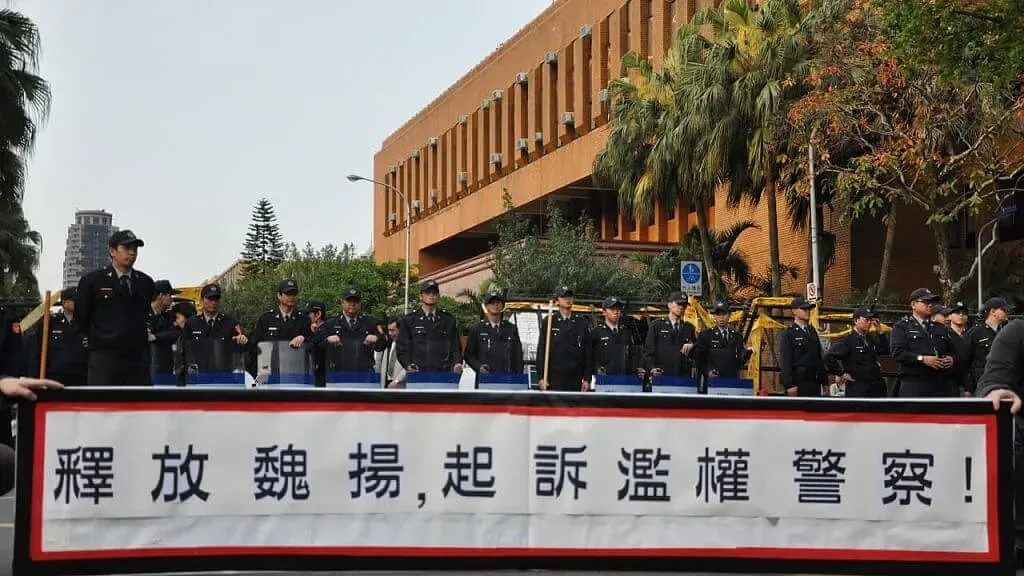
Caption: When asked why a junior prosecutor dared to step forward and challenge the Minister, Chen Chi-wen revealed that it was because he could not stomach the "politically motivated detention request" against Wei Yang, who led the charge into the Executive Yuan during the Sunflower Student Movement, which led him to run for the Prosecutors' Review Committee.
Shihlin District Prosecutors Office Prosecutor Chen Chi-wen sought a provisional disposition from the court to freeze the Minister of Justice's "cherry-picking power," but his request was recently dismissed. Media headlines sensationalized the outcome as "The Junior Prosecutor's Counterattack Fails!"—framing it as a David versus Goliath story. Naturally, framing it this way adds dramatic tension.
Compared to the Taipei High Administrative Court, the press release issued alongside its dismissal ruling received less attention, yet it actually conveyed a significant amount of information. The first paragraph of the press release stated outright that "the Minister of Justice's cherry-picking power is suspected of exceeding the scope of authorization of the parent act, the Judges Act." However, Article 4, Paragraph 2 of the Regulations Governing the Deliberation of the Prosecutors Review Committee of the Ministry of Justice (hereinafter the "Deliberation Regulations," which serves as the legal basis for the Minister's "cherry-picking power") does not meet the requirements of Article 298, Paragraph 2 of the Administrative Litigation Act, and thus does not constitute a "legal relationship under public law."
Therefore, the Taipei High Administrative Court held that Prosecutor Chen could not use these "Deliberation Regulations" as grounds to petition for this provisional disposition. Viewed as a whole, although unfavorable to Prosecutor Chen, this ruling seemingly left some room for maneuver. The judges do not appear to think the Minister of Justice's "cherry-picking power" is "entirely unproblematic"; rather, they reserved their opinion—almost as if they had more to say—on who should, through what procedure, and based on what law discuss or declare the "cherry-picking power" to be illegal. Although the provisional disposition was dismissed, is there truly no possibility of a provisional disposition whatsoever? Or was there simply insufficient "necessity"? Could another provision serve as the basis? And how should this dispute ultimately be resolved? All these questions are worth further exploration.
Where is the Right / Legal Relationship?
According to the judges, "rights and obligations" or a "legal relationship" must exist between two parties in order to file for a provisional disposition. Two types of connection may exist between Prosecutor Chen and the Ministry of Justice. Described using the concept of "rights," one is the "right to promotion," and the other is the "right of deliberation." The former refers to "Prosecutor Chen wanting to be promoted himself," in which case the Minister's cherry-picking power might infringe upon his rights. The court held that this ground is untenable because Prosecutor Chen himself does not wish to be promoted or transferred, nor is he on the current list for promotion and transfer.
The other is Prosecutor Chen's "right(power) to deliberate on the transfers of others." Because he is a member of the Prosecutors Review Committee, he naturally possesses the "right of deliberation." Prosecutor Chen argued that the Minister of Justice's "cherry-picking power" hollows out his "right of deliberation." This point is arguably the most direct and hits closest to home, aligning best with common intuition: the Minister's "cherry-picking power" infringes upon the "right of deliberation" of the members of the Prosecutors Review Committee.
In response, the reasoning of the Taipei High Administrative Court judges was brief, stating only that if Prosecutor Chen has a dispute over a personnel case, he "may raise it for discussion in the Review Committee," and thus his right of deliberation will not be affected. This reasoning is somewhat specious, because if the "Deliberation Regulations" Article 4, Paragraph 2 indeed exceeds the authorization of the parent act, Prosecutor Chen's right of deliberation has been infringed upon, and this infringement is not "transformed" into a non-infringement merely because he is able to "raise it for discussion."
Consequently, the administrative court actually needs to delve deeply first into whether Article 4, Paragraph 2 of the "Deliberation Regulations" violates Article 90 of the Judges Act.
Shaking Off the Infamous Label of a "Court of Dismissals"
This is to say that the administrative court cannot evade expressing a legal opinion on whether "the subsidiary legislation conflicts with the parent act" in order to handle the petition for provisional disposition and the legality and merits of subsequent litigation. This is a more arduous path, but one that judicial officers must not dodge. If the administrative court wishes to shake off its infamous label as a "court of dismissals," it can no longer simply throw up its hands and leave this dispute over "internal institutional personnel power-sharing" to be handled by the Grand Justices at a later date. (Of course, the administrative court could perhaps emulate the Grand Justices and hold that this is the authority of the legislator, or even an internal core matter of the executive branch, which is not subject to judicial determination. That is also an option.)
Judged purely by legal form, the administrative court could adopt the Ministry of Justice's argument, determining that the Prosecutors Review Committee enjoys a "power of nomination," which grants it greater power compared to the personnel of judges, who should possess even higher independence. The Minister of Justice does not even possess the power of nomination, and their scope of power is smaller than that of the President of the Judicial Yuan. (Of course, judges "theoretically" do not have the issue of "getting promoted," whereas prosecutors seemingly do. Since there is no issue of "getting promoted," is it unproblematic for the President of the Judicial Yuan to monopolize the nomination power? That is another interesting question.)
Viewed in this light, the Prosecutors Review Committee enjoys greater power than the Judges Review Committee, and the Minister "merely" possessing the "cherry-picking power" is just a minor and necessary "power-sharing system," which does not seem excessive. Therefore, even though it is not explicitly stipulated in the Judges Act, it does not constitute an infringement upon the power of the Prosecutors Review Committee. Unless Prosecutor Chen intends to argue that the Minister of Justice's personnel power should be completely abolished. One can certainly make such an argument, but it requires much stronger argumentation.
Substantively speaking, if the administrative court were to adopt Prosecutor Chen's argument and hold that the Minister of Justice exercises "total control" over personnel power precisely through this "cherry-picking mechanism," it is because the Minister of Justice would have long ago "planned the list," pushing it forward through government-appointed committee members or negotiating in advance with various local factional forces so that locally elected committee members can jointly submit it. The "core list" has long since been mapped out, and any additional names submitted merely serve to create some "token candidates" to pull the wool over people's eyes, or to mitigate irreconcilable conflicts of interest. In the end, the "cherry-picking power" is the most formidable trump card, allowing the Minister to handpick the "core list" one by one, sealing the deal. The entire Prosecutors Review Committee becomes a mere formality.
However, the real dilemma of this argument is that the composition and actual operation of the Prosecutors Review Committee clearly amount to a "dividing the spoils among themselves." If Prosecutor Chen's substantive reasoning holds true, even if the Minister were stripped of the cherry-picking power, they could still "manipulate the list," firmly grasping personnel power through other government-appointed or faction-elected representatives, leaving little substantial meaning to the change. Instead, the Review Committee would once again prove its own "incompetence" and "hollowness," while paradoxically undermining the legitimacy of the Review Committee's exercise of personnel power. Since it is currently so feeble and reliant on the will of superiors, should it really be granted even greater power? This remains doubtful.
At the end of the day, people must respect themselves before others will respect them. One must first prove that they are a trustworthy group before they deserve to be entrusted with greater power. The public is watching with sharp eyes to see what the autonomy and self-discipline of prosecutors are truly like.
This article is an AI-generated translation of the original Chinese text. In the event of any discrepancy, the Chinese version shall prevail.