
Hollow Review, Paper-Thin Grand Justices
Last edited: 2026-07-27
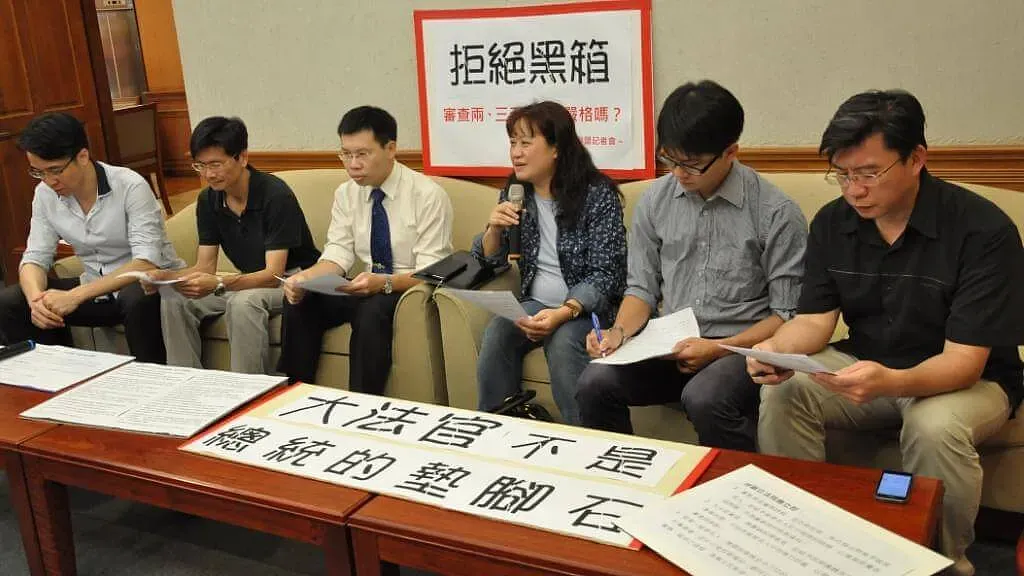
This Wednesday (June 10), the Legislative Yuan began reviewing the presidential nominees for Grand Justices. Wednesday was a public hearing, Thursday was a plenary committee meeting, and the vote to exercise consent is scheduled for Friday. The process should be solemn and dignified, given the prestigious status of Grand Justices and their power to hold the final power of constitutional interpretation. Yet, contrary to expectations, the hollowness of the procedure is too painful to watch.
The expert public hearing on the first day lasted only half a day—merely going through the motions—and legislators' attendance was sporadic. The experts and scholars spoke in generalities that likely offered little help to the legislators. Everyone seemed to be talking into the air, with no intersection whatsoever. Each voiced their own opinions, and there was no exchange on the issues. The nominees did not have to attend, did not have to respond, and there was no encounter between persons. It is hard to believe that this was the preparatory work for the review of Grand Justices, who hold the highest judicial status in our country; no wonder lawmakers showed little interest.
In the subsequent plenary committee meeting, lawmakers could directly question the nominees, producing somewhat more sparks. However, the Grand Justices only needed to "endure it for a bit"; regardless of how sharp the legislators' questions were, each was limited to just 15 minutes. After 15 minutes, the microphone would even be muted. The Grand Justices nominees could simply dodge and evade, give evasive answers to substantive questions, or smile without answering, leaving the legislators utterly helpless. Some say that the Legislative Yuan's review of Grand Justices has "always been this way." Even more absurdly, the nomination reviews for nearly all personnel appointments are actually conducted this way. The question is: Will Taiwan continue like this? Are there no other practices worth emulating and learning from? These are Grand Justices, after all!
Questionnaires, Q&A, and Experts Are the Key
Taking the United States as an example, Presidents Obama nominated Justices Sotomayor and Kagan in 2009 and 2010 respectively. About a month and a half after the nominations, the Senate would begin its review. The review is handled by the Judiciary Committee, which decides whether to open hearings; if the Senate is unwilling to even open hearings, it constitutes a severe boycott, though such cases are rare.
Before entering the hearings, a Grand Justice nominee must first submit a detailed standard questionnaire (approximately 80 pages in length), briefly answering a wide variety of questions within it. The Judiciary Committee, consisting of about 20 members, then begins the review. Sotomayor underwent four days of review, while Kagan underwent three.
The length of the review is not rigidly prescribed; taking Kagan as an example, each member was allowed two rounds of questioning and answers. Most importantly, these Q&A sessions are not "blank cartridges" or an "unspoken agreement" like the "alternate-day shelling" after the August 23 Artillery Bombardment. Because the Grand Justices have already briefly answered the questions on the standard questionnaire, members of Congress naturally follow the clues in the questionnaire to break through and pose sharp questions. If the Grand Justices are not fully prepared, they sometimes find themselves unable to cope.
Even more lethal is the introduction of expert witnesses during the Q&A process. Experts or scholars specializing in various fields put forward various controversial or profound questions. Taking Kagan again as an example, the Republican and Democratic parties each introduced over twenty experts, all leading figures in the legal profession. In this way, on the one hand, the burden on individual senators is alleviated—after all, specialists excel in their own fields. On the other hand, through multidimensional debate, the true values held by the Grand Justice nominee are revealed amidst continuous questioning and answers.
Hearings frequently attract high media attention and are even broadcast live throughout. Consequently, they allow Americans to become acquainted with the prospective Grand Justices of their country. At the same time, because the issues discussed are fascinating, it also serves as an opportunity for civic legal education. Following the review, the Judiciary Committee holds a vote to decide whether to approve the nomination. Only if a Grand Justice is approved for nomination is the matter subsequently submitted to the full Senate for a vote to exercise the consent power.
Introducing the U.S. system for reviewing Grand Justices does not mean that the U.S. review process is necessarily correct, nor does it mean that our country must follow the U.S. approach. However, when the ruling and opposition parties both solemnly declare their intention to "strictly review" nominees, adopting or benchmarking against such "standards" might perhaps better "do justice" to the Grand Justices.
Hollow Review Leaves the Public Depressed
A review meeting is like an exam, and the operational method of the examination system will naturally determine whether the result is fair. Fairly speaking, the current personnel review procedures of our country's congress suppress "top students" while rewarding "underachievers." This masked review—conducted as a mere formality, superficial, and hollowed out—leaves those with a clear awareness of constitutional systems and human rights protection, as well as outstanding performance, with little room to demonstrate their capabilities.
On the contrary, it creates opportunities for those who trample upon human rights and infringe upon constitutional values to muddy the waters and muddle through. Incapable of measuring the "true substance" of Grand Justices, when crucial constitutional moments arise, they are prone to suffering a flare-up of "Constitutional and Human Rights Awareness Weakness Syndrome." Paper-thin Grand Justices are nothing more than high-ranking officials put on display for show. A masked review meeting leaves people feeling so depressed.
This article is an AI-generated translation of the original Chinese text. In the event of any discrepancy, the Chinese version shall prevail.