
My 28 Years Old and Chiou Ho-shun's 28 Years Old
Last edited: 2026-08-31
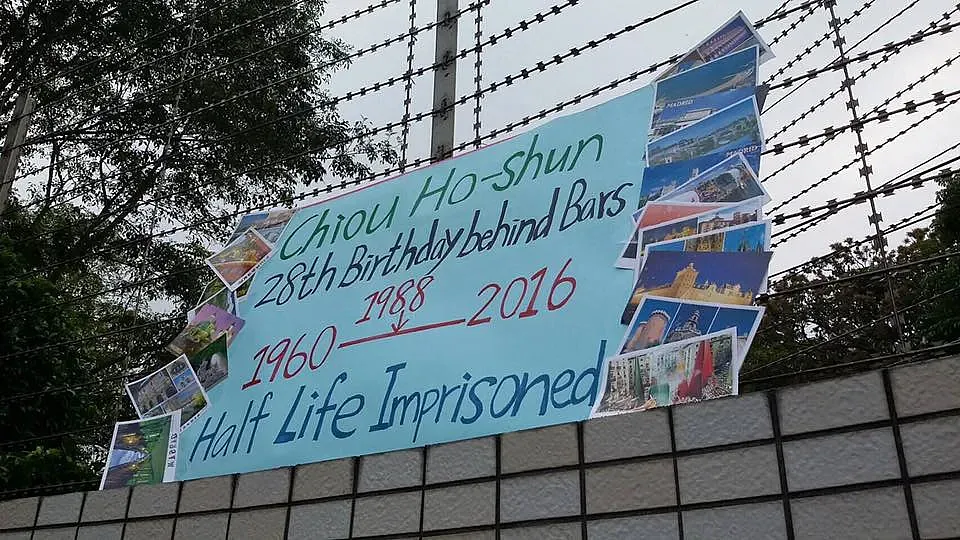
I am 28 years old this year. Over the course of 28 years, I have grown from a toddler into a young woman. I went to university, had a few relationships, worked in public service, and passed the bar exam. I feel that life is full of challenges and immensely wonderful. Chiou Ho-shun did not have a life like mine. At age 28—the exact same age as I am now—he was sacrificed under the pressure to solve a case, beaten by police, and imprisoned. For 28 years—more than 10,000 days—in a dark, sunless cell, his life was ruined by the judiciary. All he could do was count the days amidst injustice, figure out how to keep his sickly body going, and constantly try to prove his innocence.
It was the day of Grain Rain; the weather was humid and muggy. I went to the Tucheng Detention Center to visit Chiou Ho-shun. Entering the meeting room, I saw A-shun. A-shun was a bit shorter than I had imagined. Panting while wiping away sweat, he sat down with an apologetic look on his face. A thick glass window separated the two of us, and we picked up the telephone receivers to talk. I wrote my name on the glass with my hand, and speaking in Taiwanese Hokkien, he sincerely said, "Thank you for your support. You've worked hard."
In Cheng Hsing-tse's case, the prosecutor petitioned for a retrial in the interest of the defendant. Ten years after Cheng's death sentence became final, the court summoned him to court for a hearing for the first time. A-shun said he also learned about it on the radio, but because his left ear was beaten to a pulp during police torture, it would fester and discharge pus whenever he listened for too long, so he could not listen to it often. I asked him what he thought about Cheng's case. He said he graduated from the remedial class and wasn't very good at speaking, but shyly added that he thought the prosecutor was very brave. What remained unsaid, I guessed, was that in his heart he must also wonder when such "good luck" would descend upon him.
Cheng's case also boosted the morale of the defense team for Chiu's case. The petition for a retrial had been submitted, and the court had remained silent for over four months. Looking at Cheng's case, the lawyers brainstormed potential options for rescuing A-shun. In Cheng's case, the prosecutor petitioned for a retrial based on a shootout scene reconstruction and appraisal conducted by the Graduate Institute of Forensic Medicine at National Taiwan University. Subsequently, the lawyers filed a fourth petition for a retrial for Cheng Hsing-tse, using an analysis of Cheng's interrogation confession by a forensic psychology expert to conclude that Cheng's confession was inadmissible as grounds for a retrial. The judges ought to have summoned these expert witnesses to initiate retrial proceedings. In Chiou Ho-shun's case, there are similarly crucial witnesses—the testimony of two retired police officers who can prove how Chiu was tortured into confessing at the time. Perhaps we can similarly follow the approach of Cheng's case and ask expert witnesses to analyze the testimonial evidence. Out of the 288 fabricated and astonishingly voluminous transcripts in Chiou Ho-shun's case, we could reconstruct the personalities of Chiou Ho-shun and the other defendants, the environment during their interrogation, and their responses, in order to demonstrate that the confessions were actually born out of the coercion of torture rather than free will.
There is a major difference between Cheng's case and Chiu's case: "presence" versus "absence." Cheng Hsing-tse was right at the crime scene, so the defense team was able to analyze the situation at the scene using scientific methods to restore the fact that it was impossible for Cheng to have shot at the police. In Chiu's case, however, Chiou Ho-shun was never at the crime scene from beginning to end. He was plucked out of thin air simply to serve as a sacrificial offering for poor public safety. Even the victim's body and the murder weapon have never been found. Ironically, we cannot emulate Cheng's case by using scientific methods to analyze the situation at the time. Trying to model Chiu's case after Cheng's is not as easy as imagined, and an ironclad alibi ironically appears to be of no use.
With the inauguration of the new government, one cannot help but think of presidential pardons. But would a pardon be a way out? A pardon implies guilt coupled with the suspension of punishment's execution—meaning that if Chiou Ho-shun were to walk out of prison via a pardon, he would still be a guilty person. There would be no apology, no compensation for wrongful imprisonment. Yet Chiou Ho-shun's miscarriage of justice was blatantly caused by an unfair trial. After illegally imprisoning him for 28 years, the state would pat him on the shoulder, wipe the slate clean, and indoctrinate everyone into believing this is the state's goodwill toward the people. For Chiou Ho-shun, this will be the most difficult multiple-choice question: choose wrongly, and what is sacrificed is not freedom, but justice.
Following the cases of Hsu Tzu-chiang, Chiang Kuo-ching, and Cheng Hsing-tse, the notion that "miscarriages of justice exist" has been widely accepted by everyone. The efforts at the grassroots level finally seem to have prompted state organs to take tentative steps toward reform. Before stepping down, Minister of Justice Lo—who was known for "blaming others when he was in the wrong"—instructed the Prosecutor-General to establish a "Death Penalty Case Relief Review Panel" at the Supreme Prosecutors Office. For cases like Chiu's, where a death sentence has been finalized but not executed yet remains deeply controversial, the panel will proactively review once more whether grounds for a retrial or extraordinary appeal exist. If new facts or new evidence are discovered, or if it is found that the facts of the crime determined in the case clearly do not match the evidence employed, to the benefit of the defendant sentenced to death, the panel shall immediately proactively petition for a retrial or file an extraordinary appeal. While civil human rights organizations affirm this move, they believe the review panel should not impose self-imposed limitations and that its scope of review should extend to all death penalty cases to demonstrate the state's prudence regarding the death penalty.
The process of visiting Chiou Ho-shun is less sorrowful than it is anxiety-inducing—an anxiety driven by his confinement moment by moment. The instant I saw him, I was no longer a mere bystander; Chiou Ho-shun became a fully realized person. Although Chiou Ho-shun's lack of freedom and his state of being on death row were not caused by me, I feel a pang of a guilty conscience. There is always a feeling that the more we pay attention and the more we cry out, the weaker the judiciary's courage to admit its mistakes becomes. Our judiciary has invested a great deal of time and energy into defending certain things, yet it is unwilling to question whether something went wrong along the way. A judiciary marked by transitional injustice clings to past misjudgments and continuously replicates past rulings because adhering to old precedents and avoiding the risk of slapping the faces of judicial predecessors will undoubtedly incur the absolute minimum resistance. Confessions by conscientious police officers are dismissed by judges because the truth is always too real, making them afraid.
The campaign to rescue Chiou Ho-shun has never stopped. Pro bono lawyers gather for brainstorming meetings, racking their brains to find various pieces of favorable evidence. Every week at the JRF, volunteers from the Chiou Ho-shun Support Team also discuss Chiu's case, schedule visits, and organize international advocacy letters.
Chiou Ho-shun has never given up either. He told supporters who have advocated for him over the years, "Although I have lost a much, I have also gained an equal amount of warmth." Although he is forbidden from singing in his cell, he still finds joy in writing lyrics and composing music. He even joked and bantered with me about the judiciary and talked about what he wants to do after getting out of prison. I truly love this kind of Chiou Ho-shun—flesh-and-blood, spirited, living life to the fullest, refusing to lose himself or give up on life.
Postscript
On the afternoon following the completion of this article, we received Ruling No. 104-Sên-Tzu-258 of the Taiwan High Court: both the petition for a retrial and the stay of execution of punishment were dismissed. This news is discouraging, but we will continue our efforts until justice arrives.
※ Originally published at PNN Public Television Service News Issue Center
This article is an AI-generated translation of the original Chinese text. In the event of any discrepancy, the Chinese version shall prevail.