
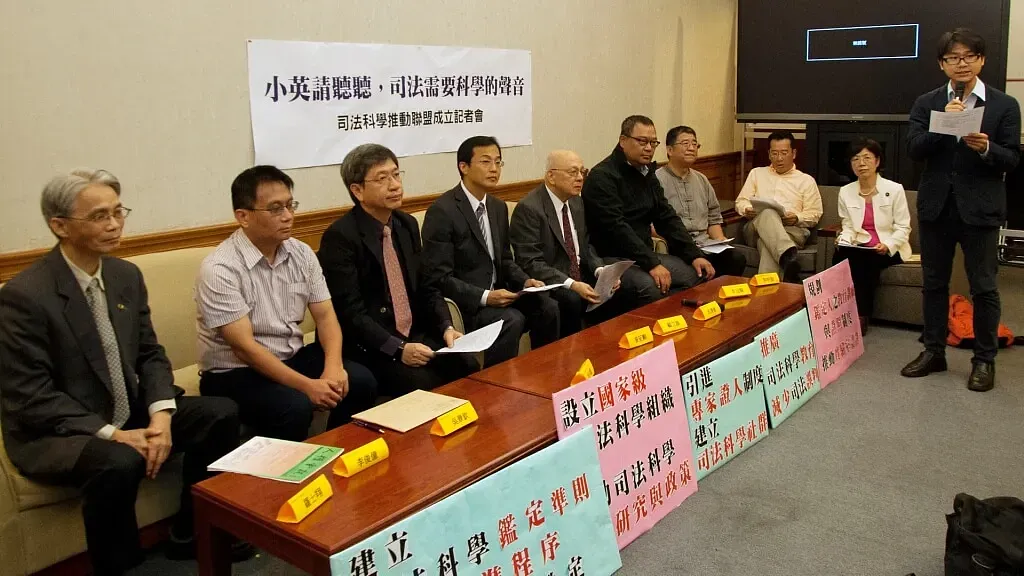
President-elect Tsai, Please Listen: The Judiciary Needs the Voice of Science ~ Press Conference on the Establishment of the Judicial Science Promotion Alliance
Last edited: 2026-08-31
President-elect Tsai Ing-wen's judicial reform proposals during her campaign included: "Enhance investigative equipment and forensic facilities for prosecutors, police, and investigators; establish standards for evidence collection and forensic operations; study the establishment of a dedicated forensic science agency to improve scientific investigation capabilities and ensure the reliability and credibility of forensic science in court."
This proposal aligns with public expectations, as the modern judiciary increasingly relies on interdisciplinary integration to uncover the truth. Unreliable scientific evidence can mislead the direction of investigations and trials, while judicial personnel's unfamiliarity with judicial science and its limitations is also a major cause of wrongful convictions. This can be seen from Taiwan's painful history of wrongful convictions, such as the Su Chien-ho (蘇建和), Chiang Kuo-ching (江國慶), and Hsu Tzu-chiang (徐自強) cases.
Sensing that the judiciary heavily relies on scientific investigation, trial, and fact-finding—making the reliability and credibility of forensic science paramount—civil society organizations have formed the "Judicial Science Promotion Alliance" to urge Tsai Ing-wen to fulfill her campaign promises regarding judicial science after taking office as president, and to bring due attention to forensic science. This Alliance is composed of the Taiwan Association of Medical Examiners, National Association of Building Public Safety Inspection of the Republic of China, Toxicology Society of Taiwan, National Federation of Fire Equipment Professional Associations of the ROC, Taipei Bar Association, Taiwan Forever Society, Taiwan Academy of Forensic Sciences, Taiwan Society for Risk Analysis, Taiwan Association for Innocence, Taiwan Occupational Hygiene Association, Judicial Reform Foundation, and Legal Aid Foundation (listed in stroke order).
The key points of statements made by representatives of various organizations and attending legislators at this press conference are as follows:
Enhancing Forensic Examination: Taking Root at the Grassroots and Developing Upward
 Chairman Ch'iu Ch'ing-hua
Chiu Ching-hua (邱清華), Chairman of the Taiwan Association of Medical Examiners, stated that the main purpose of establishing the Judicial Science Promotion Alliance is to propose the creation of a national-level judicial science organization. Because discovering the truth in law relies heavily on scientific evidence—which spans a wide range of aspects—this area has been relatively neglected in the past. Chairman Chiu pointed out that forensic medicine is also a very important branch of judicial science. To enhance the development of forensic examination, he believes there are two key demands. First, taking root at the grassroots level: enabling district prosecutors' offices to conduct forensic examinations and autopsies directly, rather than having them handled by the central government every time. Second, developing upward: establishing a central-level judicial science organization above the Institute of Forensic Medicine of the Ministry of Justice to supervise, set policies, and establish standard operating procedures to promote judicial science in a more complete and systematic manner.
Bringing Scientific Expertise into the Courtroom
 Vice Chairman Li Kuan-hsien
Li Kuan-hsien (李冠賢), Vice Chairman of the National Association of Building Public Safety Inspection of the Republic of China, stated that they have worked for more than a decade on maintaining building public safety, while post-disaster response and countermeasures are areas they have focused on developing in recent years. In the field of judicial science, they also hope to contribute their share of effort.
 Secretary-General Chiang Chih-kang
Chiang Chih-kang (姜至剛), Secretary-General of the Toxicology Society of Taiwan, stated that toxicology is a broad field that provides knowledge on the metabolism, absorption, and excretion of toxic substances in the body, thereby offering scientific evidence regarding bodily injuries caused by toxins. Secretary-General Chiang expressed his hope to translate toxicological knowledge into popular science and convey it into the judicial system.
 Chairman Li Ming-chih
Li Ming-chih (李明智), Chairman of the National Federation of Fire Equipment Professional Associations of the ROC, stated that their primary goal is to assist the public in fire prevention. The reason for supporting the Judicial Science Promotion Alliance is that science is a means to discover the truth, and scientific investigation is a starting point; for the benefit of society, they are willing to cooperate and assist.
Flawed Appraisals Deserve Review
 Standing Board Director Wu Ching-ch'in
Wu Ching-ch'in (吳景欽), Standing Board Director of the Taiwan Forever Society, stated that the Taiwan Forever Society previously placed more emphasis on holding judicial personnel accountable when wrongful convictions occurred, while paying less attention to forensic personnel, even though forensic personnel are a core part of cases. Past judicial reforms often focused solely on trial structures or changes in judicial personnel while neglecting appraisals and forensics. Standing Board Director Wu noted that there are doubts as to whether the "science" currently used in courtrooms is truly "scientific," such as polygraph testing. Furthermore, since polygraphs are currently administered exclusively by official agencies, the issue of prejudgment may arise. Appraisal issues can also be illustrated by the Taiwan South-Link Line Derailment Case, in which at least five cause-of-death appraisals were conducted. The appraisal reports were inconsistent with one another, yet all stated that poisoning "could not be ruled out" as the cause of death. Based on "could not be ruled out," the judge concluded that death "was" caused by poison, which violates the principle of in dubio pro reo (when in doubt, rule in favor of the accused). The boundary between the roles of the expert appraiser and the judge is worth reviewing. Therefore, Standing Board Director Wu stated that it is necessary to pay attention to the issue of expert appraisers and to promote private appraisals to prevent appraisers and investigative agencies from belonging to the same group.
 Standing Board Director Li Chün-i
Li Chun-i (李俊億), Standing Board Director of the Taiwan Academy of Forensic Sciences, stated that judicial appraisals to consolidate criminal evidence are extremely important. If not done well, they lead to wrongful convictions, but unfortunately, this has never received proper attention. For example, in the Chiang Kuo-ching wrongful conviction case, the president at the time demanded a comprehensive review, but aside from holding people accountable for torture, the issue of erroneous scientific evidence was never reviewed.
 Executive Director Lo Shih-hsiang
Lo Shih-hsiang (羅士翔), Executive Director of the Taiwan Association for Innocence, stated that in handling wrongful conviction cases, they found that judicial appraisal errors were a major cause of wrongful convictions, yet they were rarely reviewed. For instance, in the case of Lu Chieh-min (呂介閔), who was exonerated last year, DNA evidence ruled out Lu's involvement, but Lu had undergone three polygraph tests—passing twice and failing once. Different polygraph agencies acted independently, and no agency reviewed whether these three tests had flaws. Therefore, establishing standard operating procedures and a superior authority to review appraisal flaws is necessary. Take the Cheng Hsing-tse (鄭性澤) case as another example: a forensic doctor stated that a Mr. Lo, who was shot in the heart at the scene, died instantly, and the court subsequently adopted this statement. However, data from the Taiwan Provincial Police School in 1946 recorded that being shot in the heart does not necessarily lead to instant death. The forensic doctor who made this statement was also never scrutinized.
The National Judicial Reform Conference Should Incorporate Issues Between the Judiciary and Science
 Chairman Lin Yung-sung
Lin Yung-sung (林永頌), Chairman of the Judicial Reform Foundation, stated that the 1999 National Judicial Reform Conference did not specifically address issues between the judiciary and science. From 1999 to the present, judicial authorities have also rarely focused on this area. The Judicial Yuan has recently been promoting the "tech courtroom"—allowing case files and evidence to be projected in court—which is very important. However, achieving a more scientific trial is equally crucial. The establishment of this Alliance reflects that judicial problems are not merely issues of the trial system; systems regarding forensics, medical examination, and expert witnesses are also relevant. Therefore, these problems should be listed as one of the important topics for the National Judicial Reform Conference.
The Alliance calls upon President-elect Tsai Ing-wen to include institutional reforms related to judicial science as an important topic when convening the National Judicial Reform Conference and in any permanent judicial reform committee established thereafter, so that it receives the attention it deserves. We look forward to more government-public dialogue on this issue and hope that experts from more fields will join the Alliance.
 Legislator Ku Li-hsiung
 (顧立雄) stated that he is very pleased to see civil society establish such an alliance, and he is very glad that the Alliance's press release mentioned President-elect Tsai Ing-wen's campaign proposal. This proposal was put forward by the Democratic Progressive Party's Policy Committee, and he himself has a responsibility to promote it. Legislator Ku stated that public hearings will be held to discuss how to establish a national-level judicial science organization, what its operational scope should be, and to gather more opinions.
 Legislator Yu Mei-nu
 (尤美女) stated that the public's expectation for judicial reform is earnest, but expecting judges, prosecutors, and defense attorneys to adjudicate cases like gods is impossible; therefore, equipping them with proper peripheral support is crucial. In the past, judicial appraisals often relied on isolated breakthroughs, focusing solely on medical examiners, but cross-disciplinary alliances are now essential. Legislator Yu stated that various fields should establish relevant standard operating procedures, promote various educational training programs, and cultivate relevant talent in universities to make court trials fairer and more objective. She also hopes that President-elect Tsai Ing-wen's policy commitments will be fulfilled and will work together with civil society organizations.
Time
April 29, 2016 (Friday) 10:00 AM – 10:30 AM
Venue
Room 103, Chung-Hsing Building, Legislative Yuan (No. 3-1, Sec. 1, Chinan Rd., Zhongzheng Dist., Taipei City)
Attendees
Legislator Yu Mei-nu
Legislator Ku Li-hsiung
Chiu Ching-hua, Chairman, Taiwan Association of Medical Examiners
Li Kuan-hsien, Vice Chairman, National Association of Building Public Safety Inspection of the Republic of China
Chiang Chih-kang, Secretary-General, Toxicology Society of Taiwan
Li Ming-chih, Chairman, National Federation of Fire Equipment Professional Associations of the ROC
Wu Ching-chin, Standing Board Director, Taiwan Forever Society
Li Chun-i, Standing Board Director, Taiwan Academy of Forensic Sciences
Lo Shih-hsiang, Executive Director, Taiwan Association for Innocence
Lin Yung-sung, Chairman, Judicial Reform Foundation
Press Contact
Lo Shih-hsiang, Executive Director, Taiwan Association for Innocence
Origins and Demands of the Establishment of the Judicial Science Promotion Alliance
Origins
The application of science in the judiciary has become a critical key to "discovering the truth and upholding judicial justice." Furthermore, modern judicial litigation often involves cross-disciplinary and cross-field expertise, and the judiciary increasingly relies on interdisciplinary integration to uncover the truth.
According to an analysis of the causes of wrongful convictions in the United States, up to 47% of DNA exoneration cases resulted from invalid or improper scientific testimony leading to wrongful convictions. Reviewing the exonerations of several major judicial wrongful convictions in Taiwan, scientifically invalid evidence affected the direction of investigations and trials, while judicial officials in charge of investigations and trials were unfamiliar with judicial science and its limitations, which was also a major cause of judicial miscarriages.
How to enhance the function of judicial science and strengthen judicial science education has become an urgent issue for the next stage of judicial reform.
Referring to the experience of the United States, as early as eleven years ago (2005), the U.S. National Academy of Sciences began analysis and evaluation, and put forth reform measures in 2009. Systematic planning and reform have continued since then. In contrast, today's Taiwan, despite experiencing several major wrongful convictions that brought unbearable and painful costs, still lacks cross-disciplinary and cross-departmental reflection and dialogue.
To enhance the functions of judicial science and strengthen the application of cross-disciplinary sciences in the judiciary—including Taiwan's forensic medicine, forensic science, fire science, food safety science, epidemiology, environmental safety, and judicial behavioral science—and to prevent judicial miscarriages, organizations concerned with judicial science, judicial reform, and human rights protection have jointly formed the "Judicial Science Promotion Alliance" to call upon the government to value judicial science and promote institutional reform.
Civil society organizations call on the newly inaugurated president in 2016 to hold a National Judicial Reform Conference. The Alliance plans to submit its main demands and reform proposals to the upcoming National Judicial Reform Conference, making judicial science an important item on the national judicial reform agenda and striving for reform.
Main Demands
-
Introduce the Expert Witness System and Establish a Judicial Science Community
Scientific progress relies on the flourishing development of a scientific community, as well as mutual critique and review within the community; the continuous progress and development of judicial science are no exception. Current appraisal agencies are mostly established within government units, lacking professional review outside the agencies, which is also unfavorable to the formation of a scientific community. Therefore, our country should introduce an expert witness system, allowing parties in litigation to respectively appoint different experts to present professional opinions. The data, methods, and experimental processes upon which their opinions are based should be publicly disclosed in court as much as possible to undergo scrutiny, and experts must also appear in court to be cross-examined. Through this, the quality of expert opinions can be substantially tested in court, strengthening mutual review within the judicial science community in pursuit of progress.
-
Plan Education, Training, and Certification Systems for Appraisers, Promote Laboratory Accreditation, Establish Guidelines and Standard Operating Procedures for Judicial Science Appraisals, and Review Flawed Appraisals
Coupled with the introduction of the expert witness system, the government should make every effort to promote the sound development of the appraisal field. It should plan appropriate education, training, and certification systems for different appraisal fields, as well as laboratory accreditation, to ensure that appraisers possess professional qualifications and capabilities and that laboratories maintain quality. Furthermore, guidelines and standard operating procedures for judicial science appraisals should be established to serve as a basis for compliance and review, and a review mechanism for flawed appraisals should be established. If an appraisal flaw is confirmed, it should be reviewed and improved immediately.
-
Promote Judicial Science Education to Reduce Judicial Miscarriages
To ensure that judicial science knowledge and appraisal conclusions are properly utilized and understood in courtrooms, judicial science education should be promoted among judicial practitioners including judges, prosecutors, lawyers, and police, while allowing the general public to easily access educational resources related to judicial science.
-
Establish a National-Level Judicial Science Organization to Promote Judicial Science Policies
To achieve the aforementioned three goals, the government should establish a national-level judicial science organization to promote judicial science policies and strengthen development and research, thereby enhancing the quality of judicial science.
Alliance Members
Taiwan Association of Medical Examiners
National Association of Building Public Safety Inspection of the Republic of China
Toxicology Society of Taiwan
National Federation of Fire Equipment Professional Associations of the ROC
Taipei Bar Association
Taiwan Forever Society
Taiwan Academy of Forensic Sciences
Taiwan Society for Risk Analysis
Taiwan Association for Innocence
Taiwan Occupational Hygiene Association
Judicial Reform Foundation
Legal Aid Foundation
(Listed in stroke order)
This article is an AI-generated translation of the original Chinese text. In the event of any discrepancy, the Chinese version shall prevail.